
From photographic plates to a catalogue of nebulae
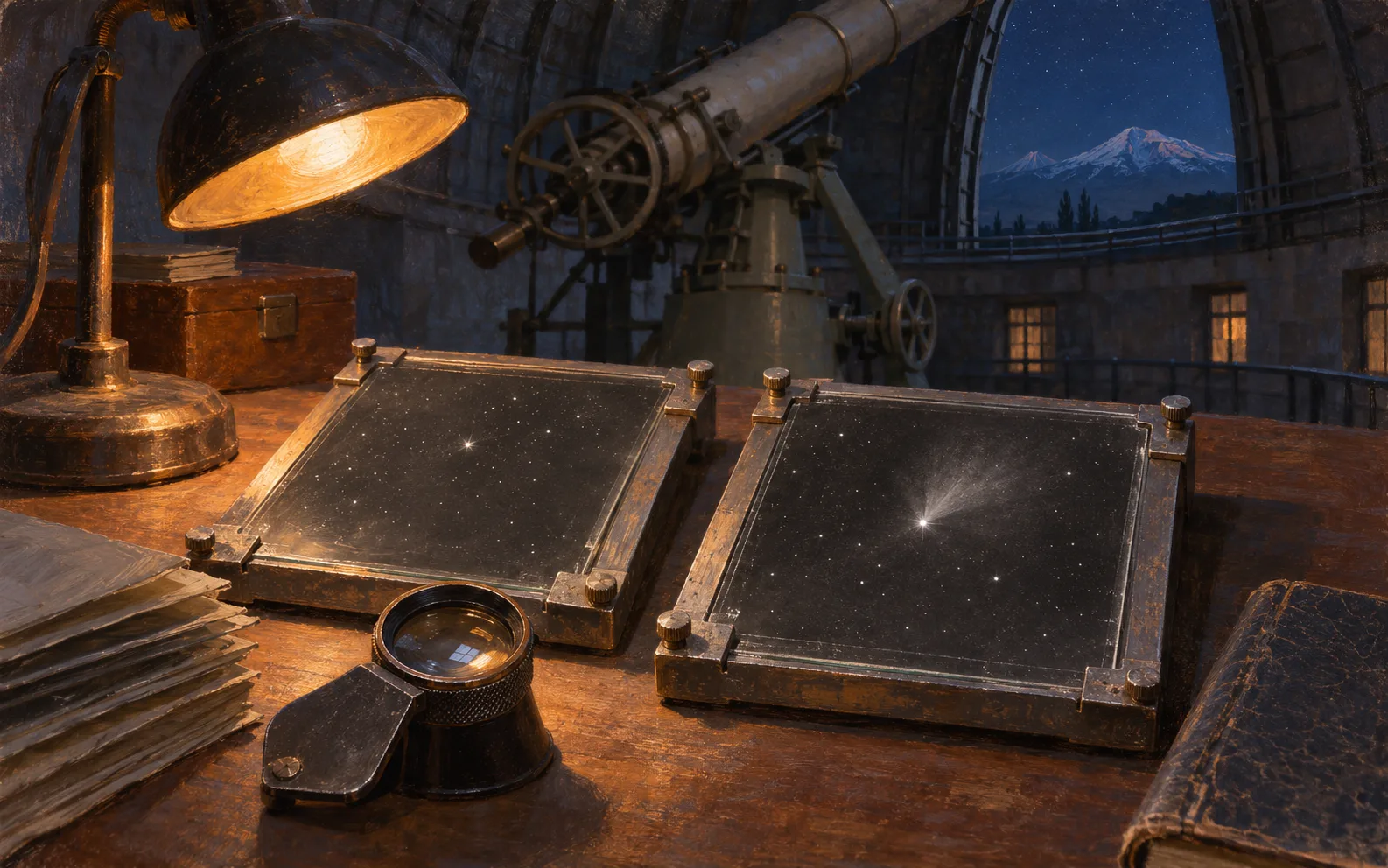
Elma Parsamian was born in Yerevan on 23 December 1929. After graduating from Yerevan State University in 1954, she joined Byurakan Observatory. At Viktor Ambartsumian’s suggestion she began studying faint nebulae associated with young stars. Their fan or curved outline can resemble a comet on a photographic plate. The term “cometary” here describes a shape: the object is an interstellar cloud, far beyond the Solar System.
Using the Palomar sky survey, Parsamian searched for these shapes against a crowded background of stars. In 1965 she published a first list. In 1979 she and V. Petrosian compiled a catalogue of 106 objects. A designation such as Parsamian 21 lets astronomers find the same target decades later, even when new observations change their explanation of it. Coordinates answer “where?”, while the outline supplies an initial clue about what to measure next.
How can light reveal dust?
Parsamian combined photometry, which measures brightness, with polarimetry, which measures the preferred orientation of light waves. Starlight scattered by dust can become polarized. Comparing these measurements across a cloud helps astronomers test where its illuminating star lies. She also studied the rapid brightening of flare stars in groups such as the Pleiades and Orion. Comparing repeated observations reveals events a single exposure can miss. In 2000 she was elected a corresponding member of Armenia’s National Academy of Sciences.