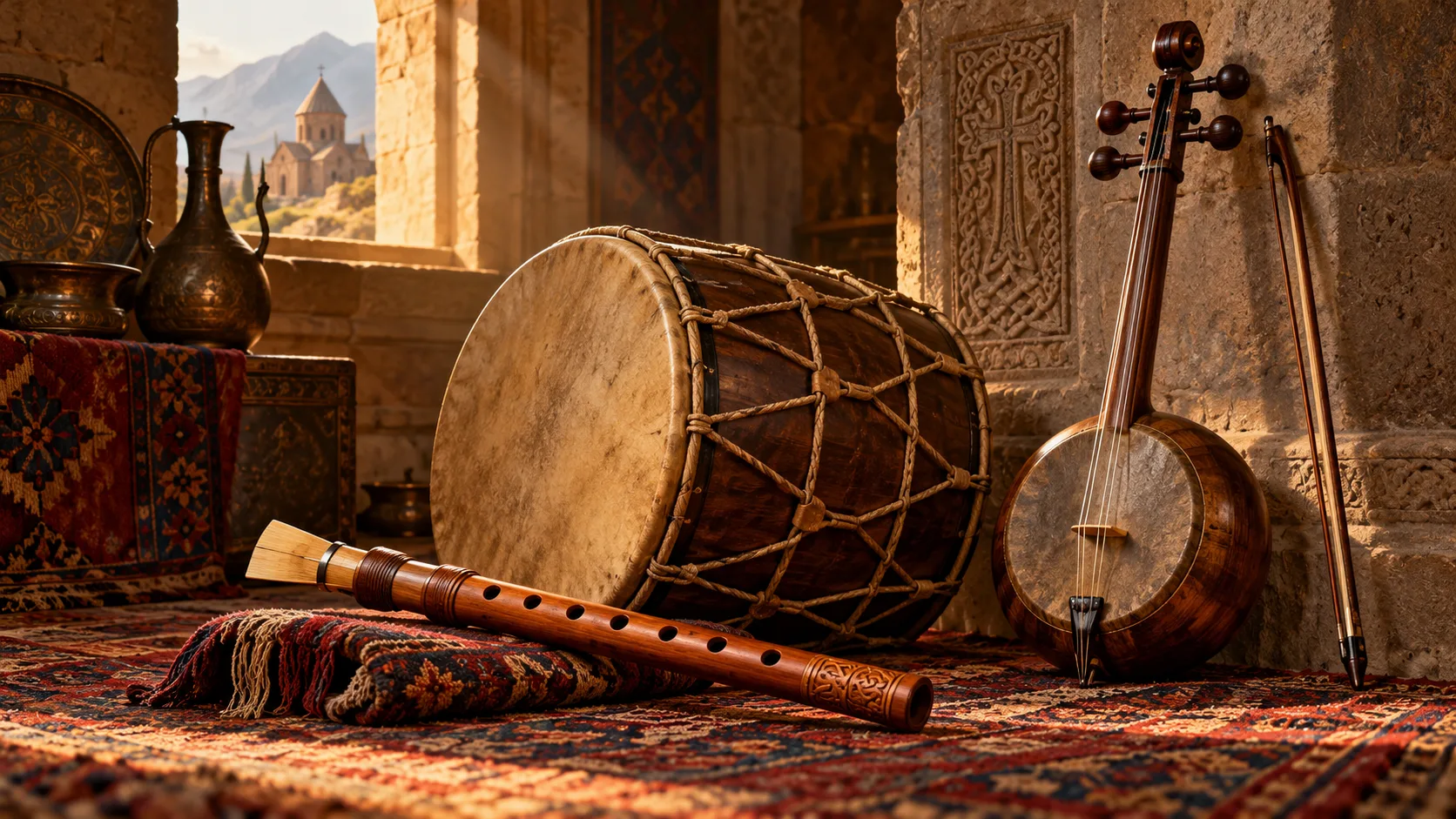
Sayat-Nova’s creative heritage mainly consists of khaghs — ashugh songs and poems. His songs were intended not only to be read, but also for live performance. He created his words and melodies so that they would sound with the accompaniment of the kamancha, saz, or another stringed instrument.
His main theme is love, but this love is not merely a personal feeling. In Sayat-Nova, love can be suffering, worship, devotion to beauty, the pain of unattainability, a test of human dignity, and sometimes a spiritual search. In his love songs, the beloved often appears as an almost otherworldly beauty, while the lover appears as a suffering soul that remains faithful to its feeling.
Self-awareness also holds an important place in Sayat-Nova’s songs. He often speaks about his art, his talent, and the value of his song. He understood that his word was not an ordinary song, but the result of mastery, inner fire, and the trial of the soul. In his songs, the ashugh appears as a person who is at once in love, wounded, proud, and vulnerable.
Musical and Artistic Analysis
The strength of Sayat-Nova’s art lies in the inseparability of word and melody. His khaghs are not only literary poems; they are texts created to be sung. They contain inner rhythm, sound repetition, play of sounds, melodic breath, and the power of oral performance.
His poetic language is rich in metaphors. The beloved may be compared to a rose, pomegranate, moon, jewel, gazelle, nightingale, or precious stone. Yet these images in Sayat-Nova are not simply beautiful ornaments. They create the world of love — luxurious, painful, unattainable, and burning from within.
From a musical point of view, Sayat-Nova’s heritage is also important because it connects the Armenian ashugh tradition with the musical thinking of the Caucasus and the Near East. His songs contain a sense of mugham-like thinking, an extended melodic line, emotional tension, and the expressive force of speech. He does not build the song according to European classical forms; his song lives in the voice, the word, the instrument, and immediate emotional impact.
Sayat-Nova is also a unique linguistic phenomenon. He was able to create an equally powerful poetic world in different languages. This shows not only linguistic ability, but also cultural flexibility. He could remain Armenian while speaking in the artistic language of the entire Caucasus.
Main Works
The exact dates of most of Sayat-Nova’s works have not been firmly preserved. They mostly belong to the middle and second half of the 18th century. His surviving heritage includes Armenian, Georgian, and Azerbaijani/Turkic songs.
“Kani Vur Jan Im” — 18th century, exact date not firmly established
“Dun En Glkhen Imastun Is” — 18th century, exact date not firmly established
“Ashkharums Akh Chim Kashi” — 18th century, exact date not firmly established
“Tamam Ashkhar Ptut Eka” — 18th century, exact date not firmly established
“Ashkharhs Me Panjara E” — 18th century, exact date not firmly established
“Kamancha” — 18th century, exact date not firmly established
“Yis Ku Ghimeten Chim Gidi” — 18th century, exact date not firmly established
“Amen Sazi Mejen” — 18th century, exact date not firmly established
“Blbuli Hid” — 18th century, exact date not firmly established
“Patkirked Ghalamov Kashats” — 18th century, exact date not firmly established
“Arants Kiz Inch Konim” — 18th century, exact date not firmly established
“Dzened Kagh-tsr Unis” — 18th century, exact date not firmly established
Collections of Armenian, Georgian, and Azerbaijani/Turkic khaghs — 18th century
Davtar, the main manuscript or written collection of Sayat-Nova’s khaghs — mid-18th century
Care is needed when dating Sayat-Nova’s songs. Many songs have been preserved in manuscript collections, oral tradition, and later records. Therefore, on the website it is correct to indicate the century or creative period, but not to give invented exact dates.
Commentary on Selected Works
“Kani Vur Jan Im”
“Kani Vur Jan Im” is one of Sayat-Nova’s best-known love songs. It expresses the state of a person in love, where love becomes sacrifice, pain, and complete devotion. In the song, the beloved is not only a beautiful being, but a force before which the singer bows with his whole soul.
The value of this work lies in its immediacy. Sayat-Nova does not speak in a cold poetic form; he speaks with a living voice, as if the song is being born at the very moment of pain. That is why “Kani Vur Jan Im” is still perceived not as an old text, but as a living confession of love.
“Dun En Glkhen Imastun Is”
“Dun En Glkhen Imastun Is” is a beautiful example of Sayat-Nova’s reflective and love language. Here, the beloved is presented not only through external beauty, but also through inner elevation. The song contains worship, dialogue, admiration, and painful distance.
This work shows Sayat-Nova’s ability to turn a love song into a psychological portrait. He does not describe beauty alone; he creates the tension of a relationship in which the lover simultaneously admires, suffers, and speaks of his helplessness.
“Ashkharums Akh Chim Kashi”
“Ashkharums Akh Chim Kashi” is one of Sayat-Nova’s works in which the love theme is joined with life experience and inner resilience. It is not only about personal love, but also about human destiny, the pain of living in the world, and the ability to endure with dignity.
This song is important because it reveals a broader image of Sayat-Nova. He is not only an ashugh in love. He is a person who knows the pain of the world, yet tries to preserve the strength of his soul and the honesty of his song.
“Tamam Ashkhar Ptut Eka”
“Tamam Ashkhar Ptut Eka” is a vivid expression of Sayat-Nova’s worldview. At the heart of the song is a feeling of life’s road, search, and human experience. The ashugh seems to have passed through the world, seen different people, cultures, and destinies, but continues to speak in the language of love and inner pain.
This work is also important because in Sayat-Nova’s art, the road often becomes a symbol of inner experience. Passing through the world is not only physical travel, but also spiritual and emotional maturation.
“Kamancha”
“Kamancha” has special importance because it connects Sayat-Nova with his instrument. For him, the kamancha was not merely a musical instrument. It was an extension of the singer’s voice, a bearer of his pain, love, and inner speech.
Through this work one can understand the essence of ashugh art. The ashugh is not only a poet, not only a singer, and not only a musician. He is the unity of all three. “Kamancha” shows that in Sayat-Nova’s art, the instrument becomes a living interlocutor, while melody becomes a direct expression of the human soul.