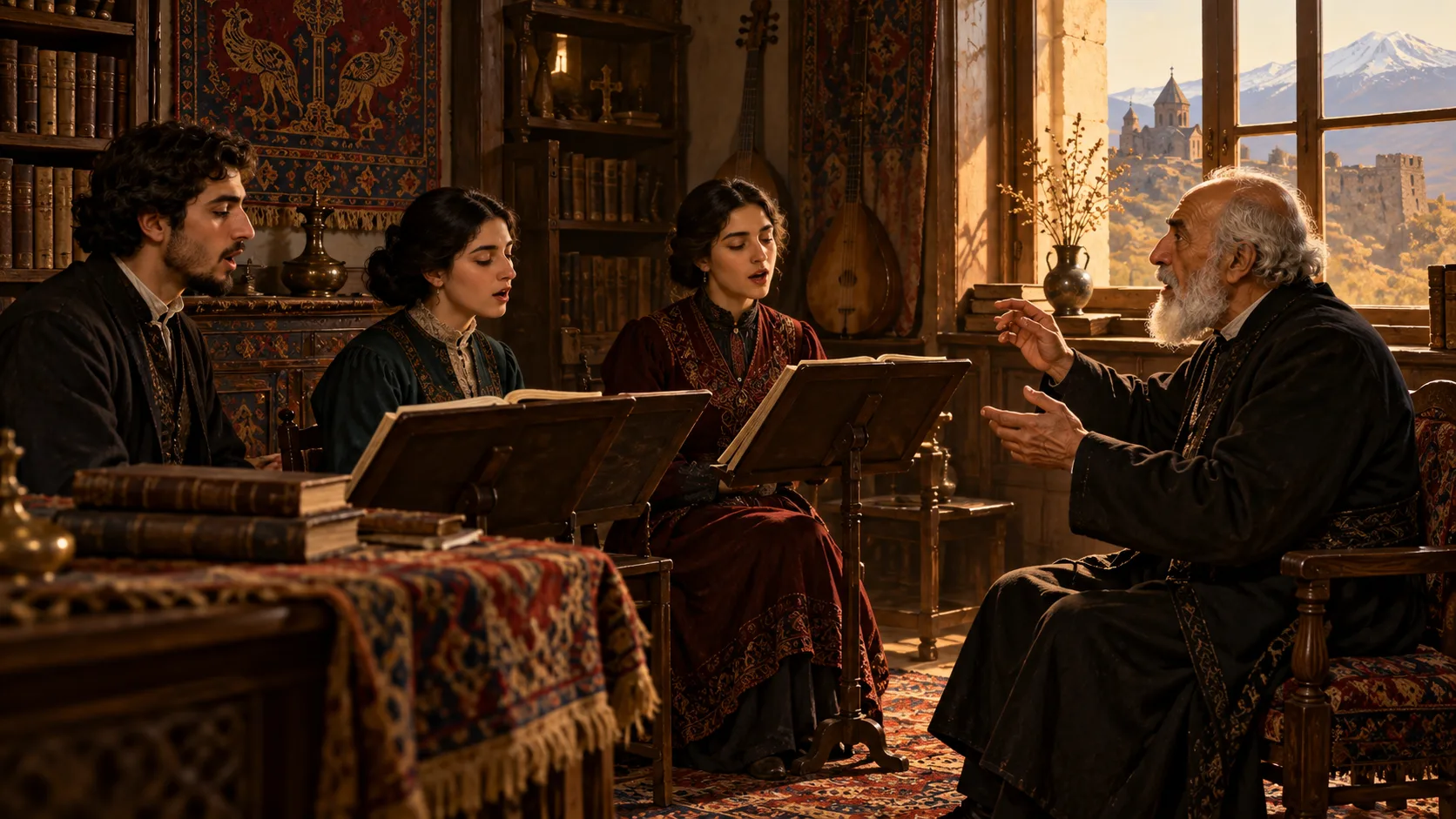
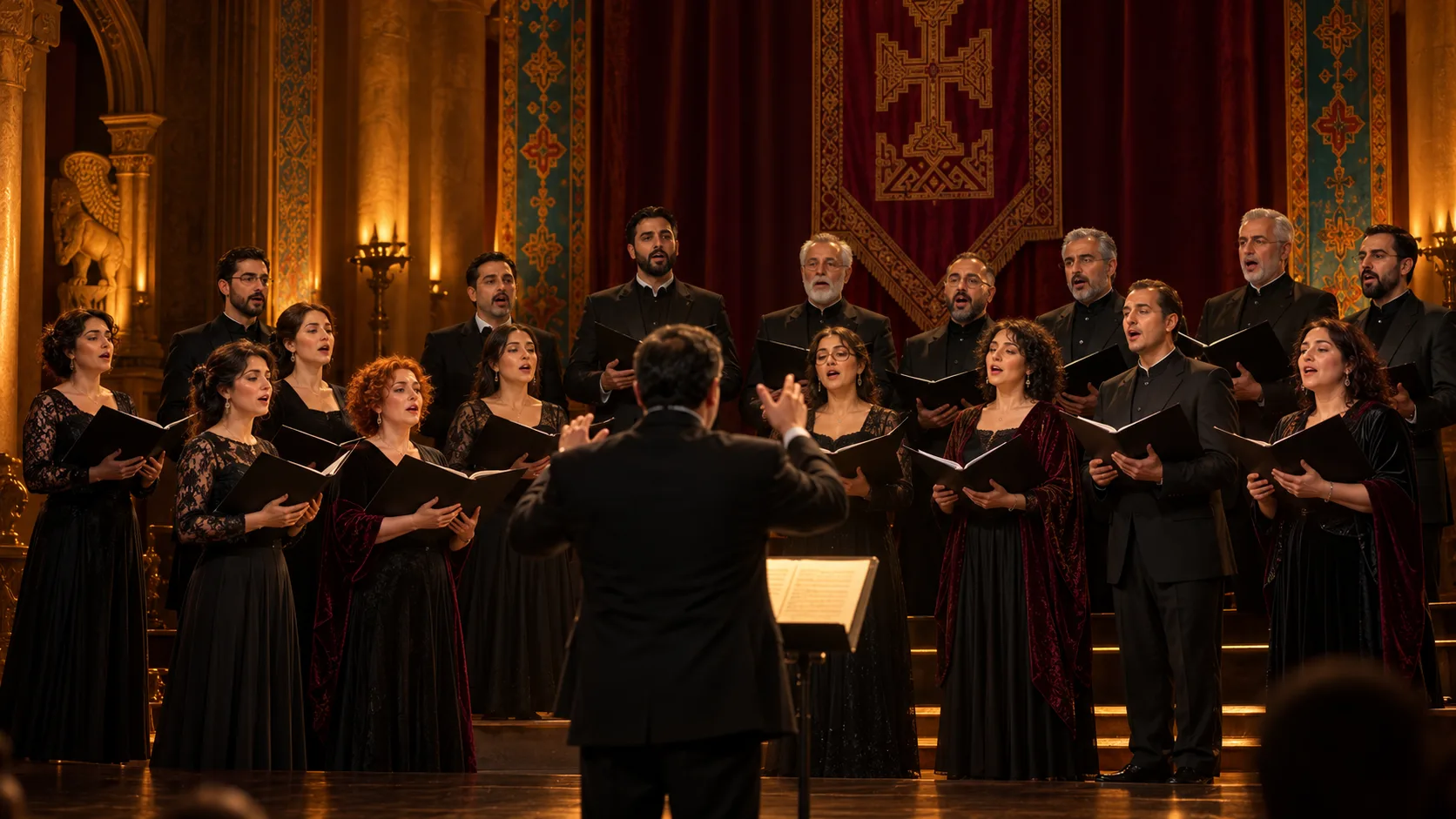
At the center of Romanos Melikyan’s creative activity stands the song. He wrote romances, vocal cycles, children’s songs, choral works, arrangements of folk songs, piano pieces, and mass songs. However, the high point of his art is Armenian romance.
In Melikyan’s early romances, one feels personal lyricism, gentle moods connected with nature, and themes of love, separation, autumn, sorrow, and longing. In these works, he gradually found the language that would later mature in the song cycles “Zmrukhti” and “Zar-Var.”
The “Zmrukhti” cycle is one of Melikyan’s most famous works. It was created in 1916–1918 and published in 1928. In this cycle, Armenian romance reaches a major national, lyrical, and artistic wholeness. The songs are built on Armenian poetic speech, folk melodicism, and deep psychological delicacy.
The “Zar-Var” cycle, created in the early 1920s and published later, has more descriptive, landscape-like, and folk-life colors. Here Melikyan’s musical language is more colorful, more mobile, and closer to images of popular life.
Melikyan also attached great importance to children’s song. He understood that national musical culture must begin at school and in childhood. For this reason, he created children’s songs, edited song collections, and tried to raise the artistic level of music intended for children.
Musical and Artistic Analysis
The main value of Romanos Melikyan’s art lies in deepening the small form. He showed that a song can be short, simple, and restrained, yet internally very rich. In his romances, everything is built on fine nuances: the accent of a word, a melodic turn, the soft sound of the piano, harmonic color, and the feeling of silence.
Melikyan’s music is distinguished by melodic purity. His songs often sound so natural that they can be perceived as folk songs. Yet behind this naturalness lies great compositional taste. He did not literally repeat folk melody; he absorbed its way of thinking and created a new authorial song language.
In his romances, the piano is not merely an accompanying instrument. It creates atmosphere, inner movement, and lyrical space. Voice and piano together form a psychological miniature. That is why Melikyan’s songs are often closer to chamber music than to simple everyday song.
A subtle attitude toward poetic speech is also important in Melikyan’s art. He felt the musicality of words, the breathing of speech, and the inner rhythm of the line. For him, the purpose of song was not to “decorate” poetry, but to reveal its inner music.
Melikyan’s significance in Armenian music is especially great in strengthening the national foundations of Armenian romance. He showed that Armenian romance can be not an external imitation of a European form, but an independent genre of national melodicism, Armenian poetic thought, and subtle psychological expression.
Main Works
“Autumn Song” — 1908, one of the composer’s first published works
“Rose” — publication in 1911
“Autumn” — publication in 1911
“Willow,” duet after Atabek Khnkoyan — early 1910s
“Song of Separation” — 1910s
“Murik’s Sorrow” — 1910s
“Ballad” — 1910s
“Armenian Soldier’s Song” — 1914
“Autumn Lines,” vocal cycle — around 1907–1913
“Zmrukhti,” vocal cycle — 1916–1918, published in 1928
“Zar-Var,” vocal cycle — around 1922, published in 1949
“Children’s Songs,” collection — 1920s
“Pioneer Songs,” collection — late 1920s–1930s
“Songs of New Days,” cycle — 1920s–1930s
Editorial work on “Red Army Songs” — 1929–1930
Arrangements of Armenian folk songs — various years
Piano works and miniatures — various years
Choral and children’s songs for schools — various years
The exact dates of some of Melikyan’s works have not been fully preserved in different sources. In such cases, it is more accurate on the website to indicate the creative period or publication date rather than add unsupported dating.
Commentary on Selected Works
“Zmrukhti”
“Zmrukhti” is one of Romanos Melikyan’s most famous vocal cycles and one of the most important pages in the history of Armenian romance. It was created in 1916–1918 and published in 1928. In this cycle, Melikyan’s lyrical thinking reaches its most mature expression.
In “Zmrukhti” there is delicate sadness, a sense of nature, the quiet pain of love and longing, but also light and inner purity. This cycle shows that Armenian romance can be not only an expression of personal feeling, but also a high form of national melodic thought.
“Sev Kakavik”
“Sev Kakavik” is one of the best-known songs of the “Zmrukhti” cycle. It is based on words by Hovhannes Tumanyan and carries a feeling of folk lament, longing, and loss. The image of the partridge becomes not only the image of a bird, but also a symbol of lost beauty, pain, and spiritual delicacy.
In Melikyan’s setting, the song preserves folk simplicity but gains chamber refinement. It does not become heavy with external drama. Its strength lies in restrained pain, the natural flow of melody, and the musical breathing of the word.
“Mi Lar”
“Mi Lar” is one of the psychologically delicate songs of the “Zmrukhti” cycle. It is built on consolation, passing pain, and a philosophical perception of life. In the song, pain is not denied, but is presented as a passing state that a person must be able to overcome.
Melikyan’s music here is very careful. It does not impose emotion, but opens inner calm. The song seems to speak to a person from a very close distance — without a loud voice, without pathos, but with deep conviction.
“Gishern Ekav”
“Gishern Ekav” is a lullaby-like song in which the image of night, a child’s sleep, and maternal tenderness are united. The song contains the purity of the child’s world and the desire for peace.
Melikyan’s musical language here is simple, but not simplistic. He is able to turn the everyday form of a lullaby into an artistic miniature. The gentle line of the voice and the subtle atmosphere of the piano create a world filled with light and tenderness.
“Zar-Var”
“Zar-Var” is the second important high point of Melikyan’s vocal thinking. If lyrical and psychologically deep moods dominate in “Zmrukhti,” then in “Zar-Var” the elements of nature, folk life, color, and movement are more pronounced.
In this cycle, Melikyan is more colorful, sometimes more playful, and more pictorial. “Zar-Var” shows that his art is not only sadness and subtle lyricism. It also contains bright colors, movement, and living images of popular life.
Children’s Songs
Romanos Melikyan’s children’s songs hold a special place in his legacy. He wrote songs for children not as simple educational material, but as works with artistic value. For him, a children’s song had to be pure, natural, memorable, and capable of forming national musical taste.
Through these songs, Melikyan participated in the formation of Armenian music education. He understood that if a child hears good song from childhood, then later they will have a more delicate ear, healthier musical taste, and a deeper connection with their culture.