
Nor Varagavank Monastery
East of the village of Varagavan, in the wooded valley of the Hasani Jur, the scale of the surviving buildings makes two phases of construction easy to distinguish. The earlier group, known as Anapat, was built in 1193–1198 under the patronage of Prince David of the Kiurikian dynasty. Its small single-nave church has two sanctuaries. A nearby family burial chapel recalls the monastery’s role in commemorating the princely household.
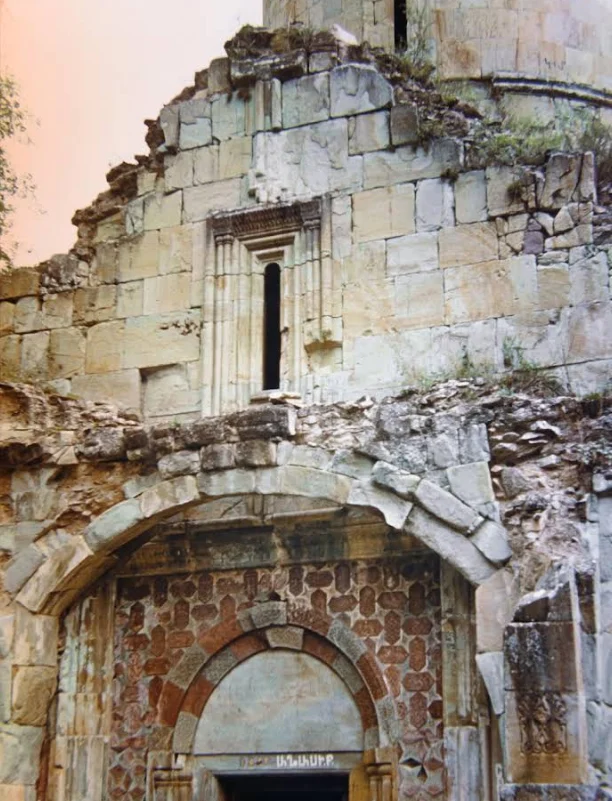
In the next generation the complex expanded northward. Under David’s son, Prince Vasak, the Church of the Holy Mother of God was built between 1224 and 1237. Its tall dome rises above the lower buildings of Anapat. Contrasting colours of stone highlight the entrances against the pale masonry of the walls. A jamatun, a hall used for gatherings, adjoins the church on its western side.
The site’s names preserve another part of its history. Anapat is the name found in inscriptions and in medieval historical writing. Church tradition connects the later name Nor Varag, or New Varag, with the transfer of the relic of the Cross of Varag from the monastery of Varagavank in Vaspurakan. The name links the history of this Tavush monastery with the monastic culture of the Lake Van region.
The southern group contains a small church, an entrance hall, a burial chamber and a chapel. The church measures only about three metres across, yet two altar platforms were fitted side by side. Such an arrangement is unusual in a single-nave Armenian church. Small engaged columns frame the entrance, while carvings and cross-stones set into the walls show the care lavished on this compact space. North of the hall stood the burial chamber. By about 1200 it had made the monastery a place of family remembrance for the Kiurikian dynasty.
Work on the Church of the Mother of God, initiated by the cleric Hovhannes, ran from 1224 to 1237. The church was consecrated in 1240. Its two doors lead to different halls. The south door communicated with the old Anapat hall, while the west opened onto the later zhamatun, an assembly hall. The coloured tiles of the south portal and the surviving walls of the zhamatun help trace these once-covered passages.
The older Varagavank stood in the Lake Van basin. Nor Varagavank stands in Tavush. Their histories meet in the relic known as the Cross of Varag, whose transfer is associated with the cleric Ghukas. The courtyard also bears witness to later generations. One of its largest cross-stones was carved by a master named Vardan in 1620.