Makar Yekmalyan’s creative activity includes church music, arrangements of folk songs, romances, piano works, and choral compositions. At the center of his creative legacy, however, stands the “Patarag.”
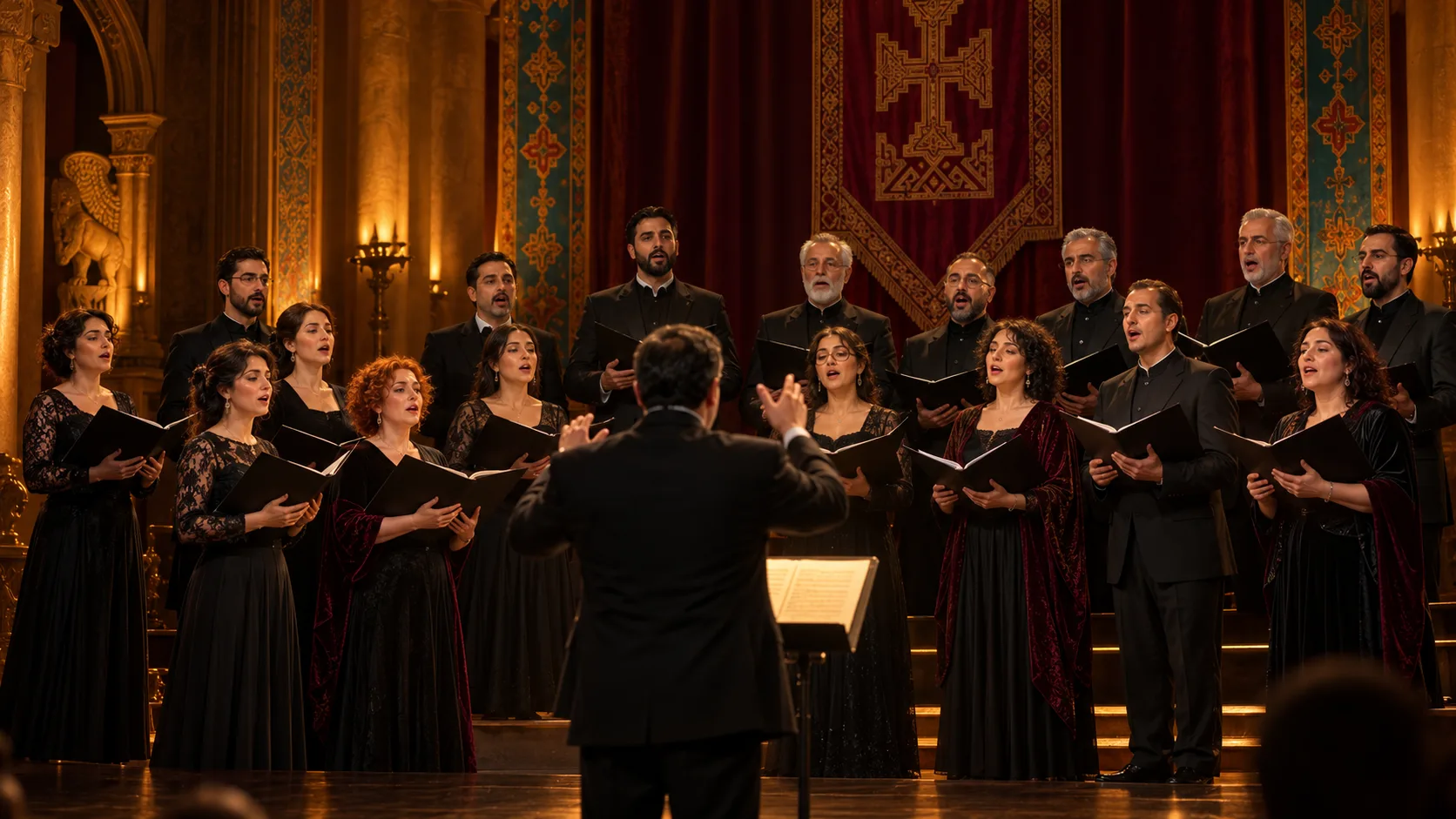
Yekmalyan arranged the singing of the Divine Liturgy of the Armenian Apostolic Church in polyphonic form. He created versions for different ensembles: three-part and four-part male choirs, as well as a four-part mixed choir. This work was highly important because, for the first time, the singing of the complete church rite was presented in a professionally arranged polyphonic form.
Arrangements of folk songs also hold an important place in Yekmalyan’s creative thought. He understood that the foundation of Armenian music was not only church tradition, but also folk song. In his arrangements one feels the natural flow of Armenian melody as well as the influence of European harmonic thinking.
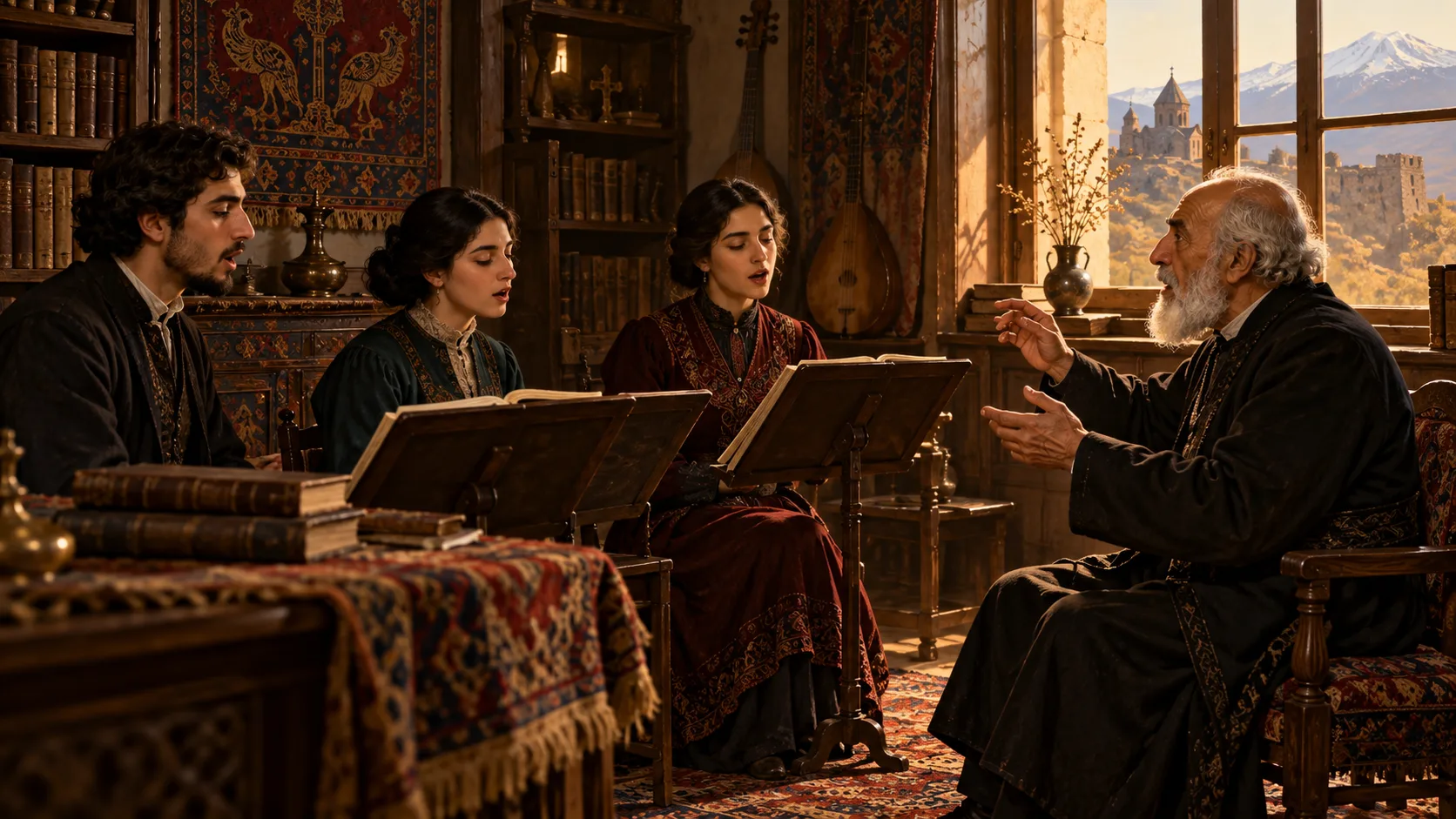
Yekmalyan was also a teacher. His pedagogical and choral activity had a strong influence on the Armenian musical environment. He formed a generation of musicians and singers that would later continue the work of studying and arranging Armenian song.
Musical and Artistic Analysis
The main value of Makar Yekmalyan’s art lies in the combination of Armenian monodic singing and European polyphony. He sought to find a form in which Armenian sacred song would preserve its liturgical seriousness while sounding broader, richer, and more complete chorally.
His “Patarag” is built on the principles of clear, balanced, and homophonic harmony. Yekmalyan does not aim for overly complex polyphonic structures. His goal is to create a clear, prayerful, understandable, and unified sound. That is why his Patarag remained usable and beloved for a long time in both church and concert settings.
The influence of the Russian compositional school can also be felt in Yekmalyan’s music. Yet he does not lose the Armenian character. His harmonies serve the Armenian melody rather than covering it. This is one of Yekmalyan’s strengths: he does not try to make Armenian song foreign, but tries to give it a new sound while preserving its foundation.
Yekmalyan’s significance should also be viewed in relation to Komitas. Komitas later studied the nature of Armenian folk and sacred song more deeply, but Yekmalyan had already opened an important path by showing that Armenian song could become material for professional arrangement. In this sense, Yekmalyan is a preparatory and foundational figure.
Main Works
“Patarag” / “Chants of the Divine Liturgy of the Armenian Apostolic Church” — 1891–1892
“Patarag,” version for three-part male choir — 1891
“Patarag,” version for four-part male choir — 1892
“Patarag,” version for four-part mixed choir — 1892
First publication of “Patarag” — 1896, Leipzig
“Nocturne” for piano — mentioned in press sources in 1892
“Song Without Words” — 1888
“10 Armenian Folk Songs” — 1889
“3 Armenian Folk Esquisses” — 1891
Arrangements of Armenian folk songs — 1880s–1890s
Songs and romances — late 19th century
Choral compositions — late 19th century
Piano works — late 19th century
The exact dates of some of Yekmalyan’s works have not been clearly preserved or are not fully presented in sources. In such cases, it is more accurate to indicate the creative period without artificial dating.
Commentary on Selected Works
“Patarag”
“Patarag” is Makar Yekmalyan’s principal work and one of the most important compositions in the history of Armenian church music. It was created in 1891–1892 and first published in 1896 in Leipzig. With this work, Yekmalyan presented the singing of the Divine Liturgy of the Armenian Apostolic Church in a complete polyphonic arrangement.
The value of this work is not only musical. It is connected with Armenian church rite, language, national spiritual identity, and choral culture. Yekmalyan did not try to turn the Patarag simply into a European choral work. He preserved the liturgical character of Armenian sacred melody and enriched it with harmonic sound.
In the “Patarag,” sections such as “Khorhurd Khorin,” “Surb, Surb,” “Hayr Mer,” “Miayn Surb,” “Ter, Voghormya,” and others stand out. They show Yekmalyan’s ability to turn prayerful words into music that is resonant, clear, and at the same time elevated.
“Surb, Surb”
“Surb, Surb” is one of the best-known sections of Yekmalyan’s Patarag. It has prayerful dignity, a calm structure, and clear harmonic movement. Here Yekmalyan’s musical thinking is simple, but powerful: the word is not lost in the music, but lifted through it.
This section is important because it shows Yekmalyan’s main principle: church music should not be showy, but prayerful. In his work, the combination of voices creates not theatrical drama, but spiritual ascent.
“Hayr Mer”
“Hayr Mer” is one of the central prayer sections of the Patarag. In Yekmalyan’s arrangement, it receives a humble, pure, and communal sound. The unified voice of the choir is especially important here, because the prayer is presented not in the name of an individual, but in the name of the community.
The value of Yekmalyan’s “Hayr Mer” lies in its simplicity. He does not burden the melody with unnecessary ornamentation. The music serves the word, and the word serves prayer. That is why his Patarag was able to remain in church use for a long time.
Arrangements of Armenian Folk Songs
Yekmalyan’s arrangements of folk songs show his broader national thinking. He was interested not only in church music, but also in the song heritage of the people. His “10 Armenian Folk Songs” and other arrangements reveal the lyrical, simple, and emotional sides of Armenian melody.
In these works, Yekmalyan tries to adapt folk song to piano or arranged musical forms. He preserves the national character of the melody, but presents it in a more professional framework. This was important for the development of Armenian music, because folk song was gradually becoming the foundation for compositional arrangement.
Piano Works
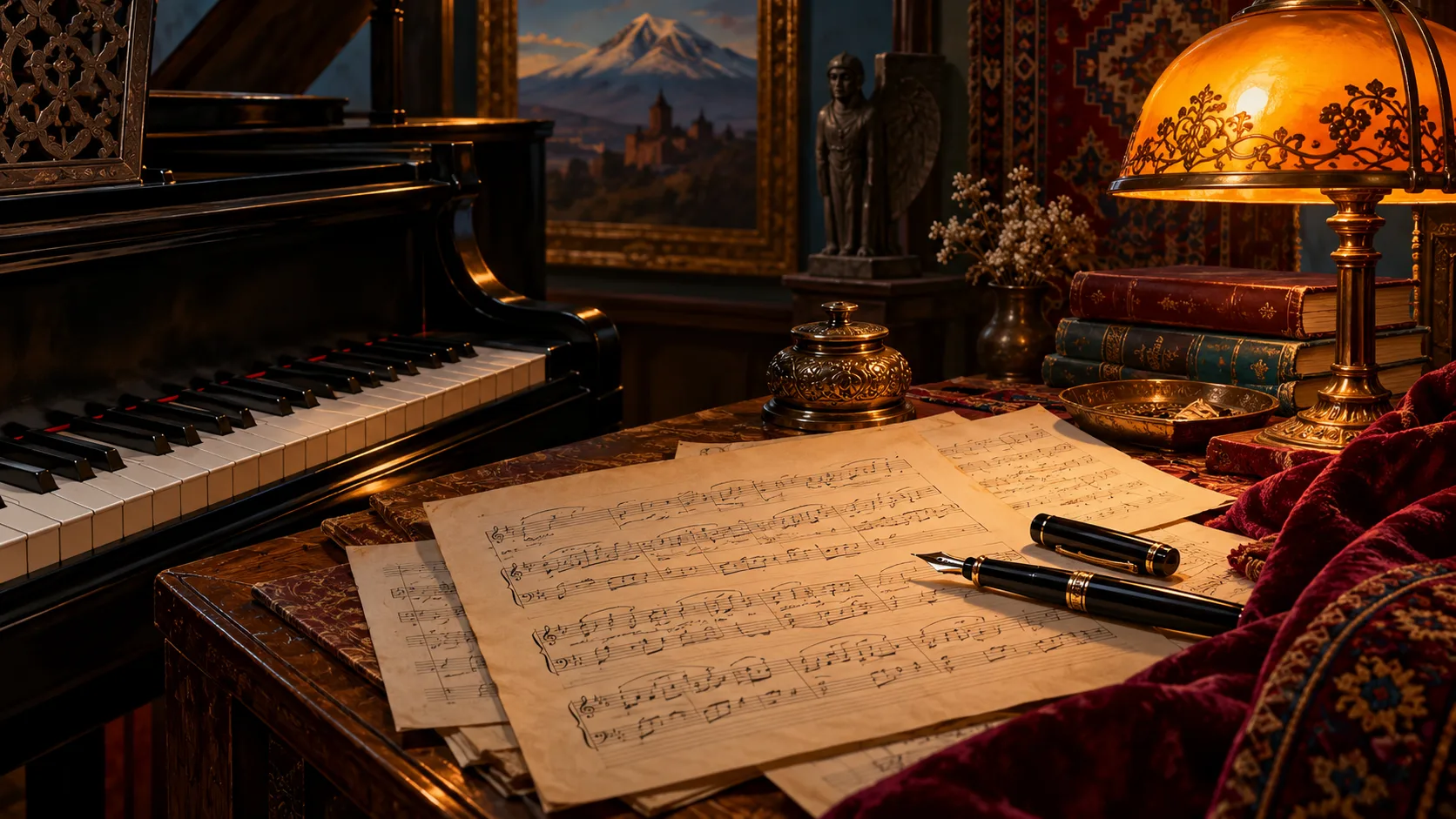
Yekmalyan’s piano works present the more chamber-like and intimate side of his creativity. In them one feels the influence of European Romantic music, but also the trace of Armenian melodic thinking. For him, the piano becomes not only a means of virtuosity, but also of lyrical expression.
These works are important because they show that Yekmalyan was not only an author of church music. He also worked in secular and instrumental genres, expanding the boundaries of Armenian composed music.