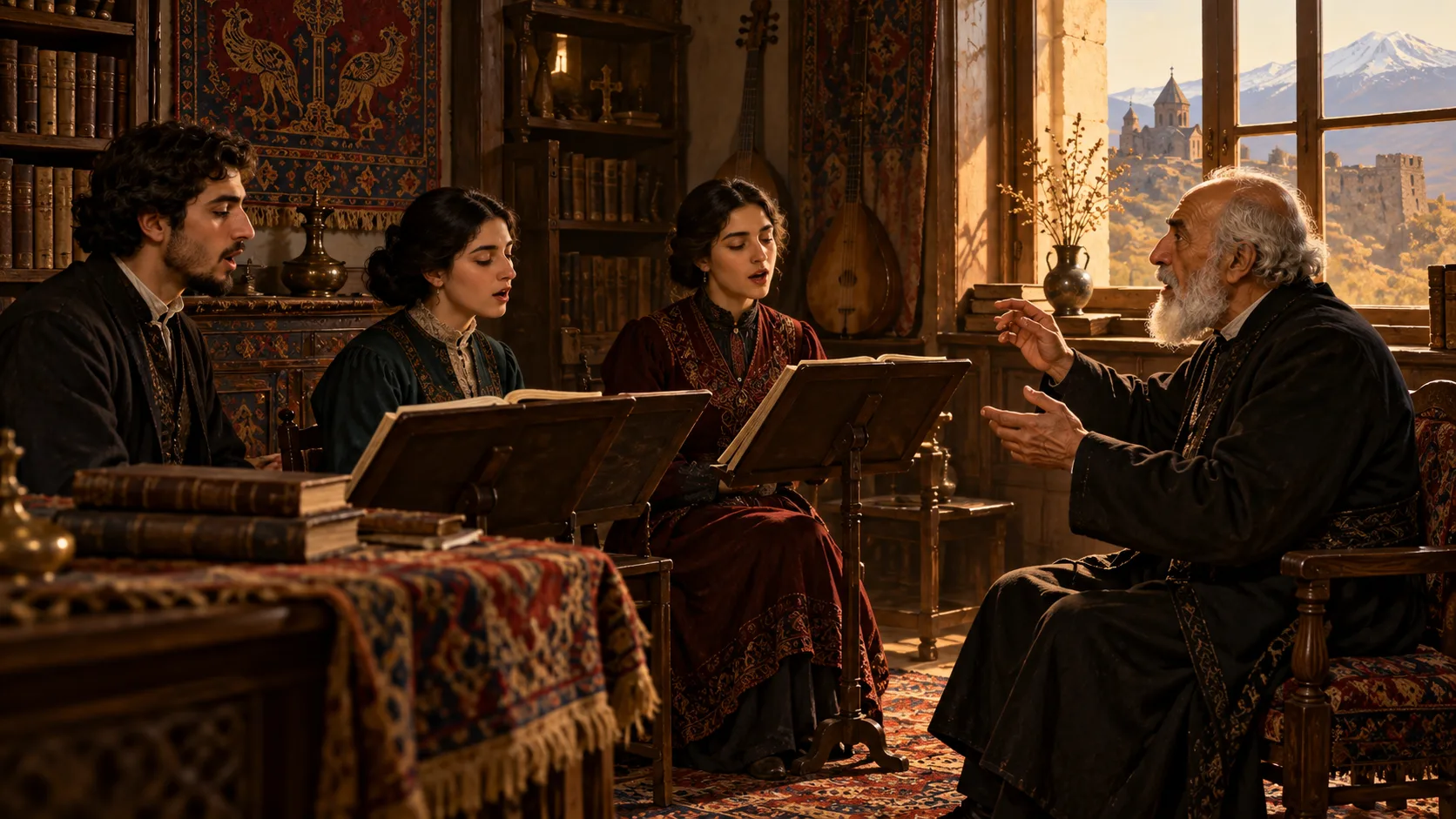
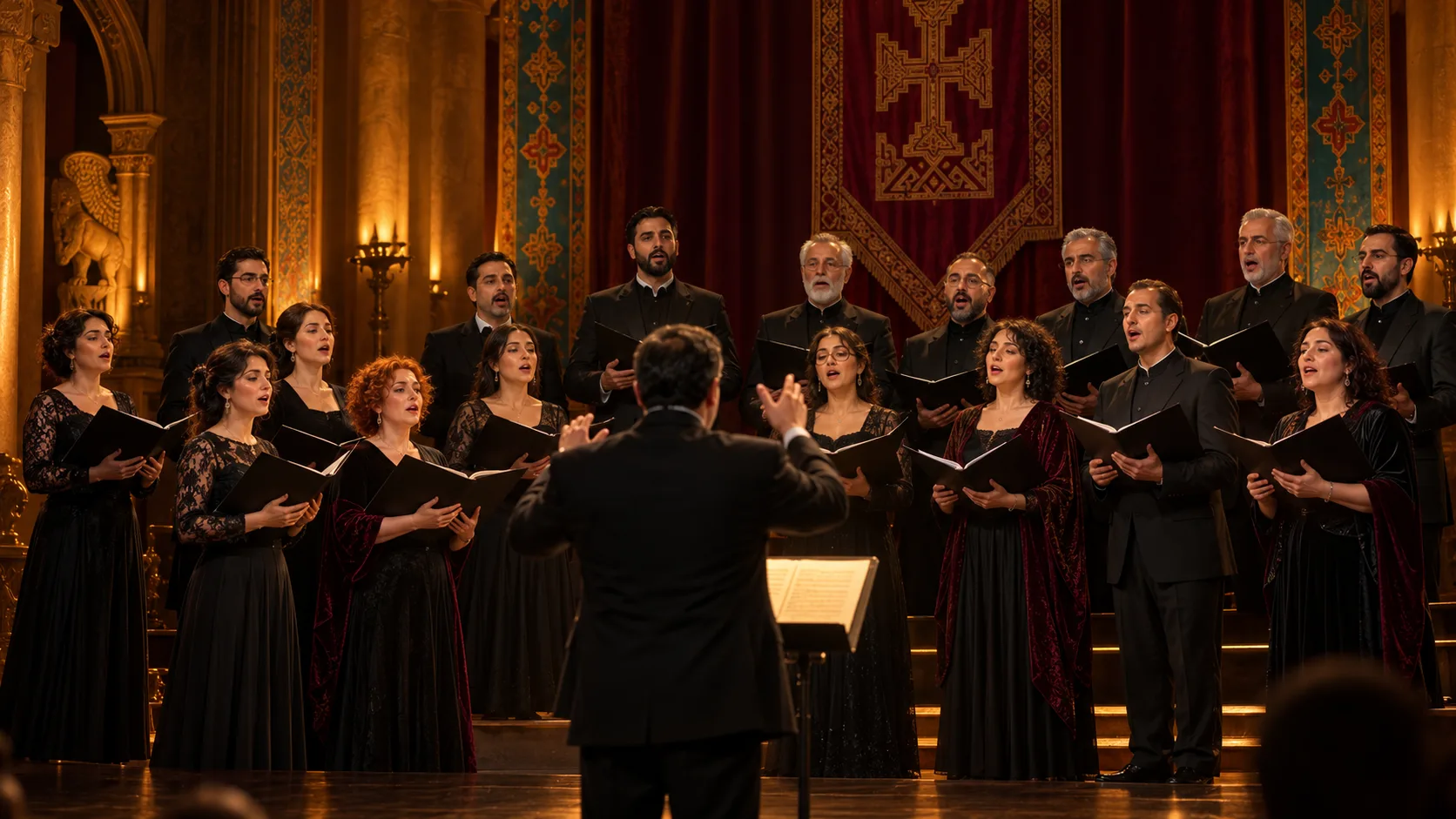
Kristapor Kara-Murza’s creative activity was multifaceted. He collected and arranged folk and gusan songs, wrote songs and romances based on the words of Armenian poets, created piano and instrumental works, music for dramatic performances, and also worked on the opera “Shushan,” which remained unfinished.
His most important field was choral arrangement. Kara-Murza presented folk songs in polyphonic versions, seeking to introduce homophonic, chordal thinking into Armenian singing. For its time, this work was innovative. He tried to show that the Armenian folk melody could sound not only in solo or monophonic form, but also in organized, rich, concert-style polyphony.
Kara-Murza also paid great attention to musical education. His concerts often had educational significance. He not only performed songs, but also formed an audience, teaching people to hear Armenian song in a new way, to appreciate the artistic value of folk melodies, and to understand the power of choral culture.
Music criticism was also an important part of his work. He wrote articles and reviews, responded to concerts and opera productions, and raised questions of musical taste, performance quality, the development of national music, and church singing. In this sense, Kara-Murza was not only a creator, but also a shaper of musical thought.
Musical and Artistic Analysis
The main value of Kristapor Kara-Murza’s art lies in the creation of a public and polyphonic life for Armenian song. He did not limit himself to collecting folk songs. He tried to turn them into arranged music that could sound before a large audience. This was an important turning point, because folk song began to be perceived not only as folkloric material, but also as the foundation of national musical art.
His polyphonic arrangements may seem simple or early experiments today, but for their time they were a bold step. Armenian song had developed for centuries mainly in a monophonic tradition, while Kara-Murza tried to place it within a new choral way of thinking. This step opened the road for Makar Yekmalyan, Komitas, and later Armenian composers.
The public force of Kara-Murza’s musical thinking is also important. His choirs were not only artistic bodies. They were social phenomena. In different cities, he brought people together, taught them to sing, created Armenian musical environments, and spread polyphonic singing. In his work, music becomes a means of education, identity, and public organization.
His art also has a transitional character. Kara-Murza does not yet fully reach the ethnographic depth of Komitas or the systematic church polyphony of Yekmalyan, but he opens the path. He was among the first to show in practice that Armenian song could become the basis of choral culture.
Main Works
Polyphonic arrangements of Armenian folk songs — 1880s to early 1900s
Arrangements of gusan and ashugh songs — 1880s to early 1900s
Songs and romances based on the words of Armenian poets — late 19th century
Music for dramatic performances — late 19th century
“Shushan,” opera — unfinished, exact date not firmly established
“Patarag,” an attempt at polyphonic arrangement — 1890s, exact completion date not firmly established
Musical arrangement of Mikael Nalbandian’s poem “The Song of the Italian Girl” — exact date not firmly established
“Pot-Pourri sur des Airs Arméniens,” Op. 11 — 1885
“Marche funèbre” — 1890
Choral arrangements of folk songs such as “Alagyaz,” “Kezi Merrnim,” “De Gna, Kigam,” “Khorotik,” “Lepho, Le, Le,” “Hodallo,” and others — exact dates not firmly established
The exact dates of many of Kara-Murza’s songs and arrangements have not been preserved in sources. Therefore, on the website it is correct to indicate the creative period rather than give unsupported exact dates.
Commentary on Selected Works
Polyphonic Arrangements of Armenian Folk Songs
Kara-Murza’s greatest contribution lies in his polyphonic arrangements of Armenian folk songs. He collected folk melodies and presented them in choral form. This work was important because Armenian song moved beyond only oral or everyday settings and became material for concert culture.
In these arrangements, Kara-Murza sought to preserve the simplicity and immediacy of the folk melody while giving it a new sound. His polyphony is not always complex, but it creates choral support, communal resonance, and broader stage impact. This was an important step on the road toward the professionalization of Armenian music.
“Alagyaz”
“Alagyaz” is one of the folk songs arranged by Kara-Murza or spread through his choral programs. At the heart of the song is the feeling of Armenian nature, longing, and mountain imagery. In such works, the image of nature becomes not only a beautiful landscape, but also part of national memory.
The value of this song is especially revealed in choral sound. When a folk melody sounds in polyphony, it gains broader breath. The individual song becomes a shared voice, while a song about the homeland’s landscape becomes an expression of national feeling.
“Kezi Merrnim”
“Kezi Merrnim” is an example of folk love-song language. In Kara-Murza’s arrangement, such songs preserve their simple and direct emotionality while gaining a more developed musical structure. What matters here is not heavy drama, but the naturalness of feeling.
Through such songs, Kara-Murza showed that the folk love song could also have artistic value and a place on the concert stage. This was especially important at a time when the value of national song still had to be explained and affirmed before the public.
“Lepho, Le, Le”
“Lepho, Le, Le” is an example of a lively folk song in which dance movement, rhythm, and communal joy can be felt. For Kara-Murza, such songs were important because they showed the vital, mobile, and open side of Armenian folk music.
In choral arrangement, this kind of material could become highly effective on stage. Rhythm, repetition, and shared energy immediately connected the audience with the song. This was an important side of Kara-Murza’s musical-educational work: he was able to turn folk song into a public celebration and concert experience.
“The Song of the Italian Girl”
The musical arrangement of Mikael Nalbandian’s poem “The Song of the Italian Girl” has special importance because this text later became the basis of the national anthem “Mer Hayrenik.” Kara-Murza’s connection with this material shows how musical arrangement could enter the field of national and political memory.
The significance of this work is not only musical. It is connected with ideas of freedom, homeland, national struggle, and statehood. For Kara-Murza, such material could not be an ordinary song; it carried ideological force and public resonance.
“Patarag”
Kara-Murza attempted to arrange the Armenian church Patarag polyphonically. This work was important because he sought to introduce polyphony not only into folk song, but also into church singing. These efforts show that Kara-Murza thought about the full development of Armenian music, from folk song to church rite.
Although Makar Yekmalyan’s “Patarag” later became the more accepted and widely used version, Kara-Murza’s attempts are historically important. They show the intellectual and musical struggle through which Armenian church singing moved from monophonic tradition toward polyphonic arrangement.