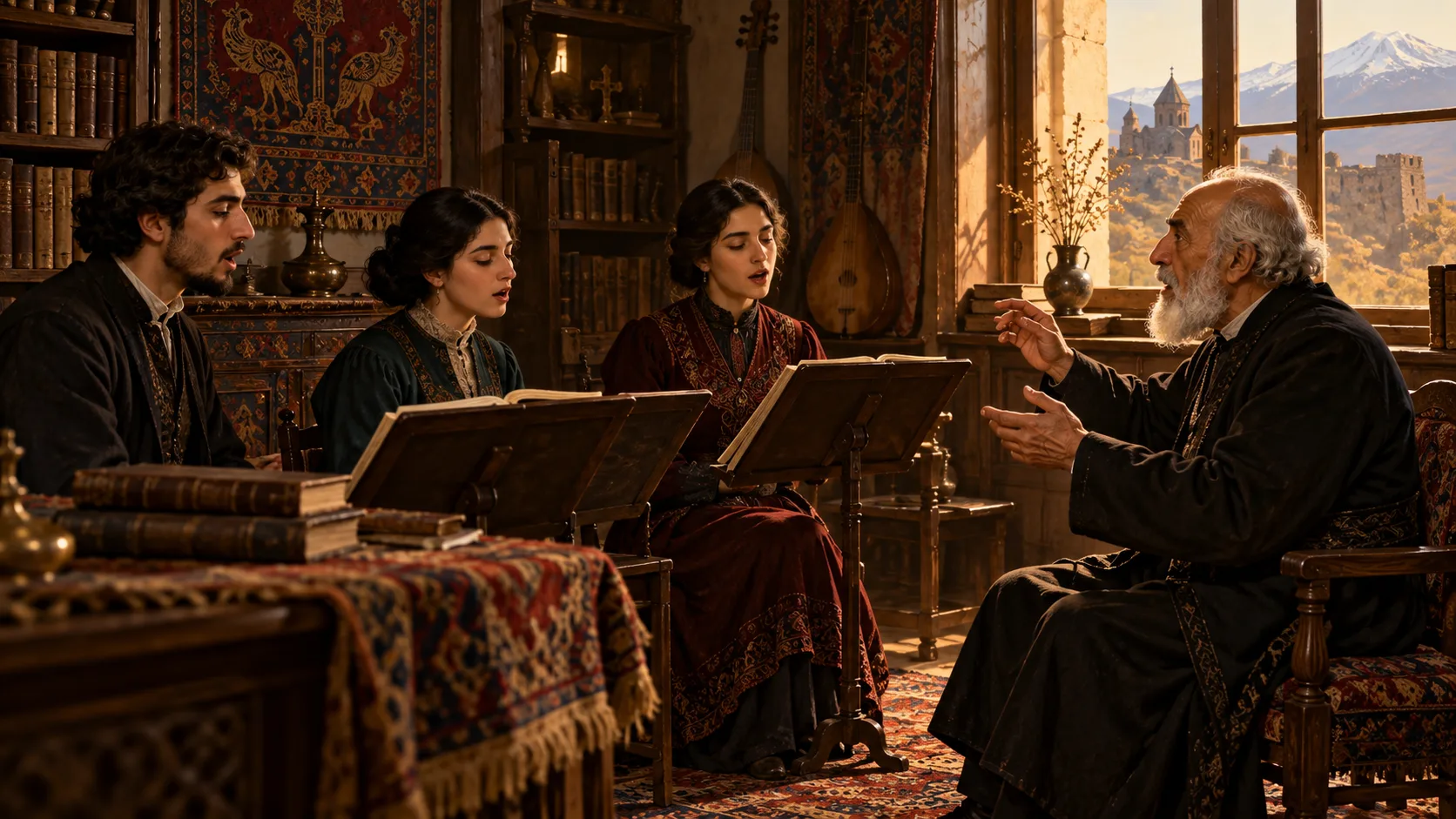
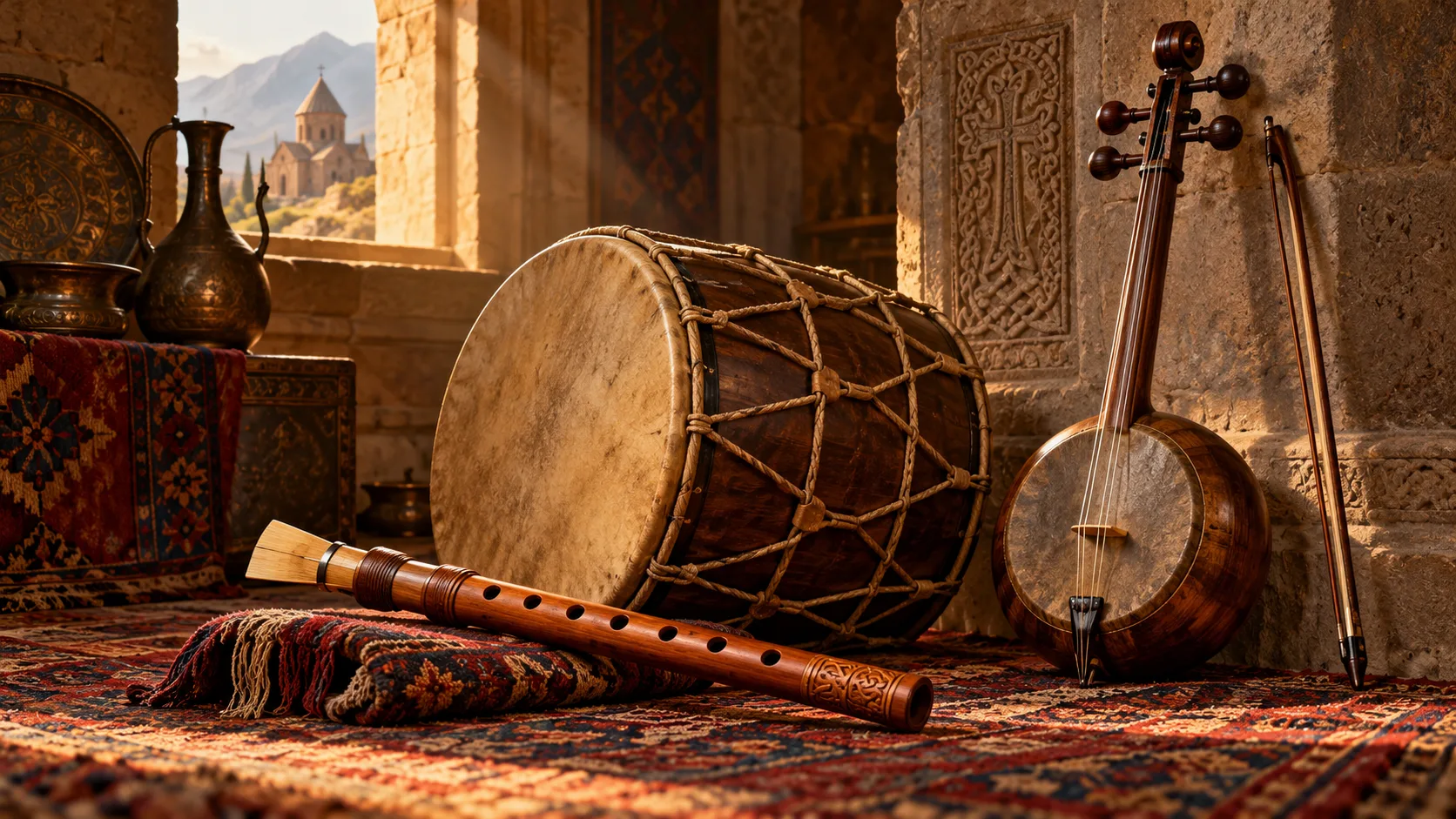
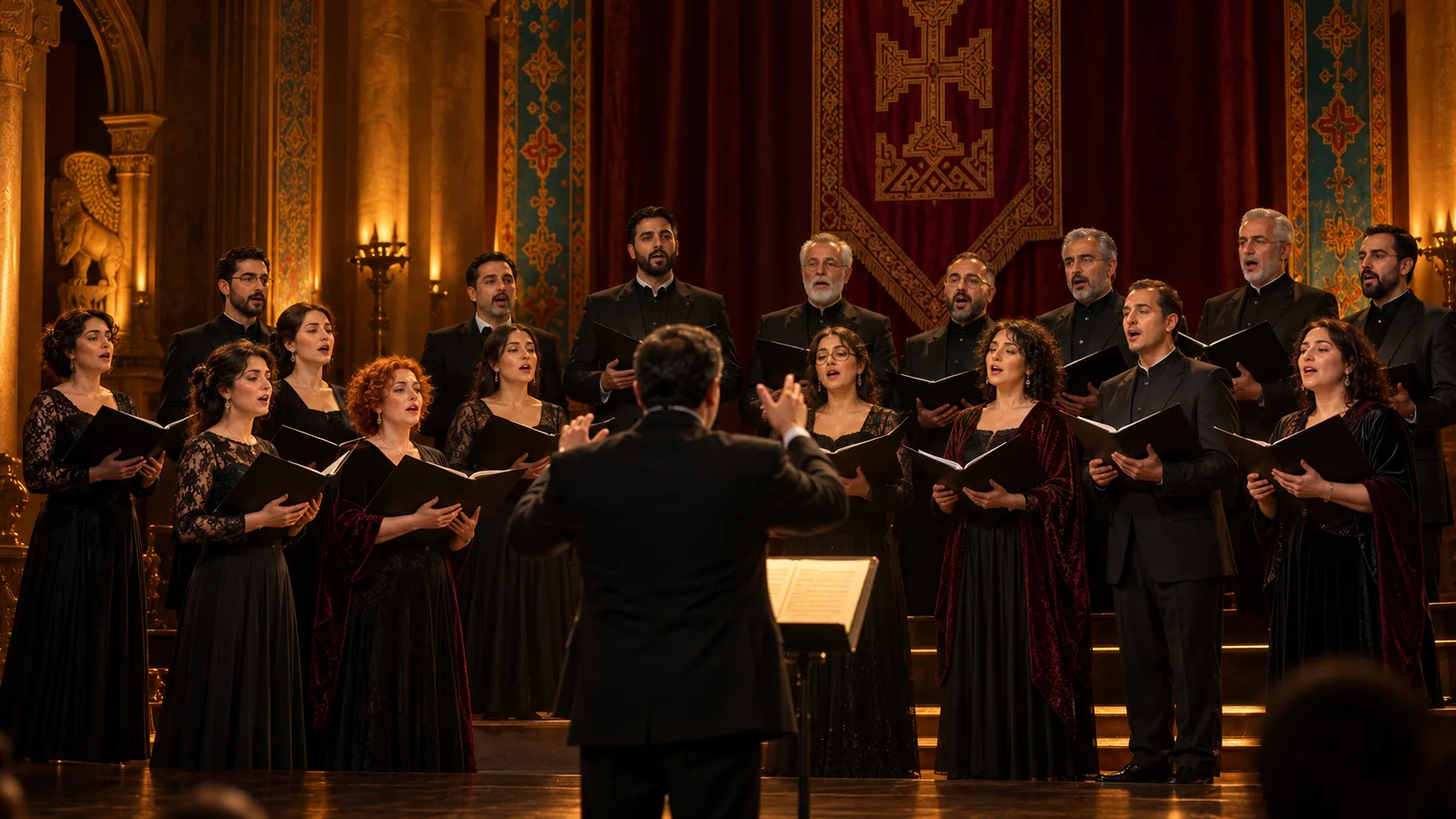
Komitas’s creative activity includes several main directions: folklore collection, musicological research, choral arrangement, the rethinking of church music, performance, pedagogy, and compositional work.
One of his greatest achievements was the collection of folk songs. Komitas traveled through Armenian villages and towns, listened to the songs of peasants, workers, women, elders, and children, and transcribed them. He collected not only the melody, but also tried to understand the song’s environment: when it was sung, and with what work, ritual, pain, or joy it was connected.
Komitas arranged folk songs in a way that did not destroy their natural character. He did not burden the song with unnecessary European harmonies. His purpose was not to “beautify” the song, but to reveal its true beauty. That is why in his arrangements the folk melody remains the central force, while the piano or choir serves it.
Komitas also played a major role in the study of Armenian church music. He studied khaz notation, ancient sacred melodies, the singing of the Patarag, and tried to reveal the historical layers of Armenian church music. His “Patarag,” written for male choir, is one of the great values of Armenian sacred music.
He was also an exceptional performer. Komitas had a rich and expressive baritone voice, sang with great impact, and was able to communicate the inner force of Armenian song to his listeners. In European concerts and lectures, he presented Armenian music not only as a performer, but also as a scholar and cultural ambassador.
Musical and Artistic Analysis
The main value of Komitas’s musical thinking lies in revealing the essence of national song. He understood that Armenian folk song should not be reshaped according to European standards. It should be studied according to its own laws. For his time, this approach was revolutionary.
Purity is essential in his arrangements. In Komitas, the melody never disappears. He respects the natural breath of the song, the accent of the word, the freedom of rhythm, and the modal color. His songs often seem simple, but within that simplicity there is great scientific precision and artistic depth.
Komitas also revealed the connection between Armenian song and life. For him, song was not abstract musical material. The work song was connected with the rhythm of labor, the wedding song with ritual, the lullaby with the mother’s world, the song of exile with longing, and sacred song with prayer. Thanks to this approach, Komitas’s music is alive: it sounds like the psychology of a people.
Silence also holds an important place in his art. A Komitas song is sometimes very restrained, but within that restraint there is deep pain, longing, and inner light. He does not seek external effect. His music is strong from within. That is why it is at once simple and endlessly deep.
Komitas’s role in Armenian music can be compared to the role of Mesrop Mashtots in the history of Armenian writing. Mashtots gave the Armenian language a writing system, while Komitas gave Armenian song scientific, national, and professional self-awareness.
Main Works and Arrangements
Collection and transcription of Armenian folk songs — 1890s–1910s
Choral arrangements of Armenian folk songs — 1890s–1910s
Solo arrangements of Armenian folk songs with piano accompaniment — 1890s–1910s
“Patarag” for male choir — 1910s, with a complex editorial history
“Kakavik” — an original song by Komitas, with words by Hovhannes Tumanyan
“Krunk” — arrangement of a folk song, exact date not firmly established
“Antuni” — arrangement of a folk song, exact date not firmly established
“Tsirani Tsar” — arrangement of a folk song, exact date not firmly established
“Garun A” — arrangement of a folk song, exact date not firmly established
“Shogher Jan” — arrangement of a folk song, exact date not firmly established
“Lori Plough Song” — arrangement of a work song, exact date not firmly established
“Hoy, Nazan” — arrangement of a folk song, exact date not firmly established
“Alagyaz” — arrangement of a folk song, exact date not firmly established
“Yerknits Astghik” — arrangement of sacred or folk character, exact date not firmly established
“Seven Dances” for piano — 1916
“Msho Shoror” — arrangement of dance material, exact date not firmly established
Concept for the musical epic “Sasna Tsrer” — unfinished
Concept and work on the opera “Anush” — unfinished
Collection and study of Kurdish songs — 1900s
Musicological articles and lectures on Armenian folk and sacred music — 1900s–1910s
The exact dates of many of Komitas’s arrangements and transcriptions cannot always be stated with certainty. Part of his manuscripts was lost or damaged as a result of historical catastrophes, so for some works it is more accurate on the website to indicate the creative period rather than invent specific dates.
Commentary on Selected Works
“Krunk”
“Krunk” is one of the most symbolic songs arranged by Komitas. It is a song of exile, longing, and the inner pain of a person far from the homeland. In Armenian culture, the crane becomes a symbol of a messenger, a link with distant places, and a keeper of the memory of a lost world.
In Komitas’s arrangement, this song does not become an external lament. It is restrained, heavy, and deeply inward. The power of the music lies precisely in that restraint. “Krunk” is one of those examples of Armenian song where a simple melody can express the longing of an entire people.
“Antuni”
“Antuni” is one of Komitas’s deepest and most painful arrangements. At the heart of the song is the state of a person left homeless, alienated, and having lost his place in the world. This is not only personal pain; it may be understood as a musical image of national destiny.
In Komitas, “Antuni” sounds without unnecessary drama. His musical language does not scream; it burns silently. That is why the song becomes even more powerful. It seems to speak about pains that words cannot fully express.
“Kakavik”
“Kakavik” is an original song by Komitas with words by Hovhannes Tumanyan. Its bird imagery, lively rhythm, and light melody evoke nature and the joy of life.
This song is important because Komitas is often connected only with pain, longing, and lament, while in his legacy there is also a large place for light, play, humor, and vital energy. “Kakavik” is one of the beautiful examples of that side.
“Lori Plough Song”
“Lori Plough Song” is a powerful example of a work song. It is connected with the land, labor, the plough, rural life, and collective rhythm. For Komitas, such songs were very important because in them music was born from a concrete action of life.
In this work, rhythm is not only musical structure. It is the breathing of labor. The song organizes movement, gives strength to workers, and unites them in one shared sound. Through this song, Komitas shows that folk music is a natural continuation of life.
“Tsirani Tsar”
“Tsirani Tsar” is one of Komitas’s arrangements in which the image of Armenian nature merges with longing and delicate feeling. The apricot tree in Armenian culture is not merely a tree; it is a symbol of homeland, fertility, memory, and beauty.
In Komitas’s arrangement, the song preserves the simplicity of the folk melody but gains special delicacy. There is no heavy expressiveness here. Everything is built on the natural flow of melody and inner light.
“Seven Dances”
“Seven Dances” is one of the most important works of Komitas’s piano legacy. It shows that Komitas was not only a collector and arranger of songs, but could also turn folk dance material into instrumental art. In these works, dance rhythm, folk movement, and piano form are united.
“Seven Dances” is also important because it shows the modern side of Komitas’s thinking. He does not mechanically repeat folk material, but transforms it so that it can sound on the professional stage while preserving its national energy.
“Patarag”
Komitas’s “Patarag” is one of the greatest values of Armenian church music. It is connected with the rite, prayer, and sacred singing of the Armenian Apostolic Church. Here Komitas seeks to present the church melody with pure, restrained, and deep sound.
If Makar Yekmalyan’s “Patarag” was a major systematic example of polyphonic arrangement of Armenian church singing, then in Komitas the emphasis is placed more on preserving the national and liturgical character of the melody. For him, church music must remain prayer, not only concert beauty.