
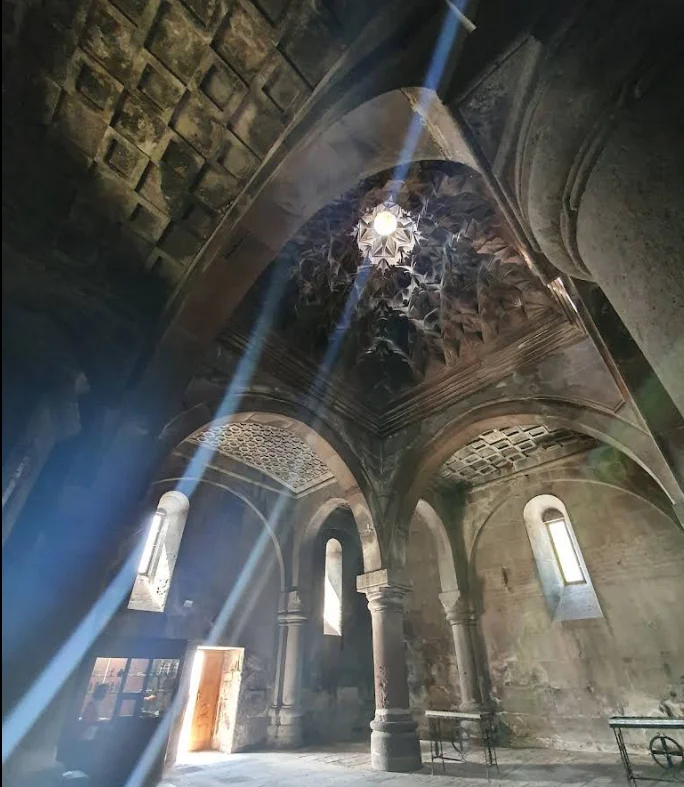
Khoranashat Monastery
Khoranashat occupies a wooded hillside near the village of Chinari in Tavush. Its foundation is associated with the thirteenth-century scholar and cleric Vanakan Vardapet. The principal church, dedicated to the Holy Mother of God, was built between 1211 and 1222. The buildings and accounts of teaching at the monastery preserve two different kinds of history.
The church is a domed hall. Inside, the unusually broad semicircular apse contains fourteen niches. Their repeated forms draw the eye around the curve of the sanctuary wall. A gavit, or assembly hall, adjoins the church on the west. Tombstones and fragments of the enclosure wall also survive on the site.
At Vanakan’s school, books were both material for study and the product of a student’s labour. Pupils copied manuscripts from carefully chosen exemplars, adding their copies to the monastic library. Vanakan also composed teaching material in a question-and-answer form. The historians Kirakos Gandzaketsi and Vardan Areveltsi are associated with the school. Khoranashat thus offers a concrete example of how medieval teaching preserved earlier texts while training new authors.
In 1224 Princess Vaneni commissioned a Gospel book on parchment at Khoranashat. The patron is known, although the scribe and illuminator left no names. The text is in erkatagir, an Armenian majuscule script. Alongside portraits of the four Evangelists, the manuscript has decorated canon tables and ornament in the margins. The canon tables, framed by painted arches, helped readers locate parallel episodes in the Gospels.
The monastery’s teaching also extended to the calendar. For a discourse to be read at the New Year, Vanakan drew on the work of the early scholar Anania Shirakatsi. The library therefore served the study of theology, the copying of texts and the practical calculation of the year.
The western gavit of the Church of the Mother of God was built between 1222 and the 1240s. Four columns support arches that intersect at the centre of the roof. The western entrance is framed by reliefs with protective symbolism, while the eastern end has sanctuaries on two levels. This arrangement can be compared with the wide semicircular apse in the adjoining church.
South of the main group stands the small domed Church of Saint Kiraki, also from the thirteenth century. Farther uphill to the east are tombstones and the ruins of Surb Chgnavor, the Holy Hermit’s chapel. These smaller buildings preserve the setting for private prayer and the remembrance of the dead alongside the school and the main church.