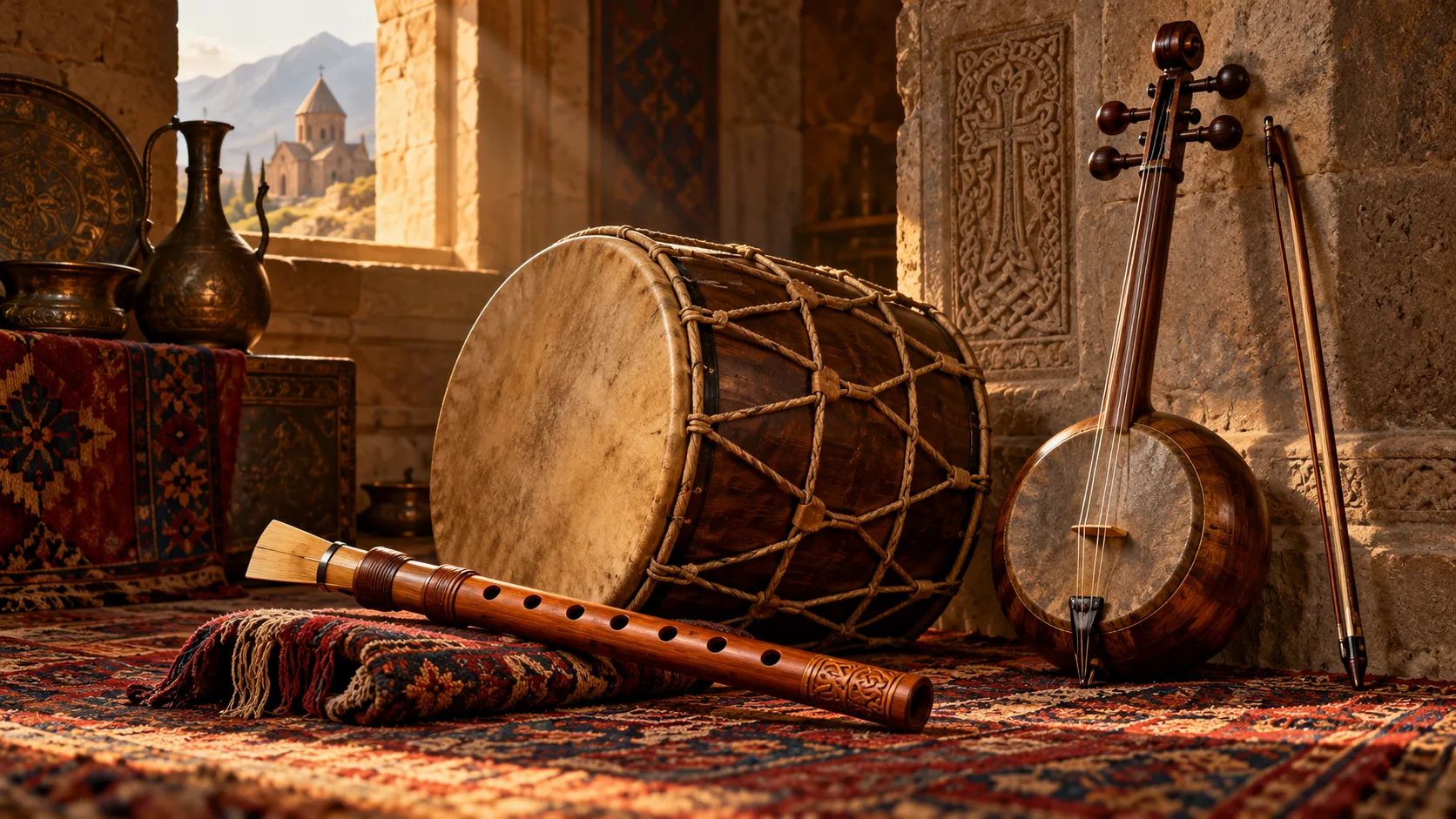
At the core of Jivan Gasparyan’s creative activity are Armenian folk song, the traditional performance school of the duduk, and deeply personal interpretation. He worked mainly in duduk performance, arrangements of folk melodies, album recordings, film music, and international collaborations.
The main feature of his style is the human quality of the sound. Gasparyan’s duduk often resembles not an instrument, but a human voice: sometimes singing, sometimes crying, sometimes praying. In his performances, technical mastery never turns into display. He does not hurry, does not overload the melody with unnecessary ornamentation, but creates a long-breathed musical speech filled with inner tension.
His playing is built on slowness, breath, pause, and inner silence. These pauses are very important: in Gasparyan’s art, silence is as expressive as sound. His performance thinking is close to Armenian sacred and folk singing, where a single voice can carry an entire history.
Gasparyan also played a major role in developing ensemble thinking for the duduk. The duduk was usually perceived as a solo instrument accompanied by a drone duduk, but he also tried to present it through different sound layers, including the format of a duduk quartet. This approach showed that the duduk could create not only a monologue, but a complete sonic space.
His international collaborations are also important. He worked with different musicians and composers while preserving his Armenian voice even when the duduk sounded in a non-Armenian musical environment. For this reason, his art is not perceived merely as an “ethnic color.” It is an independent, dignified, and complete presence in world music.
5. Main works and albums
Jivan Gasparyan’s legacy is represented mainly by performance recordings, albums, arrangements of folk melodies, and international collaborations. In his case, the concept of “work” should be understood not only as a written original composition, but also as performance interpretation, because in the duduk tradition the master’s performance itself has creative value.
Main albums and recordings include:
“Duduk. Armenian Folk Songs” / “I Will Not Be Sad in This World” — original recording: 1983, international release: 1989
“Moon Shines at Night” — 1993
“Ask Me No Questions” — 1994
“Apricots from Eden” — 1996
“Black Rock” with Michael Brook — 1998
“Djivan Gasparyan Quartet: Nazeli” — 1998
“Heavenly Duduk” — 1999
“Armenian Fantasies” — 2000
“Nazani” — 2001
“Fuad” with Erkan Oğur — 2001
“In My World, I Have No Pain” — 2002
“Endless Vision” with Hossein Alizadeh — 2005
“Nectar for the Bitter World” — 2007
“The Soul of Armenia” — 2008
“Penumbra” with Michael Brook — 2008
His music also appeared in international film productions. The musical atmosphere of the film “Gladiator” is especially often mentioned, where the sound of the duduk became an important part of the film’s emotional environment. Gasparyan’s duduk was also connected with film-music and stage projects where the need was not simply for an exotic sound, but for a deep, human, and painful voice.
In 2007, the album “Endless Vision,” which he recorded with the great Iranian musician Hossein Alizadeh, was nominated for a Grammy Award in the “Traditional World Music Album” category.
6. Commentary on selected works
“I Will Not Be Sad in This World”
This album is one of Jivan Gasparyan’s most significant recordings. It is built on Armenian folk melodies and deep duduk interpretation. The title already contains a contradiction characteristic of Armenian psychology: there is pain, there is memory, but there is also dignified resistance — the will not to break, not to disappear, not to forget.
In Gasparyan’s performance here, the duduk sounds very pure, restrained, and painful. He does not try to make the music externally dramatic. The drama is inside — in the breath, the sustained sound, the gentle tremor, and the long silences. This album is also important because it helped international audiences recognize the Armenian duduk not as a local folkloric instrument, but as a voice expressing universal human feeling.
“Moon Shines at Night”
In the album “Moon Shines at Night,” Gasparyan’s duduk has a more atmospheric, contemplative, and nocturnal character. Here, his music seems closer to the space of memory and inner dialogue. The image of the moon is not accidental: this music illuminates not with bright external light, but with a soft, distant, and sorrowful glow.
This album shows Gasparyan’s ability to create a vast emotional space with very small sonic means. His duduk does not tell a fast-moving story; it opens a feeling in which the listener remains for a long time.
“Black Rock”
“Black Rock” is the result of collaboration with Michael Brook and an important example of how the Armenian duduk can enter a modern global musical environment without losing its identity. In the album, the ancient, breath-filled sound of the duduk meets contemporary soundscapes.
In this work, Gasparyan’s role is not simply that of a soloist. He gives the entire album a psychological center. Amid contemporary sounds, his duduk remains human, connected to the earth, and heavy with memory. This is one of those cases where a traditional instrument does not become decoration, but preserves the power of the leading voice.
“Endless Vision”
“Endless Vision” is an Armenian-Iranian musical dialogue created with Hossein Alizadeh. Here the duduk meets Persian musical thought, and this encounter sounds natural because both cultures give great importance to long breath, melodic subtlety, inner tension, and a spiritual-contemplative mood.
The importance of this album is not only its Grammy nomination. More important is that Gasparyan presents the Armenian duduk here as an equal cultural voice. He does not dissolve into another tradition, but enters into dialogue with it. As a result, the music created is both national and beyond borders.
“Nazeli”
“Nazeli” is connected with the idea of a duduk quartet. This work is important because it expands the traditional perception of the duduk. Usually the duduk is heard in the format of a soloist and a second duduk holding the drone, but the quartet approach creates a richer, multi-layered sound fabric.
Here Gasparyan is not only a performer, but also a thinker who tries to show the possibilities of the duduk in a new format. This is respectful innovation toward tradition: not breaking tradition, but opening new depth within it.