
Haghartsin Monastery
Haghartsin stands in a wooded valley near Teghut, north of Dilijan. Its buildings took shape over several centuries. The oldest surviving church, dedicated to Saint Gregory, belongs to the early history of the monastery. Its dome rests on an eight-sided drum. A later addition against its western wall is the gavit, the entrance hall where people could gather before entering the church. Four freestanding columns divide up its interior.
In the late twelfth century the monastery was led by Khachatur of Taron, a poet and musician associated with Armenian sacred song. The expansion that followed can be traced in the buildings themselves. Saint Stephen’s Church dates to 1244. An inscription at the larger Church of the Holy Mother of God records work in 1281. On its eastern façade, two figures hold a model of a church between them, high enough on the wall to be seen from below.
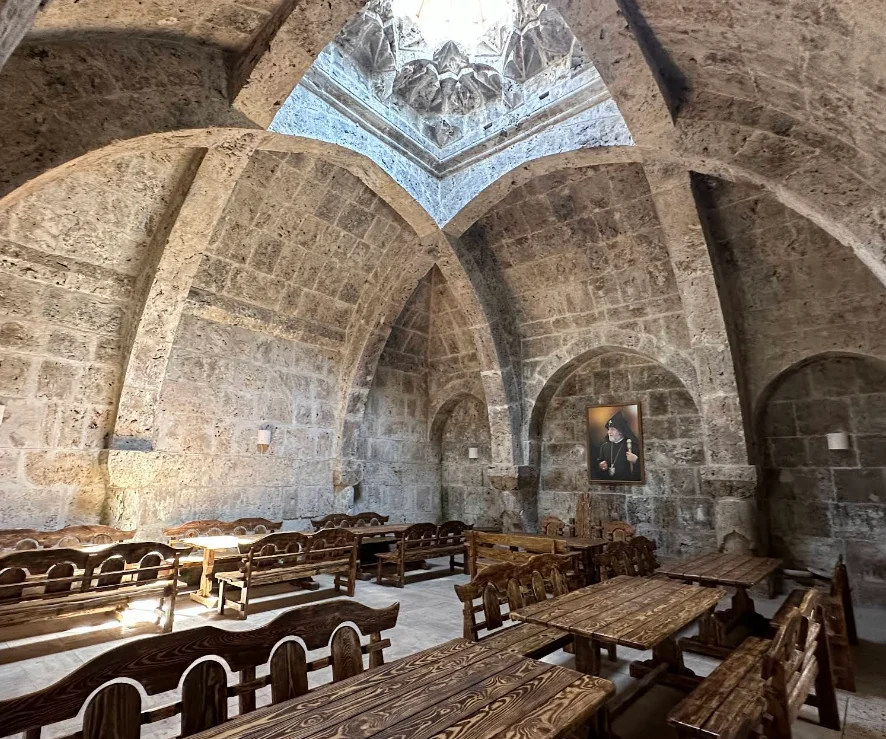
The refectory gives a different view of monastic life. An inscription dates this communal dining hall to 1248. Intersecting stone arches span two adjoining square bays, allowing the central floor to remain open. Daylight enters through openings high in the roof, while a low stone ledge along the walls served as seating. Here the same care given to the churches was applied to the practical task of gathering a community around a meal.
Above the south window of Saint Stephen’s is a sundial. Its hours are marked with the Armenian letters from Ա to ԺԲ, used as numerals for one to twelve. Below it an inscription records repairs in the seventeenth century. Individual letters on stones elsewhere in the masonry have been interpreted as possible masons’ marks.
On the east front of the Church of the Mother of God, above the paired sanctuary windows, two figures hold a model church. An eagle with spread wings perches on its dome. Scholars read the lettering over the south door in different ways. The date 1281 has been understood as the date of construction or as the date of work on an earlier church.
A large bronze cauldron was found buried in the monastery grounds during improvements in 1884. The inscription on its rim records that the priest Zosima purchased it with his own money in 1232. It measures 110 centimetres across and weighs about 350 kilograms. Three feet resemble animal paws, and four handles take the form of standing lionesses.
Seams visible on its surface show how it was made. The base was cast separately, and the body was cast in sections that were then joined. In 1931 the cauldron was transferred from the museum at Etchmiadzin to the History Museum of Armenia.