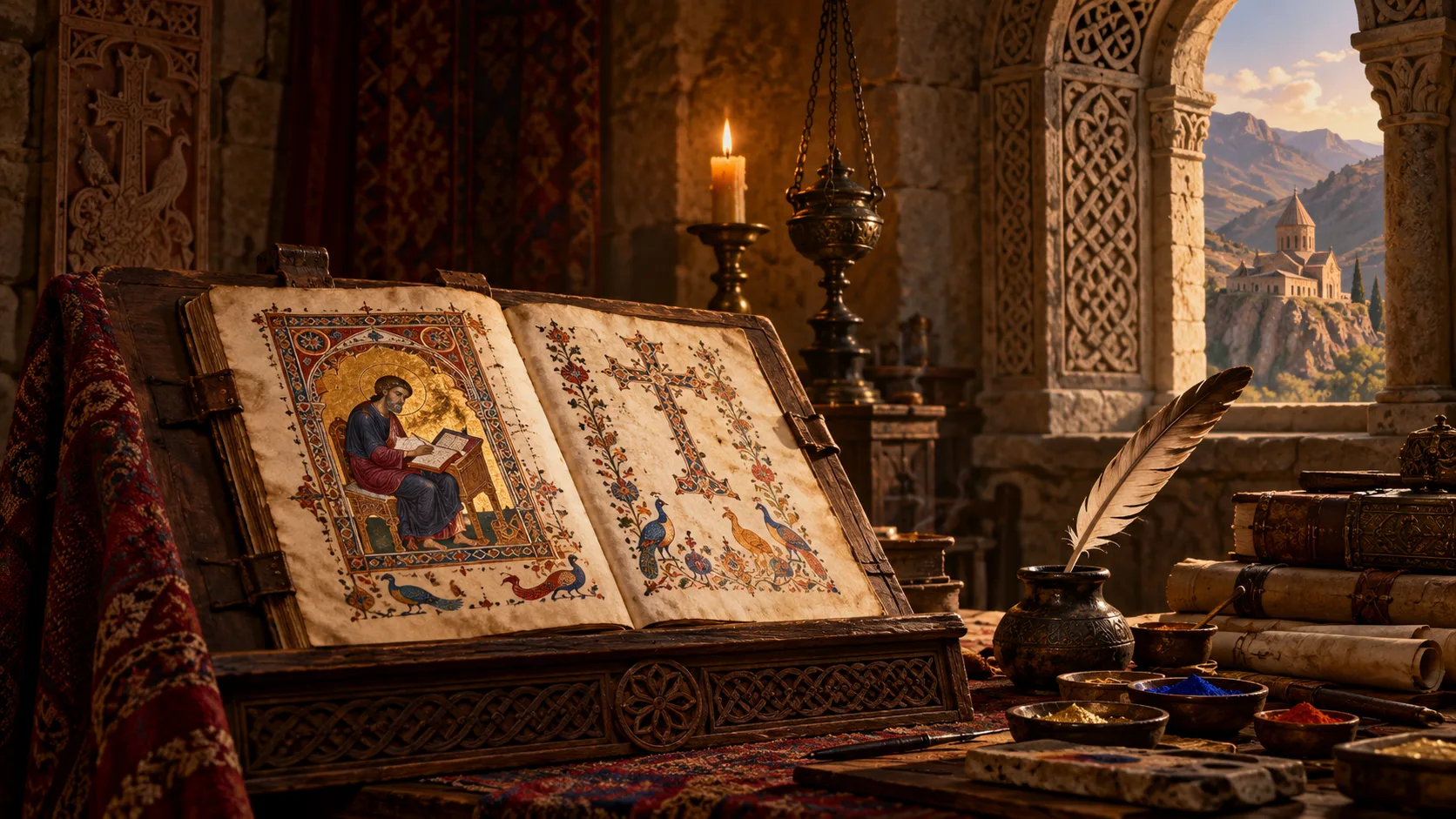
Grigor Narekatsi’s creative legacy is multilayered. He wrote commentaries, encomia, gandzes, taghs, prayers, and his greatest work, the “Book of Lamentations.” His literature is marked by deep spiritual tension, linguistic richness, vivid imagery, and an exceptional depth in portraying the human inner world.
For Narekatsi, creation was not simply literary work. It was a form of prayer, an utterly sincere conversation between the human being and God. In his texts, the human person stands before God with the full weight of sin, fear, pain, hope, and longing for salvation. That is why his language often has the character of lament, supplication, self-examination, and inner purification.
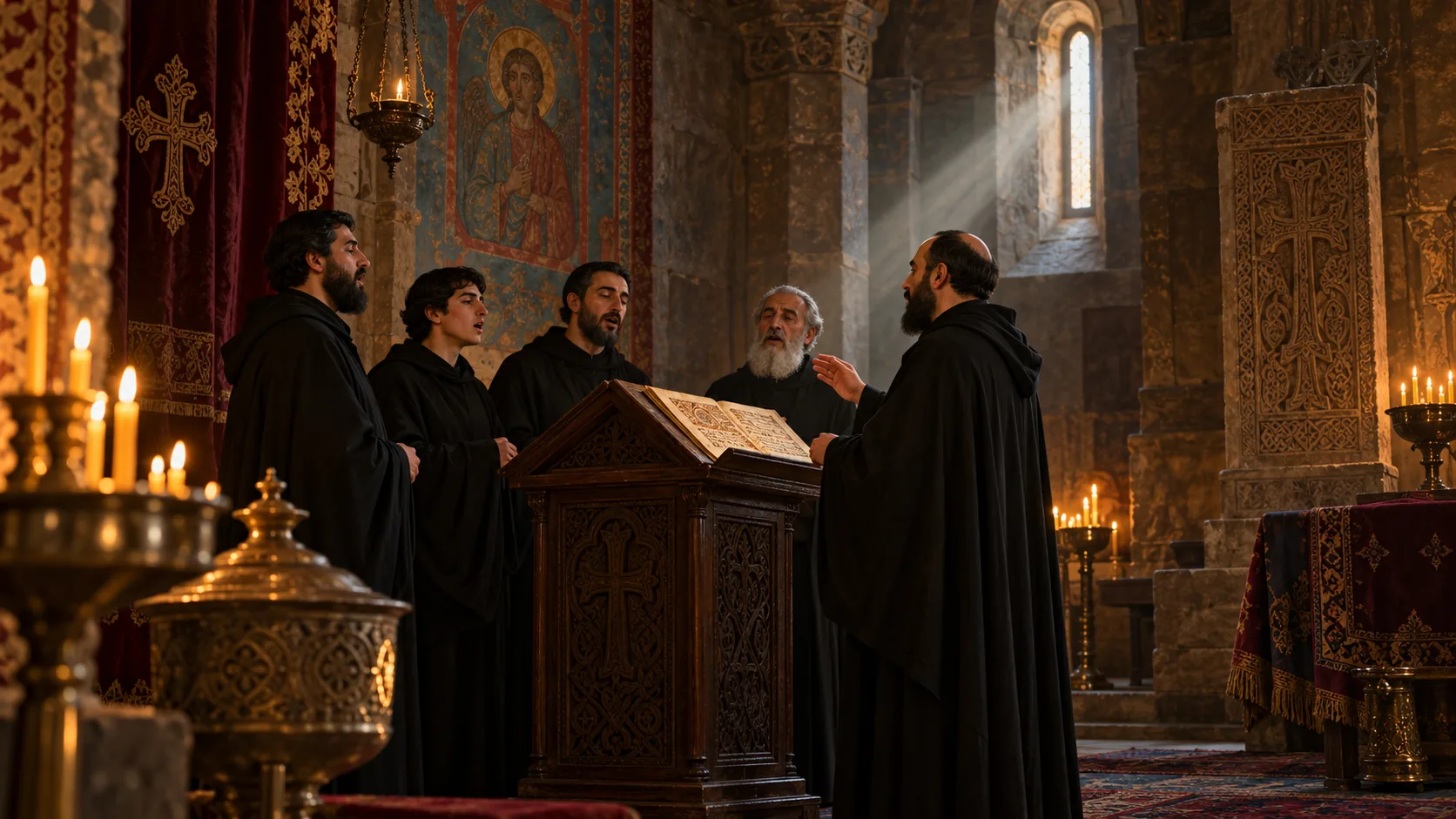
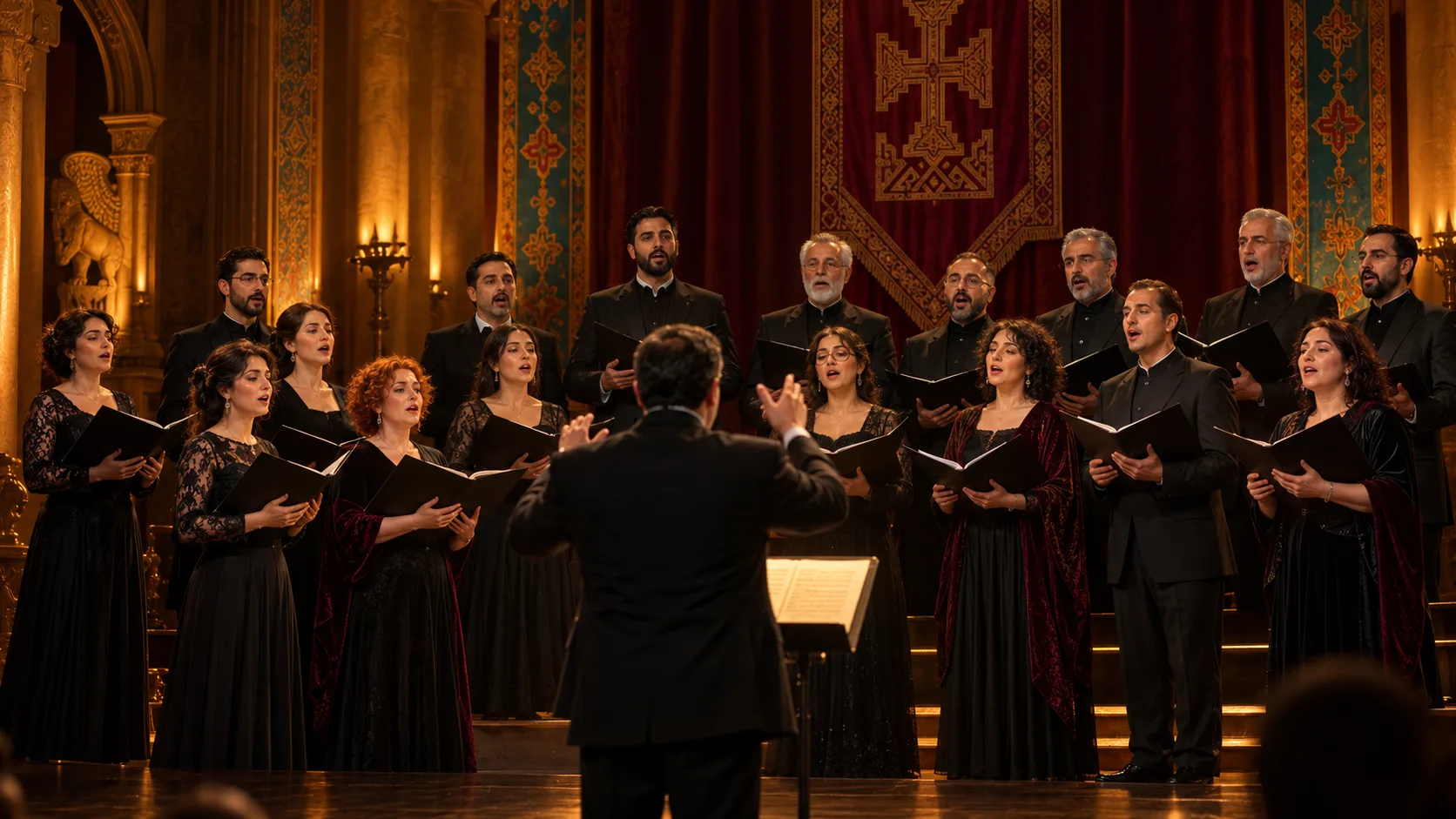
In the taghs and gandzes, Narekatsi also appears as an author with a refined musical sensitivity. His lines are built with such rhythm and imagistic intensity that they naturally connect with sung and liturgical performance. The taghs especially show Narekatsi’s ability to turn theological thought into beautiful, resonant, and vivid language.
Musical and Artistic Analysis
Grigor Narekatsi’s value in Armenian musical heritage should be understood at the boundary between word and song. He did not create a musical school in the sense that Komitas later did, but his texts shaped a high standard of sacred song-like thinking. Narekatsi’s language is musical in itself: it is built through repetitions, inner rhythms, streams of sound, imagery, and prayerful ascent.
His taghs and gandzes are important layers of Armenian medieval sacred song culture. They are connected with church feasts, biblical images, events from the life of Christ, the image of the Mother of God, and the idea of the human being’s spiritual transformation. Narekatsi is able to turn a complex theological idea into an emotional, visible, and almost audible image.
In his work, musicality is not only a matter of melody. It is a way of thinking. Narekatsi’s word moves like waves — from the awareness of sin toward repentance, from fear toward hope, from fallenness toward mercy. It is this inner movement that makes his literature deeply song-like and prayerful.
Main Works
“Commentary on the Song of Songs of Solomon” — 977
“Book of Lamentations,” or “Narek” — completed around 1002–1003
Taghs — late 10th century, exact dates of most are unknown
Gandzes — late 10th century, exact dates of most are unknown
Encomium on the Holy Mother of God — late 10th century
Encomium on the Holy Cross — late 10th century
“History of the Holy Cross of Aparank” — late 10th century
Encomium on the Holy Apostles — late 10th century
Encomium on Jacob of Nisibis — late 10th century
Prayers, sermons, and other spiritual writings
Among Narekatsi’s taghs and sacred song heritage, works often mentioned include “Havun, Havun,” “The Eye, Sea within Sea,” “Tagh of Vardavar,” “Tagh of the Resurrection,” “Tagh of the Nativity,” and others. The exact dating of some of these works cannot be stated with certainty, so they should be presented as part of the spiritual-poetic heritage of the late 10th century.
Commentary on Selected Works
“Book of Lamentations”
The “Book of Lamentations” is Grigor Narekatsi’s principal work and one of the highest monuments of Armenian medieval literature. It consists of 95 prayerful chapters and presents the inner speech of the human being with God. In this work, Narekatsi does not speak only in his own name; he takes upon himself the pain, sin, suffering, and longing for salvation of all humanity.
The power of the “Book” lies in its sincerity. Here, the human being does not hide behind beautiful words, but opens the heaviest layers of the soul. At the same time, Narekatsi does not remain in despair: his entire lament moves toward God’s mercy. That is why “Narek” has been perceived among Armenians as a book of spiritual healing, consolation, and prayer.
“Commentary on the Song of Songs of Solomon”
This work is one of Narekatsi’s early and important theological writings. In the Christian exegetical tradition, the “Song of Songs” was often understood as a symbolic book about God and the human person, Christ and the Church, heavenly love, and spiritual union. In this commentary, Narekatsi shows his theological preparation, imagistic thought, and ability to open a biblical text with spiritual depth.
This work is also important for understanding Narekatsi’s later writing. Already here, one can see the linguistic and imagistic thinking that later reaches its summit in the “Book of Lamentations.”
Taghs
Narekatsi’s taghs are among the most delicate and musical layers of Armenian medieval spiritual poetry. They have a song-like character, rich imagery, and liturgical resonance. In the taghs, Narekatsi often uses images of nature, light, water, flower, bird, eye, sky, and sea to reveal spiritual meanings.
Taghs such as “Havun, Havun” and “The Eye, Sea within Sea” show the mobility of his language and the force of his imagery. These are words created not only to be read, but also to be sounded. For this reason, Narekatsi’s taghs hold an important place in the history of Armenian sacred song culture.
Gandzes
The gandz is one of the important genres of Armenian medieval spiritual poetry and liturgical song culture. Narekatsi’s gandzes are connected with church feasts, the commemoration of saints, and theological symbols. They have not only literary, but also liturgical value.
In the gandzes, Narekatsi creates a dense, elevated, and mysterious language. His purpose here is not merely to say something beautiful, but to draw the believer into a spiritual experience. In this sense, the gandzes can be viewed as a fusion of medieval Armenian sacred song and poetic theology.