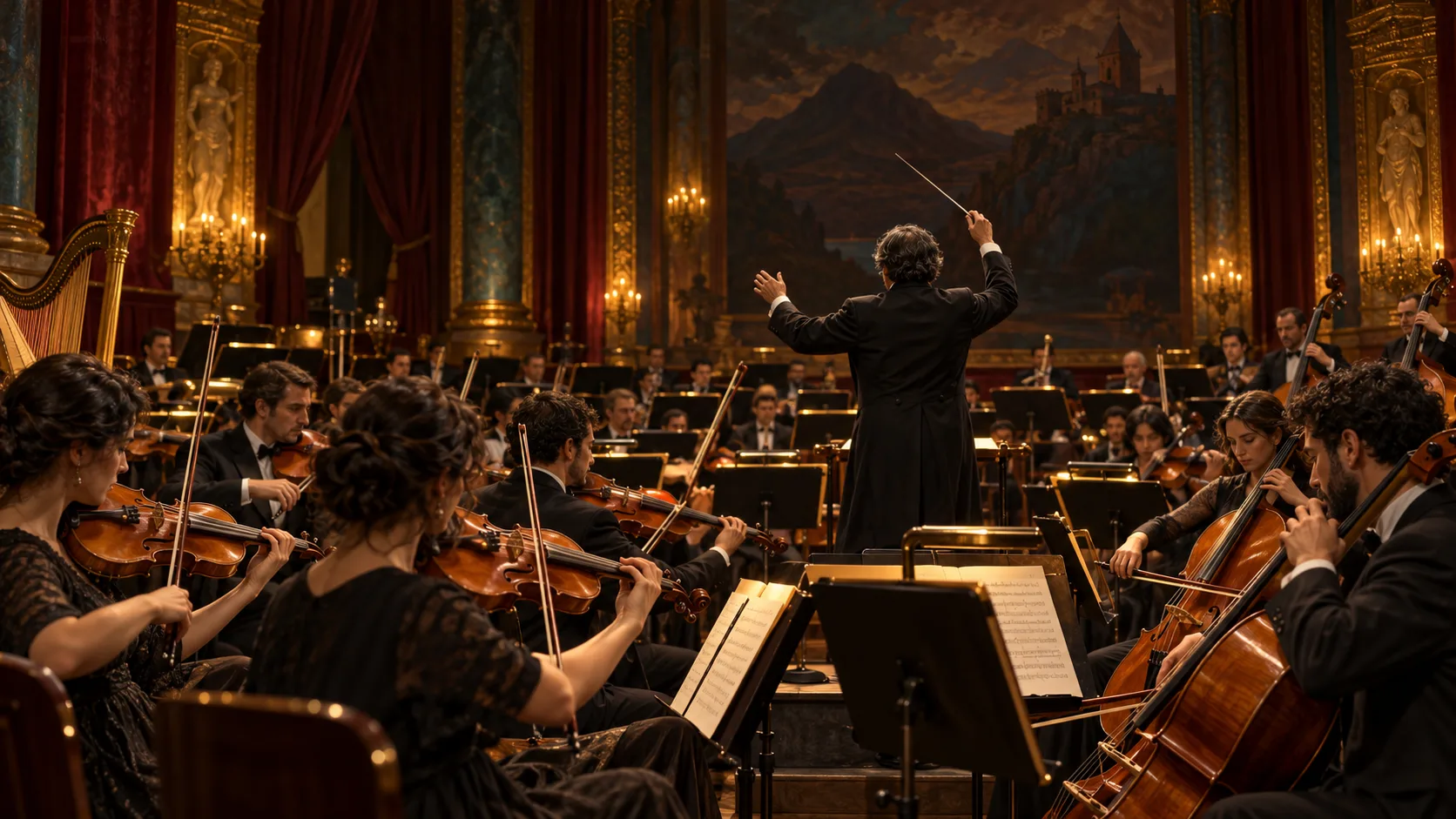
Alexander Spendiaryan’s creative legacy includes opera, symphonic pictures, suites, overtures, vocal works, romances, piano pieces, and chamber works. At the center of his creativity are especially symphonic music and opera.
His early works are connected with romance, small orchestral forms, and the European Romantic tradition. Over time, however, Spendiaryan’s music became increasingly saturated with Eastern and national coloring. He became the composer who could present folk or regional melodies through the means of a large orchestra.
“Crimean Sketches” is one of the important examples of Spendiaryan’s symphonic thinking. Here he uses Crimean Tatar and Eastern melodies, creating a colorful, living, and pictorial orchestral world. These works show his mastery in working with orchestral colors.
“Yerevan Etudes” are already connected with Armenia. They were written in 1925 in Yerevan and are based on Armenian and Eastern melodic material. In this work, Spendiaryan seems to respond musically to the cultural environment of the new Armenia.
His main stage work is the opera “Almast.” It is based on Hovhannes Tumanyan’s poem “The Capture of Tmkaberd” and became one of the most important works of Armenian opera. Spendiaryan worked on “Almast” during the last ten years of his life, from 1918 to 1928.
Musical and Artistic Analysis
One of the main values of Spendiaryan’s music is his colorful orchestral thinking. He was able to turn musical themes into visible images. His music often has a theatrical quality even when the work is not an opera. Landscapes, movements, rituals, battle scenes, Eastern dances, and psychological states open before the listener.
His creative language was formed under the influence of the Russian compositional school, especially Rimsky-Korsakov’s orchestral art. Yet Spendiaryan is not merely a follower of that school. He used this technique to present Armenian and Eastern material in a highly artistic form.
In Spendiaryan’s art, the union of national theme and symphonic structure is especially important. He does not limit national music to songs or small forms. In his work, Armenian and Eastern themes become the basis of large orchestral pictures, operatic drama, and symphonic development.
There is also theatrical tension in his music. In “Almast,” this is expressed through the opposition of characters and through lines of power, betrayal, love, war, and destiny. Spendiaryan is able to create not only beautiful melody through music, but an entire stage situation.
Main Works
“Minuet” — 1895
“Lullaby” for orchestra — 1897
“Concert Overture” — 1900, first performance in 1901
“The Fisherman and the Fairy,” ballad for bass and orchestra — 1902
“Crimean Sketches,” First Series — 1903, published in 1905
“Three Palm Trees,” symphonic picture — 1905, published in 1907
“Concert Waltz” — 1907
“Mourning Prelude” — 1908
“Al-Zamast” — 1910
“Crimean Sketches,” Second Series — 1912, final publication in 1927
“Etude on Hebrew Melodies” — 1921
“Yerevan Etudes” — 1925, published in 1927
“Toward Armenia,” heroic-patriotic aria for bass or baritone and orchestra — 1910s
“The Same Night,” romance — 1895
“Oriental Lullaby” — 1900
“To the Rose” / “O Rose,” romance — 1890s
“Almast,” opera — 1918–1928
Concept for the symphony “Sevan” — unfinished
Concept for the symphony-cantata “Armenia” — unfinished
The titles of some of Spendiaryan’s works appear in different sources in different languages: Armenian, Russian, French, or English. On the website it is advisable to preserve the main Armenian title and, when necessary, indicate the widely used foreign version in parentheses.
Commentary on Selected Works
“Almast”
“Almast” is Alexander Spendiaryan’s principal work and one of the most important pages of Armenian opera. The opera is based on Hovhannes Tumanyan’s poem “The Capture of Tmkaberd,” and the libretto was written by Sophia Parnok. Spendiaryan worked on this piece from 1918 to 1928, until the end of his life.
The strength of “Almast” lies in its dramatic structure. It contains power, love, betrayal, war, national dignity, and tragic choice. Spendiaryan is able to transform Tumanyan’s historical-poetic material into a large operatic drama.
The music of the opera is rich in Eastern coloring, dance scenes, battle pictures, and symphonic development. “Almast” is not only a historical opera; it is also an important work in the formation of Armenian national stage thinking. In 1933, the Yerevan Opera Theatre opened with a production of this opera, which gives “Almast” historical and symbolic significance as well.
“Yerevan Etudes”
“Yerevan Etudes” is one of Spendiaryan’s important late symphonic works. It was written in 1925 in Yerevan and is connected with the formation of Armenia’s new musical life. The two parts of the work, “Enzeli” and “Hejaz,” are based on Armenian and Eastern melodic material.
In this work, Spendiaryan does not only depict Yerevan; he also listens to its musical environment. There are urban intonations, Eastern melodic movements, memories of Sayat-Nova’s songs, and the cultural breath of the new capital. “Yerevan Etudes” is important because it is Spendiaryan’s connection with Armenia’s living musical reality.
“Crimean Sketches”
“Crimean Sketches” is one of the best-known examples of Spendiaryan’s orchestral mastery. The first series was created in 1903 in Yalta, and the second in 1912 in Sudak. These works are based on the arrangement of Crimean Tatar and Eastern melodies.
In these compositions, Spendiaryan appears as a colorful symphonic painter. Through the orchestra he is able to create dance, song, festive movement, melancholy, and an Eastern atmosphere. “Crimean Sketches” show his ability to raise folk or regional melodies to the level of large orchestral art.
“Three Palm Trees”
The symphonic picture “Three Palm Trees” was written in 1905 based on a poem by Mikhail Lermontov. This work is a beautiful example of Spendiaryan’s pictorial symphonic thinking. Here, literary material becomes musical landscape and dramatic story.
In this work, one feels Eastern atmosphere, warm coloring, lyrical breath, and tragic subtext. Spendiaryan does not merely describe an external scene; he creates a psychological environment. For this reason, “Three Palm Trees” is important not only as a beautiful orchestral work, but also as a symphonic drama born from literature.
“Mourning Prelude”
“Mourning Prelude” was written in 1908 under the impression of Nikolai Rimsky-Korsakov’s death. This work is a dedication to his teacher and at the same time shows Spendiaryan’s deep respect for the Russian compositional school.
The music contains restrained pain, reflection, and solemnity. It is not an external lament, but music of inner remembrance. “Mourning Prelude” is important because it shows Spendiaryan’s lyrical and contemplative side, in contrast with his more colorful and pictorial works.