
Aghavnavank Monastery
Aghavnavank stands on the right bank of a stream, about two and a half kilometres northeast of the village of the same name. It is also known as Aghnabat Monastery, after a tract of forest in Dilijan National Park noted for its yew trees. Another name, Anapat Surb Astvatsatsin, identifies the church as a hermitage dedicated to the Holy Mother of God.
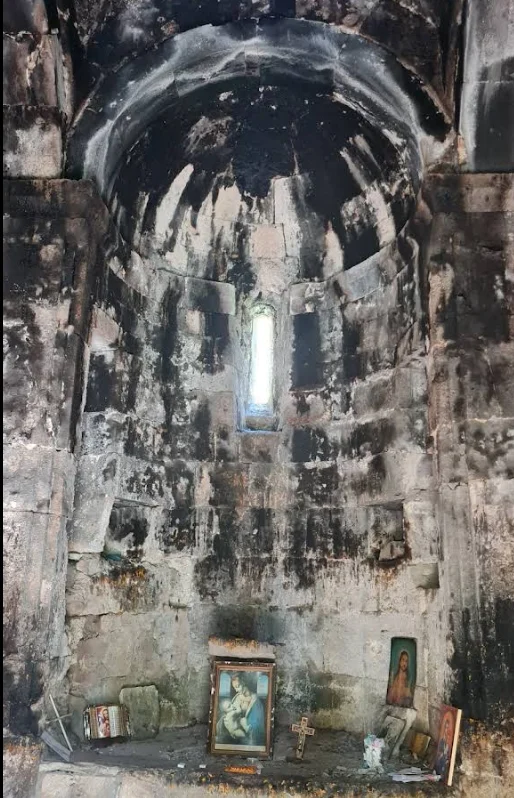
The church is built of finely dressed yellowish stone. Despite its small size it has a central dome and two chambers flanking the sanctuary. A pair of triangular niches marks the eastern façade. Inside, arches rising from supports built against the walls carry the weight of the dome. A few slabs on the roof preserve evidence of the stone covering that once protected the building.
Little written history survives. The letter forms of carvings near the side chambers are characteristic of the twelfth and thirteenth centuries, though they give no precise foundation date. The remains of buildings south of the church may have been living quarters and service rooms. Viewed together, these traces give a sense of the small community that once occupied the clearing.
The roof had a dome carried by arches and a pointed outer covering that protected it from the weather. The stone facing of that outer cone has fallen away. Only patches of the roof slabs survive on the slopes, and many of the shaped cornice stones have fallen. The outline visible now therefore differs from the building’s original finish.
The plan is easier to read. Supports attached to the walls left the central space clear for worship. Small eastern sacristies provided separate rooms for liturgical vessels and vestments. Traces of carved writing remain on their western faces. The shapes of these letters can be compared with dated inscriptions elsewhere, even in the absence of a complete foundation text.
The Akhnabad Yew Sanctuary was designated beside the church in 1958. It covers 25 hectares and protects a natural stand of European yew, Taxus baccata. The monastery and the grove often appear under similar names. One identifies the medieval religious settlement, the other the protected woodland on the mountainside.
A local tale explains the name Akhnabat through a girl named Nabat. A young healer cures the prince’s daughter with plants, falls in love with her and is rejected. Storytellers hear his lament, “Ah, Nabat!”, in the place-name. This is a folk etymology. The evidence for dating the church itself comes from its masonry and inscriptions.