
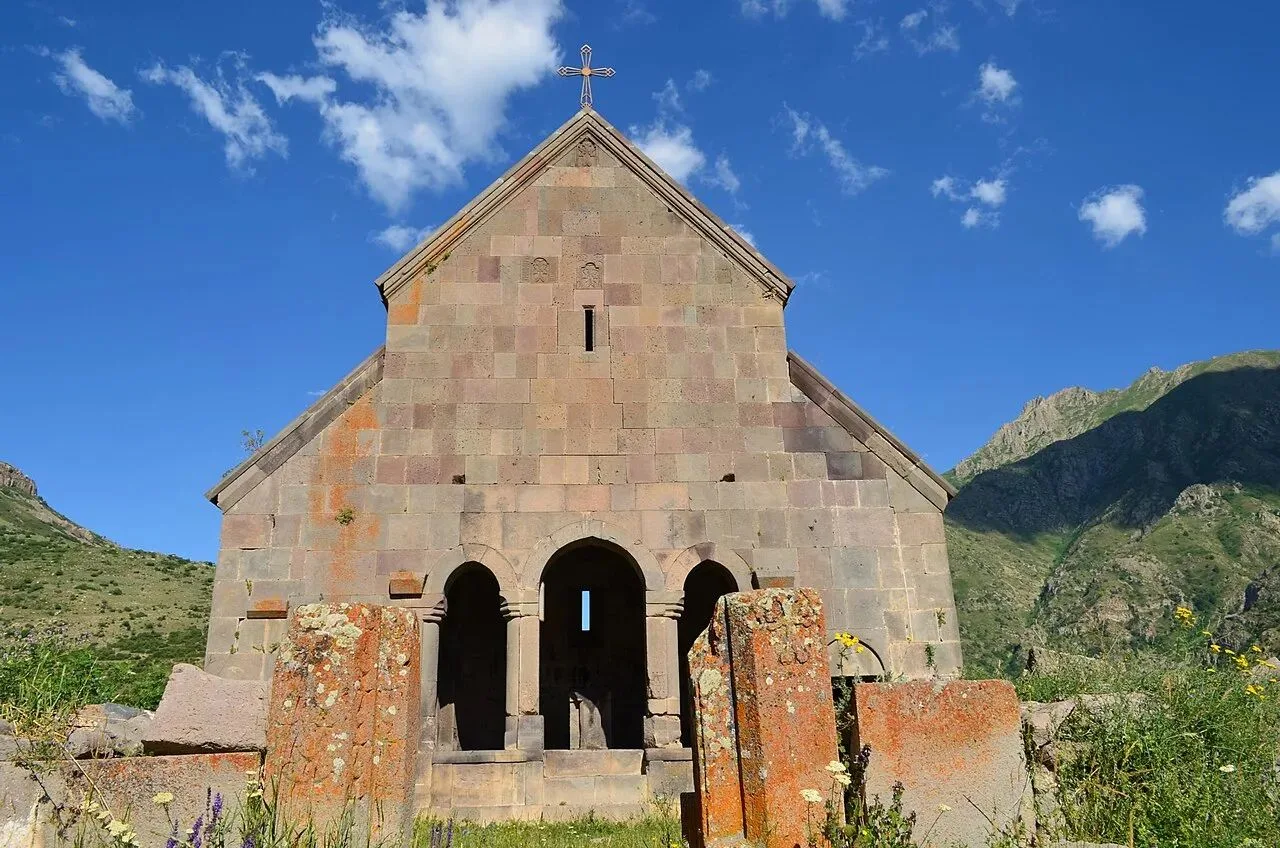
Zorats Church
Where Faith and Military Tradition Meet in Yeghegis
Zorats Church, also known as the Church of Saint Stephen or the Temple of the Warriors, stands on the eastern edge of Yeghegis in Armenia’s Vayots Dzor Province, amid the remains of the historic settlement and the surrounding mountain landscape. This fourteenth-century monument occupies a distinctive place in medieval Armenian architecture because its design differs considerably from that of conventional enclosed churches. It represents a rare form of church with an open sanctuary before which a large congregation could gather.
The church was constructed by Stepanos Tarsayich, Metropolitan of Syunik, between 1324 and 1331. At that time, Yeghegis was governed by the Orbelian princely house and was one of the important political, spiritual and cultural centres of Vayots Dzor. The settlement contained princely residences, churches, fortifications, cemeteries and centres of manuscript production. Zorats Church emerged within this developed environment and was connected with spiritual life as well as princely and military organisation.
The most unusual feature of the building is its open eastern sanctuary. A broad opening is divided into three sections by two columns, with vestries positioned on either side of the central space. There is almost no conventional enclosed prayer hall. Worshippers stood outside before the church while the priest conducted the service on the raised sanctuary. This design has led to the widely accepted interpretation that the church served large assemblies, possibly including soldiers preparing to depart for battle. The name “Temple of the Warriors” is associated with this tradition.
An open gavit stands on the western side of the church. Sections of an enclosure built from massive basalt blocks and the remains of a dressed-stone gateway survive around the complex. A medieval cemetery surrounds the site and contains numerous khachkars, gravestones and inscriptions. These monuments demonstrate that the sanctuary served not only religious ceremonies but also the preservation of the community’s historical memory.
Archaeological excavations near the church uncovered interconnected rooms containing shelves, niches and cupboards built into their walls. These features have led researchers to interpret the area as a medieval centre for manuscript copying and storage. Zorats Church was therefore not an isolated military sanctuary but part of a complex with an active educational, literary and communal life.
The importance of Zorats Church lies in its rare architectural composition and historical setting. Its open sanctuary connected religious ceremony with the assembled community and surrounding landscape, removing the conventional boundary between interior and exterior space. The church represents a medieval Armenian world in which faith, political authority, military duty, manuscript culture and historical memory formed a single cultural system.