
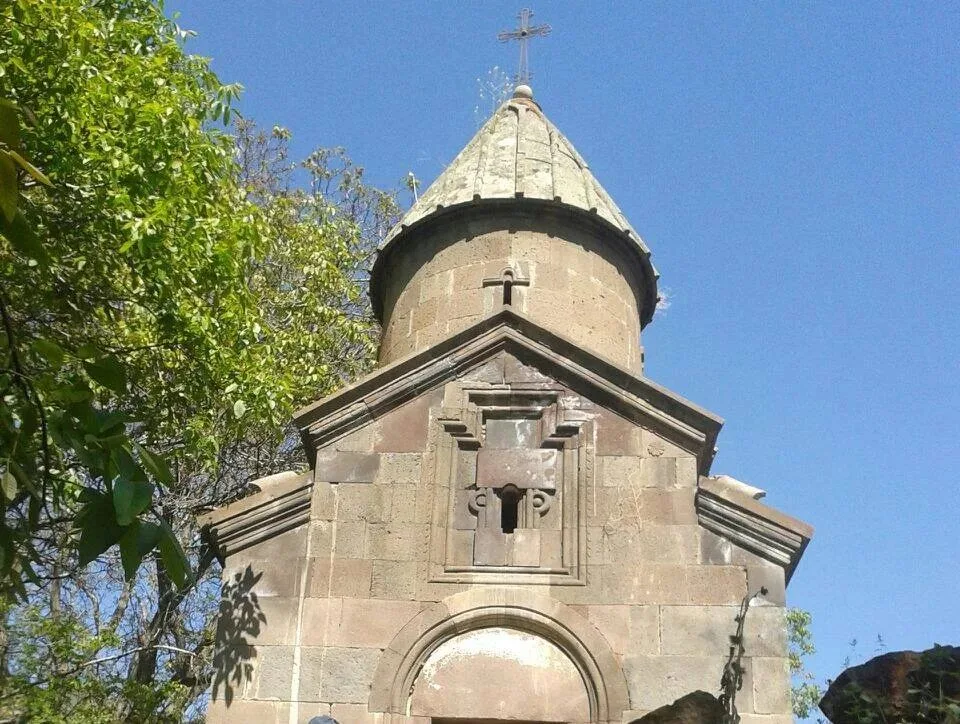
Surb Nshan Church of Yeghegis
A Witness to the Medieval Architecture of Yeghegis
Surb Nshan Church is located in the village of Yeghegis in Armenia’s Vayots Dzor Province, southwest of Zorats Church. Built in the thirteenth century, this domed monument is one of the important surviving sanctuaries of medieval Yeghegis. It is surrounded by the architectural and archaeological layers of the historic settlement, bearing witness to a period when Yeghegis was one of the notable political, economic and cultural centres of Syunik.
The church was constructed during the flourishing of Yeghegis in the thirteenth and fourteenth centuries, when the settlement was associated with the activity of the Orbelian princely dynasty. Churches, princely residences, fortifications and dynastic cemeteries were built here during this period. Surb Nshan formed part of this developed medieval environment, serving not only as a place of prayer but also as a centre of the settlement’s spiritual and communal life.
The name “Surb Nshan,” meaning “Holy Sign,” refers in the Armenian ecclesiastical tradition to the sacred sign of the Cross of Christ and the veneration of relics of the True Cross. The cross represents Christ’s sacrifice, the overcoming of death and salvation. The church of Yeghegis is also known as Saint Karapet, indicating that different traditions of naming and veneration developed around the sanctuary at various times.
Architecturally, Surb Nshan is a proportionate domed church with a centrally organised interior. Its exterior forms a simple quadrangular volume, while a semicircular sanctuary occupies the eastern section. Semi-columns attached to the projections of the western walls and the edges of the eastern apse are connected by arches and support the structure beneath the dome. This system gives the relatively small interior a sense of height, unity and solemnity.
The principal entrance is on the western side. The exterior treatment is restrained and is not burdened with elaborate carved imagery. Its architectural expression is created through the regular arrangement of dressed stone, the vertical rhythm of the semi-columns, the clear structure of the arches and the rising form of the dome. Such simplicity is characteristic of medieval Armenian architecture, in which balanced proportions and structural clarity were often more important than abundant exterior ornament.
A sundial survives on the exterior of the southern wall. Armenian letters placed around it indicated the hours of the day through the movement of the sun’s shadow. The sundial was more than a practical instrument. Within the ecclesiastical environment, it created a symbolic connection between natural time, the hours of prayer and human spiritual life. It also reflects the knowledge of astronomical observation and architectural calculation possessed by medieval Armenian craftsmen.
No extensive foundation inscription survives on the church, and the precise date of construction and the name of its patron are therefore unknown. The monument is dated through its architectural forms and historical context. The absence of an inscription does not lessen its historical importance. On the contrary, the stone structure itself becomes the principal testimony to the period in which it was created.
A carved façade stone belonging to a princely residence was discovered near the church. Its central section portrays Prince Tarsayich and his wife, Mina Khatun. This discovery shows that Surb Nshan did not stand in an isolated rural setting but within a developed environment of princely and urban construction. The church, the remains of residences, gravestones and neighbouring sanctuaries together reconstruct the multilayered character of medieval Yeghegis.
The church was restored during the Soviet period, preserving its main volume, dome and architectural unity. Today, Surb Nshan is important not only as an individual church but also as a component of the historic environment of Yeghegis. It reminds us that churches in medieval Armenian settlements were interconnected with princely life, defensive systems, education, commemoration and communal identity. Through its modest scale, harmonious structure and sundial, Surb Nshan represents one of the restrained yet deeply expressive layers of Vayots Dzor’s medieval architectural heritage.