
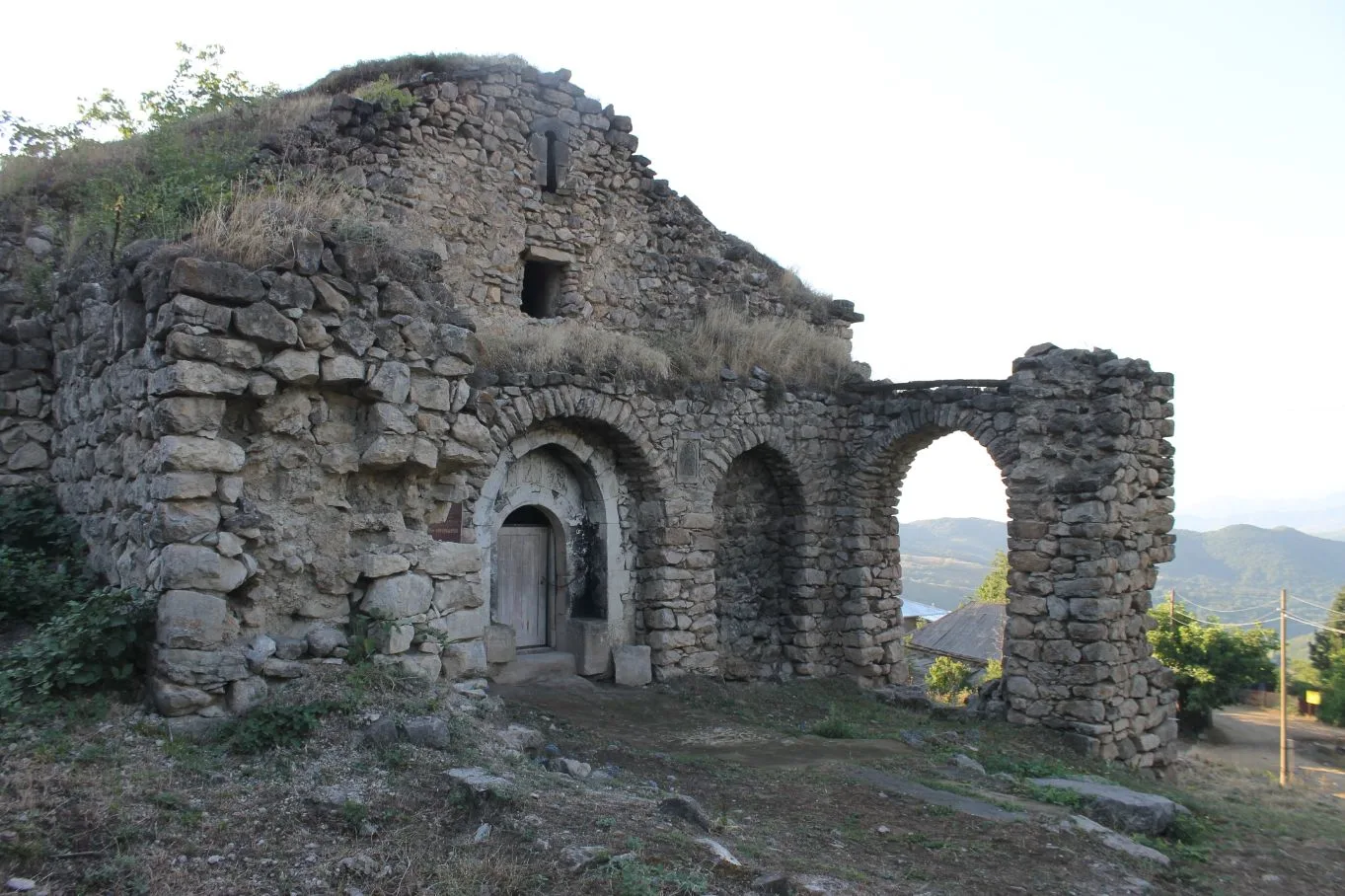
Church of the Holy Mother of God in Verin Khotanan
A Witness to Faith and Community Life in Verin Khotanan
The Church of the Holy Mother of God is located in Verin Khotanan, a village in the Kapan Municipality of Armenia’s Syunik Province, and is one of the principal monuments of the settlement’s historical and spiritual heritage. The village lies near the upper course of the Khotanan River, on the forested southern slope of the Bargushat mountain range, approximately twelve kilometres north of Kapan. Standing in a highland environment, the church blends naturally with the rocky terrain, the old cemetery and the surviving traces of traditional village buildings.
The church dates from the seventeenth century. It was built during a period when the settlements of Syunik continued to preserve their spiritual and communal life despite political instability and economic hardship. Such rural sanctuaries were not large princely monasteries, yet they often played an equally important role for the local population. Religious services, baptisms, marriages, memorial ceremonies and community gatherings were organised around them.
The dedication to the Holy Mother of God reflects the particular veneration of the Virgin Mary within the Armenian ecclesiastical tradition. In rural and mountainous communities, churches dedicated to her were frequently regarded as places of spiritual protection for the family, motherhood, the home and the entire settlement. The church of Verin Khotanan was therefore not merely a place of worship but also a centre that preserved the community’s historical identity and the memory of successive generations.
The church is built from local undressed and roughly worked stone. Its surviving thick walls, arched openings and apse-like recesses give the structure the restrained and solid appearance characteristic of the rural churches of late medieval Syunik. Instead of elaborate exterior carving, its architectural expression is created through the natural surface of the masonry, the weight of its volumes and its direct relationship with the mountainous landscape.
Today, the church survives in a partially ruined state. A substantial part of its roof has disappeared, while the exposed walls are affected by precipitation, moisture, vegetation and changing temperatures. Nevertheless, the surviving arches, masonry and architectural sections still make it possible to imagine the former unity of the building. Its ruined condition gives the church considerable historical depth but also emphasises the need for professional study, structural consolidation and conservation.
Medieval gravestones and traces of a cemetery around the church demonstrate that the site served for a long period as the sacred and commemorative centre of the village. Some of the gravestones date from the fourteenth century, indicating that the area possessed communal and spiritual importance long before the construction of the present church. These earlier remains place the monument within a multilayered historical environment containing cultural traces from different centuries.
Verin Khotanan is also associated with Movses III Tatevatsi, an important figure in the history of the Armenian Church. He is also known in historical sources as Movses Syunetsi or Khotanantsi and was born in the village of Khotanan in 1578. He later became Catholicos of All Armenians and played an important role in reorganising Armenian ecclesiastical life during the seventeenth century. The association of his birthplace with the Church of the Holy Mother of God highlights Khotanan’s place in the spiritual history of Syunik.
The value of the Church of the Holy Mother of God in Verin Khotanan is not determined solely by its age or architectural forms. It is a monument embodying the historical memory of the village. The church stones, the neighbouring cemetery and the remains of the surrounding settlement together tell the story of the community’s formation, faith, everyday life and gradual transformation. This modest sanctuary reminds us that Armenian cultural heritage consists not only of celebrated monasteries and monumental cathedrals, but also of churches in remote villages around which identity, family memory and attachment to the ancestral landscape were preserved for centuries.