
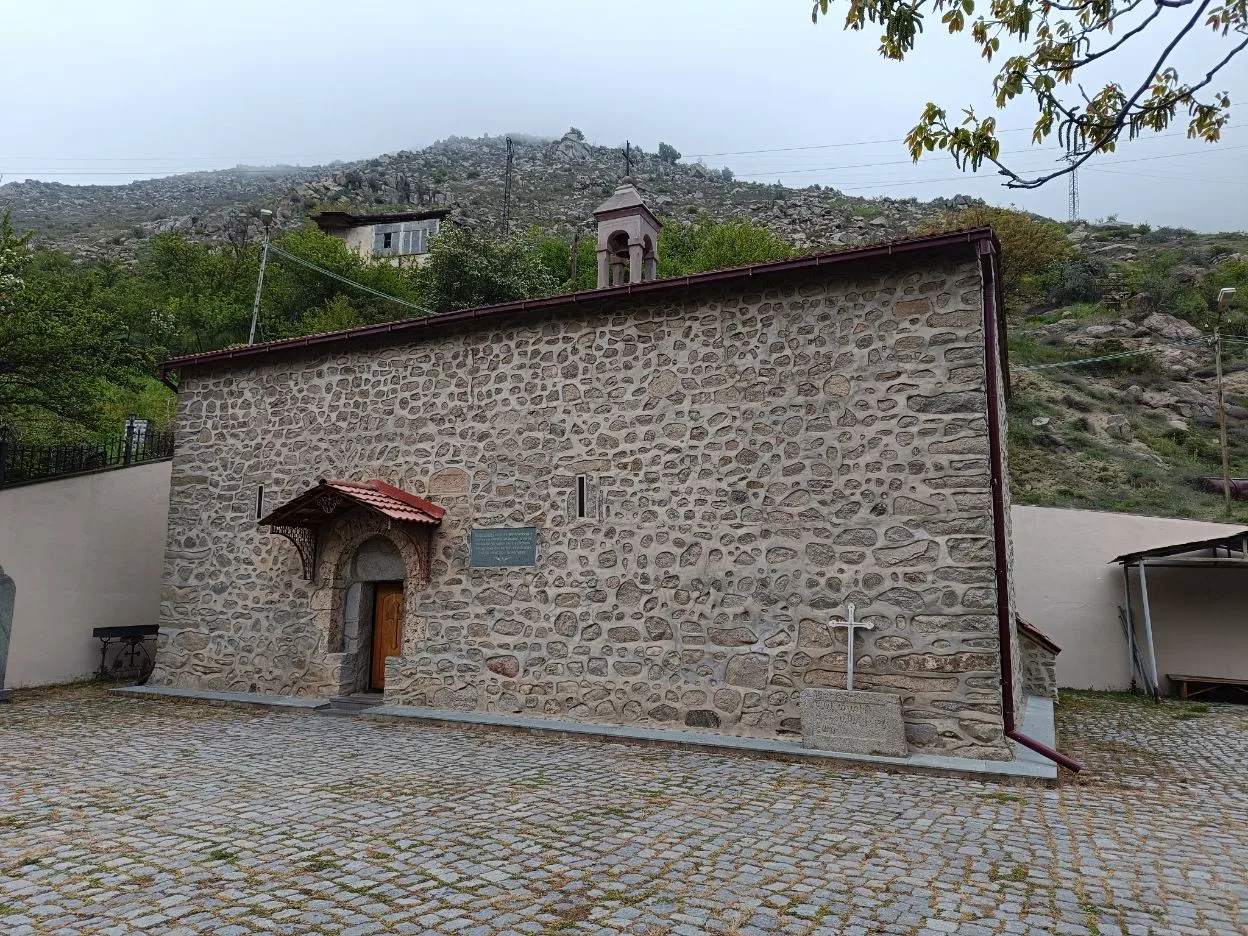
Church of the Holy Mother of God in Verin Hand
Faith and Community Memory in Verin Hand
The Church of the Holy Mother of God is located in the Verin Hand district of Kajaran in Armenia’s Syunik Province, amid rocky mountains and historic settlements. This modest sanctuary is one of the surviving spiritual monuments of the Kajaran area and connects the modern urban landscape with the history of the rural communities that once existed here. The church is distinguished not by elaborate decoration but by its simple and solid form built of local stone, naturally integrated into Syunik’s austere mountain landscape.
The present church was constructed in 1912 on the foundations of an older church. Complete information concerning the date and original appearance of the earlier building has not survived, but the decision to build the new church on the same site demonstrates the historical continuity of the sanctuary. The community did not select an unrelated new location; it restored a place that had already possessed spiritual and commemorative importance for previous generations.
The surroundings of Verin Hand contain monuments from different periods. To the north of the district lie the remains of the medieval settlement of Shlorut, its cemetery and fortress. These monuments show that the area was inhabited and held strategic importance during the Middle Ages. The Church of the Holy Mother of God is a later but living continuation of this multilayered historical environment, preserving the connection between the former settlements and the modern community.
The church is a simple elongated hall structure. It is built of local stones of different sizes, whose natural colours and irregular surfaces give the building a solid, stable and earthbound appearance. Its pitched roof responds to the climatic conditions of a mountain settlement, while the small windows preserve a calm and concentrated atmosphere within the interior. The entrance is framed by restrained stonework and a wooden canopy, and a small bell turret rising above the roof adds a vertical accent to the otherwise simple silhouette.
Elaborate carved ornament is almost absent from the building’s architecture. This restraint is not a deficiency but one of the characteristic features of Syunik’s rural churches. Such sanctuaries were built according to the practical means of their communities and were intended to serve people’s everyday spiritual life. Their value is expressed through the durability of their construction, the simplicity of their proportions and their natural relationship with the surrounding environment.
The dedication to the Holy Mother of God reflects the particular reverence for the Virgin Mary within the Armenian ecclesiastical tradition. In rural and mountainous settlements, the Mother of God was often regarded as the protector of the family, motherhood, the home and the entire community. Churches bearing her name therefore served not only as places of liturgy but also as centres for baptisms, marriages, memorial ceremonies and communal memory.
The importance of the Verin Hand church becomes especially clear in the context of Kajaran’s development. The formation of the industrial town and the expansion of mining transformed the appearance, way of life and spatial structure of the surrounding settlements. Amid these changes, the church preserved the memory of the earlier rural environment, reminding visitors that the history of Kajaran did not begin with modern industry. It also includes ancient settlements, fortresses, cemeteries, sanctuaries and the continuous presence of successive generations.
The value of the Church of the Holy Mother of God in Verin Hand does not lie in its size or architectural splendour. It is a monument embodying the historical identity of a small community. Constructed on the foundations of an earlier sanctuary, the church represents not only the history of a single building but also the repeated renewal of faith in the same place. It demonstrates that despite social change, the transformation of settlements and the natural effects of time, communities have sought to preserve their sacred places and the memory of their ancestors.