
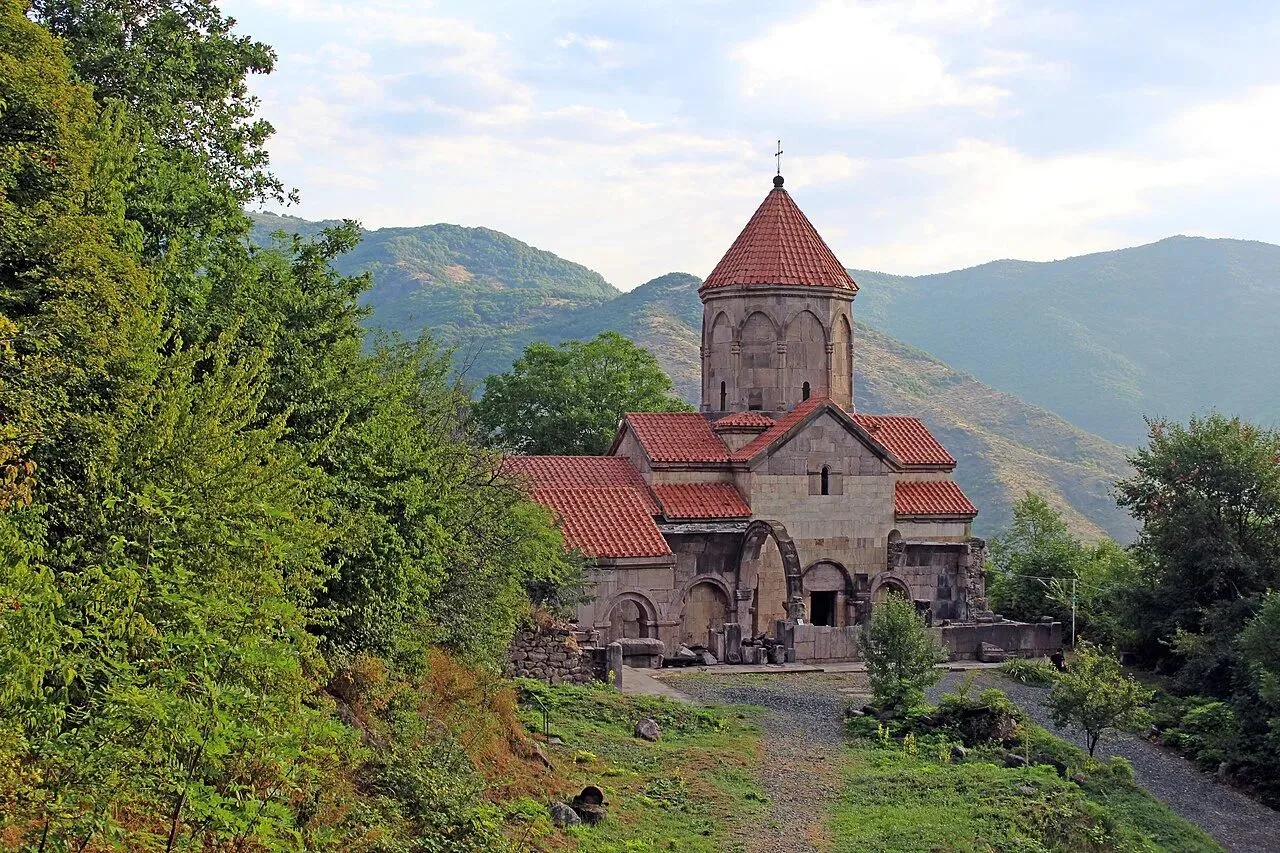
Vahanavank
A Centre of Monastic Culture and Royal Memory in Syunik
Vahanavank is situated in Armenia’s Syunik Province, approximately five kilometres southwest of Kapan, on the elevated right bank of the Voghji River and the forested slope of Mount Tigranasar. Developed during the tenth and eleventh centuries, the monastic complex was one of the important spiritual, educational and princely centres of medieval Syunik. Its buildings occupy a natural height and merge with the surrounding mountains and gorge, creating a protected and secluded environment suited to monastic life.
The monastery was founded in the early tenth century by Vahan, the son of Dzagik, the ruling prince of the historic district of Baghk. The complex was named Vahanavank after its founder. Its establishment coincided with a period of revival in Armenian statehood, ecclesiastical life and culture. The monastery was not merely an expression of Prince Vahan’s personal devotion. It also strengthened the political and spiritual presence of Syunik’s princely house. The subsequent expansion of the complex demonstrates that it quickly developed into a centre of regional importance.
The principal building is the Church of Saint Gregory the Illuminator, completed in 911. It is a domed hall constructed from finely dressed basalt, with its interior organised around a single pair of massive piers. Its restrained proportions, heavy stone walls and rising dome create a concentrated and solemn environment. The dark local basalt gives the church a sense of strength and connects it naturally with the mountainous landscape of Syunik.
A rectangular gavit adjoins the Church of Saint Gregory the Illuminator from the west. Its roof is supported by three broad arches, while its main southern entrance opens towards the complex’s elongated portico. Developed in the mid-eleventh century, these structures served not only as church vestibules but also as spaces for gatherings, memorial ceremonies and princely burials. In 1046, the principal church, gavit and portico were reconstructed by Grigor, the Prince of Princes, who later became King Grigor I of Syunik.
On a height to the south of the main complex stands the two-storeyed Church of the Holy Mother of God, built in 1086 by Queen Shahandukht of Syunik and her sister Kata. Its lower level served as a dynastic crypt, above which rises a small, single-nave vaulted church. The columned balconies on the northern and eastern sides and the platform surrounding the building give it a ceremonial and commemorative character. The church is a notable example of an Armenian two-storeyed funerary church, in which the place of prayer and the burial chamber are united within one architectural system.
Vahanavank served as a dynastic pantheon for the royal and princely houses of Syunik and neighbouring regions. Numerous gravestones, khachkars and inscriptions preserved throughout the complex commemorate kings, princes, clergymen and benefactors. These inscriptions are not merely memorials to individuals. They provide information about the monastery’s construction, donations, political relationships and the social life of medieval Syunik. This memory carved in stone makes Vahanavank an important historical record of the region.
A monastic school operated at Vahanavank, where the future Catholicos Vahan I of Syunik studied. Clergymen were educated there, while theology, ecclesiastical literature and liturgical traditions were taught. The monastery also included residential and service buildings, an extensive cemetery and a spring. Their surviving remains show that Vahanavank was not an isolated church but an organised monastic settlement with its own educational, economic, ritual and everyday life.
Vahanavank was damaged and partially ruined over the centuries, but its historical importance was not forgotten. Archaeological excavations have been conducted periodically since 1966, while restoration work was carried out during the Soviet period and again between 2006 and 2009. The Church of Saint Gregory the Illuminator and its gavit were fully restored, the portico was partially reconstructed, and the Church of the Holy Mother of God had been restored earlier. Today, Vahanavank presents a coherent picture of the spiritual, political and cultural life of medieval Syunik, reminding us that Armenian monasteries were not only centres of faith but also institutions of education, dynastic memory and historical identity.