
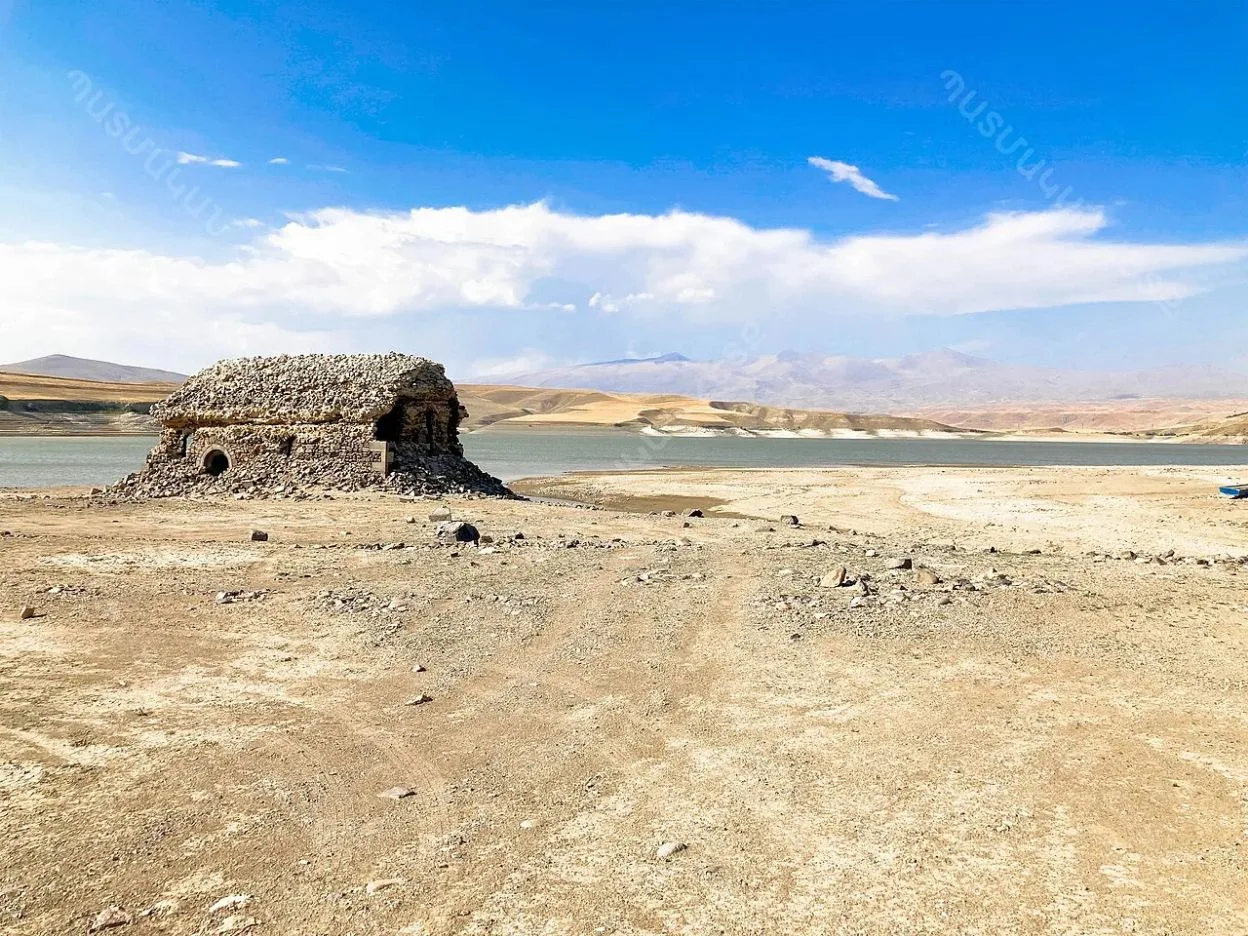
SAINT HRIPSIME CHURCH OF TOLORS
A Submerged Sanctuary and the Surviving Memory of a Lost Village
Saint Hripsime Church is located within the Sisian Municipality of Armenia’s Syunik Province, inside the Tolors Reservoir, approximately three kilometres south of the town of Sisian. For much of the year, the church is completely or partially covered by water. When the reservoir level falls, its stone structure gradually reappears, making it one of Armenia’s most unusual and vulnerable ecclesiastical monuments.
Official heritage records date the church to 1861 and classify it as a single-nave basilica. An inscription on the preserved entrance lintel confirms the year in which construction was completed, while archival accounts indicate that work had begun approximately thirteen years earlier through the initiative of the Ter-Minasyan clerical family. Local tradition suggests that an older sanctuary may have existed beneath the present building, although this has not been conclusively established.
The church is characterised by massive masonry walls, a vaulted prayer hall and the restrained composition typical of rural churches in mountainous Syunik. Its importance lies not in elaborate decoration but in the strength of its construction, which has enabled the building to withstand decades of water pressure, moisture and repeated changes in the reservoir level.
Old Tolors once stood near the confluence of the Sisian and Ayri rivers. During the 1960s, the Soviet authorities decided to construct a reservoir on the site, and the inhabitants were gradually relocated to a new settlement on higher ground. The reservoir became operational in 1976, after which the old houses, part of the cemetery and Saint Hripsime Church were submerged.
Before the reservoir was created, the church was used as a grain store during the Soviet period. Although this use was inconsistent with its religious purpose, it may have helped prevent the building from being demolished. Before the flooding, several khachkars and the inscribed entrance stone were transferred to the village cemetery, but the church itself could not be relocated.
Fluctuating water levels now pose the greatest danger to the monument. As the church is repeatedly submerged and exposed to the air, the stone loses strength, the mortar deteriorates and sections of the walls are gradually damaged. Nevertheless, the principal structure remains standing, preserving the memory not only of the sanctuary but of the entire settlement beneath the reservoir.
Folk narratives have also developed around the church. Some residents interpreted accidents that occurred after the reservoir was created as a consequence of submerging a sacred place. These accounts are not established historical facts, but they reveal the depth of the church’s place within the community’s spiritual and emotional memory.
The importance of Saint Hripsime Church extends beyond its extraordinary setting. It is a powerful reminder of settlements lost through Soviet development projects, the vulnerability of cultural heritage and the endurance of historical memory. Each time the waters recede and the church reappears, the vanished world of Old Tolors seems to return briefly with it.