Skip to content

The Marriages of Sanasar and Baghdasar

Legend
Type
Section 1

Section 1

DAVID OF SASUN

THE MARRIAGES OF SANASAR AND BAGHDASAR

1

May mercy rest, may mercy rest
Upon Lady Tsovinar.
May mercy rest, may mercy rest
Upon Sanasar and Baghdasar.
May mercy rest, may mercy rest
Upon Deghdzun-Tsam.
May mercy rest, may mercy rest
Upon the departed loved ones of those who listen.
Section 2

Section 2

2

Where shall our story turn?
To the Copper City,
To the daughter of the king of the Kajs, the spirits.

The names of Sanasar and Baghdasar grew famous.
Word of them travelled through every land:
In Sasun lived two warriors of astonishing prowess.
Tales of Sanasar's courage reached the Copper City,
Reached the king's daughter,
Deghdzun-Tsam of the Forty Braids.

The king had two daughters and no other children.
Deghdzun was a sorceress, skilled in enchantment.
Sanasar saw her in a dream
And became deeply enamoured of her.
When the maiden learned this, she thought:
“They say this man is brave.
I shall send him a letter.
Let him come; if he pleases me, I shall marry him.”
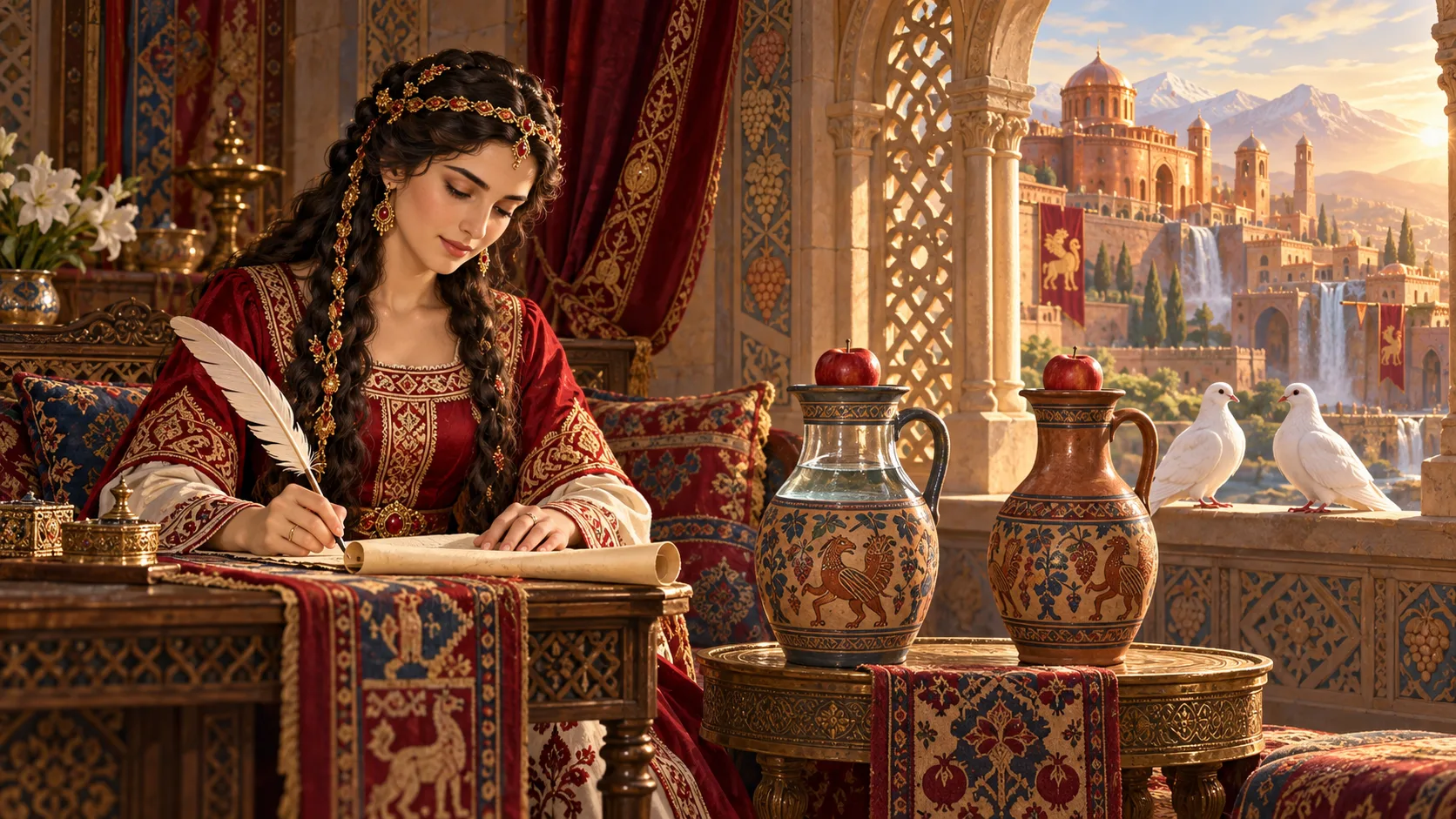
The princess of the Copper City
Filled one pitcher with water and covered its mouth with an apple.
She placed another apple over an empty pitcher,
Then wrote to Sanasar:

“From Deghdzun-Tsam, daughter of the king of the Kajs,
Warm greetings to Sanasar,
Warm greetings to Baghdasar and Sanasar.
Young Sanasar,
I am the daughter of the king of the Copper City.
My heart is as clear and unsullied as this empty pitcher;
My head is as full as this brimming pitcher.
God has filled me with His gifts.
Many have come to ask for my hand:
Forty men have come from forty places.
I have pledged myself to none, agreed to none.
I have dreamed of you. Come and marry me;
You please me greatly.
Young Sanasar,
This letter is meant for you.
How long must I remain here waiting for you?
If you have wetted your head, do not linger to shave it:
Come and take me for your wife.”

She finished the letter and enclosed her portrait.
She called two maidens,
Fastened the things to their arms and told them:
“Carry these to the town of Sasun.
Drop the letter through the opening in the roof
Onto young Sanasar's bed.
Set the pitchers at his bedside,
So that he will see them when he wakes.
If he is truly a brave man,
Let him come and take me for himself.
Mind you, I must not hear
That you dropped them into Baghdasar's room!”

These maidens, too, possessed magical powers.
They put on bird garments,
Became two white doves,
And flew with the letter to Sasun.
They alighted on the roof of the House of Sasun
And approached the roof opening on the right.
Below lay a bedspread,
And in it slept a fine young man, flushed and sweating.
His face seemed to challenge the sun:
“Step aside and let me take your place!”
A pair of candles burned beside his head,
Another pair beside his feet.
One messenger said:
“Sister, let us look through the other opening.
Perhaps this young man is not Sanasar.”
They went to the other opening
And saw another man asleep beneath the bedding.
He too was sweating,
And appeared ten times more handsome than the first.
“Sister,” one said, “this must be Sanasar.
Let us drop the letter here.”
The other answered:
“By God, girl, the first man is handsome too!
I cannot tell whether this is Sanasar
Or whether it is the other one.”
Unable to decide,
They returned to the opening on the right
And left the letter on the bed of Headstrong Baghdasar.
Section 3

Section 3

3

Baghdasar woke in the morning,
Dressed, looked about him,
And noticed a letter lying on his bed.
He picked it up, unfolded it and read.
It was from the daughter of the king of the Kajs.
Inside were the words:
“Warm greetings to Sanasar,
Warm greetings to Baghdasar and Sanasar.”
He thought: “What is this?
She greets Sanasar twice and me only once!
Well, Sanasar is the elder brother;
It is proper that she names him first.
But why does she greet him twice?”
Reading on, he found that the princess
Had written to Sanasar:
“Come and marry me. Come and take me away.”
There was a headstrong streak in Baghdasar.
He grew angry and said:
“My brother has sought a wife!
He will marry without consulting me,
As though I counted for nothing!
We are brothers, after all.
When did he give his word to her without telling me?
Sanasar has been doing something behind my back.”
He sat fuming on his bed
And would not leave his room.
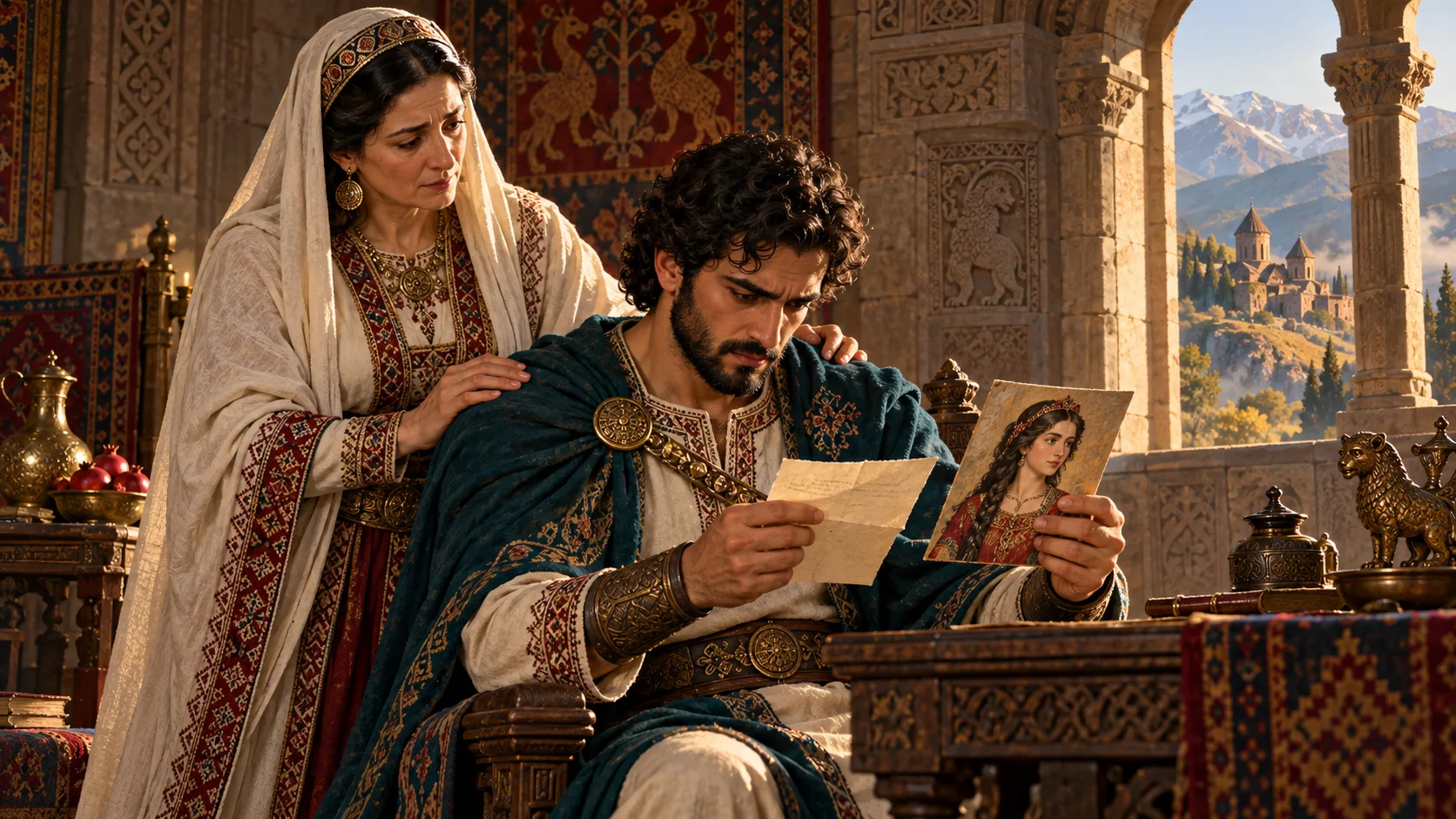
Then he saw the portrait enclosed with the letter.
He lost all reason; blood streamed from his nose.
“Either my brother lives,” he said, “or I do.”
He folded the letter and tucked it into his clothing.
He nursed the hurt in his heart,
Would not speak to Sanasar,
And answered nothing his brother said.
When everyone gathered at the breakfast cloth,
They found that Baghdasar had not come.
He remained sulking in his room:
“What a faithless brother I have!
He acts without me.
Very well: I shall not join their table
Or eat their bread.
I shall mount my horse,
Disappear into another country,
And see what God has in store for me.”

His mother asked:
“What has happened? Why has Baghdasar not come?”
She went to his door, opened it and entered.
“Baghdasar, why did you not come to eat?
What is wrong? Are you ill?”
Baghdasar answered:
“Mother, if anyone but you
Had opened that door and walked in,
I would have torn them to pieces.”
“Why? What has happened to you?”
He took out the letter and handed it to her.
“Mother, read this,
And you will see why I cannot come to breakfast.
How could I sit down at that table?
My brother has chosen a wife without telling me.
Am I not a man too?
He should have asked me first,
Then done as he wished and married.
Go and tell Sanasar:
Either he will live or I will.”
His mother read the letter.
“Son, I knew nothing of this.
It angers me even more than it angers you.”
She took it to Sanasar and said:
“Here, take your letter.”
Sanasar took it and read:

“From Deghdzun-Tsam, daughter of the king of the Kajs,
Warm greetings to Sanasar,
Warm greetings to Baghdasar and Sanasar.
Young Sanasar,
I am the daughter of the king of the Copper City.
My heart is as clear and unsullied as this empty pitcher;
My head is as full as this brimming pitcher.
God has filled me with His gifts.
Many have come to ask for my hand:
Forty men have come from forty places.
I have pledged myself to none, agreed to none.
I have dreamed of you. Come and marry me;
You please me greatly.
Young Sanasar,
This letter is meant for you.
How long must I remain here waiting for you?
If you have wetted your head, do not linger to shave it:
Come and take me for your wife.”
Having read it, Sanasar swore:
“Mother, before your God, I know nothing of this!”
“Your brother is offended with you,” she said.
Sanasar replied:
“What can I do?
The girl is a sorceress, an enchantress.
She heard our names and wrote this letter.
What can I do about that?
My brother has taken offence;
He is a little headstrong.
Go and explain it gently to him.
If his anger passes, all will be well.
If it does not, let him give me a blow or two
Until he has had his fill and his anger cools.”
His mother spoke gently to Baghdasar,
But his anger did not subside.

That evening Sanasar came home.
He greeted Baghdasar, who refused to answer.
“Brother, why are you upset?”
Baghdasar told him:
“Either I shall kill you, or you shall kill me.”
“Why? What is the reason?” Sanasar asked.
“Why did the princess greet you twice
And greet me only once?”
“Brother, what can I do? She wrote it!”
“No,” said Baghdasar, “we must fight.”
“Fight over an empty greeting?”
Baghdasar said:
“You are hiding something.
You sent that girl a letter.
Why will you not tell me?”
“Brother, I swear to God,
I have written her no letter.”
“No, we must fight,” Baghdasar insisted.
“We must wrestle and strike one another.”
“Brother, I shall not strike you.
Strike me yourself; kill me if you wish.”
Nothing Sanasar said could move his brother.
Baghdasar was obstinate, with that crooked streak;
That was why they called him Headstrong Baghdasar.
Section 4

Section 4

4

At last Sanasar thought:
“I shall take my brother out into the fields,
To the meadow, and play with him awhile.
We shall try some games on horseback;
Perhaps his heart will soften.”
He took his brother with him.
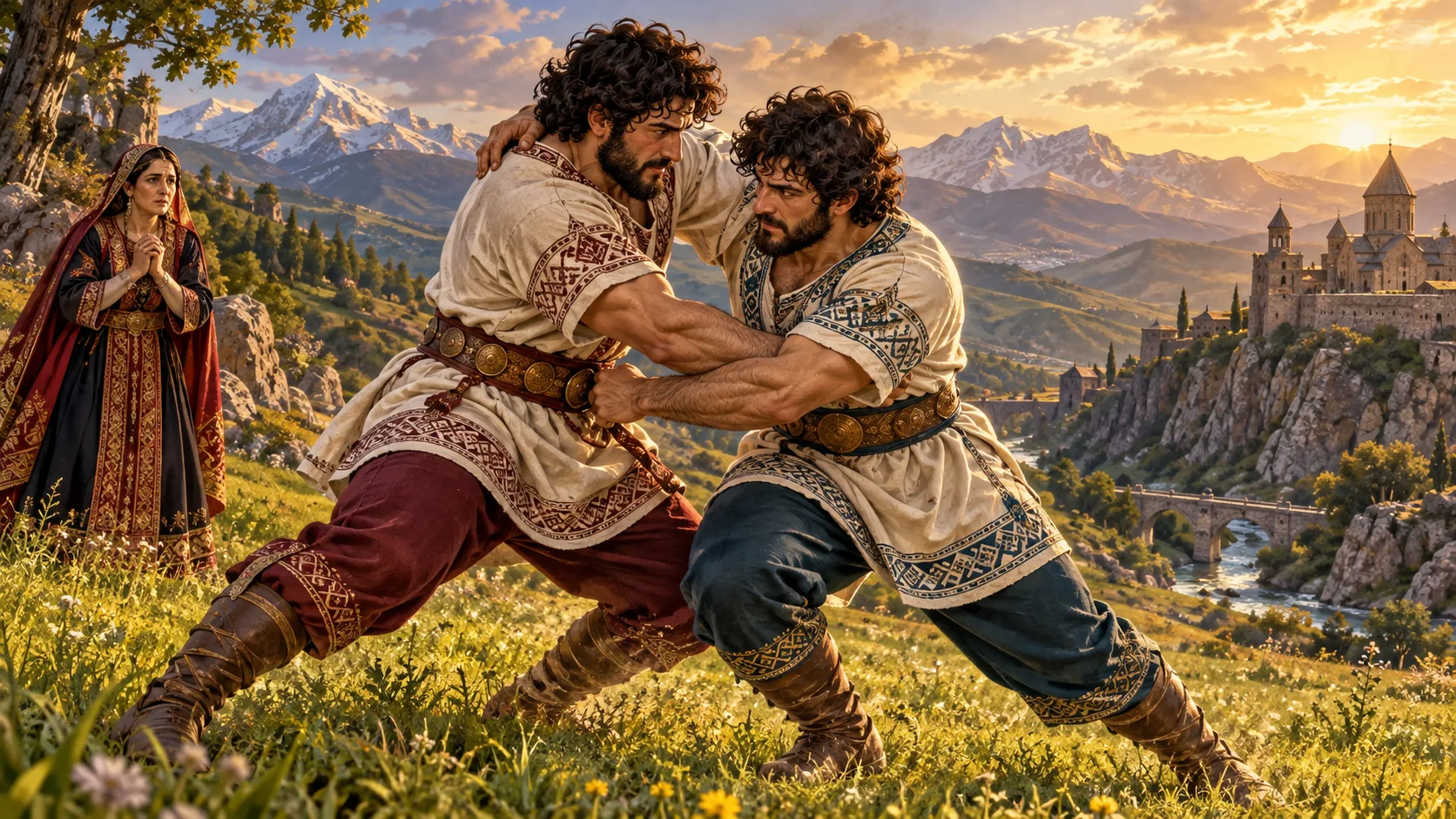
In the meadow they dismounted,
Grappled and began belt-wrestling.
They seized one another by the collar
And struggled until midday.

Their mother wondered:
“What has happened? They have not returned.”
As she came out, their cries echoed among the rocks,
And the earth shook beneath their feet.
She went to them and saw their plight.
She beat her knees; her strength gave way.
She sat watching:
Neither brother could overcome the other,
Neither could throw the other down.
Sanasar was only playing,
But Baghdasar was striking in earnest.

Their mother saw Baghdasar weakening,
His strength ebbing, defeat approaching.
She wept and cried out in song:

“O mountains, O rocks, O bushes,
Carry word to their uncle:
Let him come to his mighty warriors!”

She watched another hour.
When Baghdasar seemed about to fall,
She wept and sang:

“O seas, O waves,
Carry word to their uncle:
Let him come to his sister's sons!”

They battered each other until evening,
Yet neither threw the other to the ground.
At dusk they stopped and went home.
On the way Baghdasar said:
“Tomorrow we shall come and face each other again.”
They returned home and slept until dawn.

In the morning they rose and ate,
Led out their horses,
Took their maces and strapped on their shields,
Mounted and rode to the field of combat.
Their mother followed them.
She sat there weeping,
And cursed the sorceress:

“May the one who caused this never prosper!
Since the first light of morning my two sons
Have seized each other by the throat;
They will strike and maim one another.”

The brothers fought on horseback with their maces.
Sanasar took his place by the target stone.
Baghdasar hurled his mace,
Aiming in earnest to kill him.
The mace flew over Sanasar's head.
Sanasar caught it and threw it back,
Taking care that it did not reach his brother.
Baghdasar seized it and hurled it again.
Again Sanasar caught it and returned it.
Sanasar's heart was pure and open:
He would not strike Baghdasar in earnest,
Would not hurt his brother.
He merely raised his shield
To keep the blows from reaching him.
Baghdasar struck with all his might,
Seeking to knock Sanasar from his horse,
To kill his brother there with a single blow.
Sanasar's mace, meanwhile, flew harmlessly above him.
“Perhaps he will tire of this,” Sanasar thought.
But Baghdasar kept striking without pause.
“He will not stop,” Sanasar told himself.
They fought through noon
And on towards evening.

Sanasar thought:
“His anger still has not cooled.
As far as I can see,
He truly means to strike me down.
Let us see whether he is as strong as I am.
He aims to kill me,
And I turn aside his blows
So that they cannot reach my body.
Now let me strike him once.
Can he ward off my blow,
Stand firm and withstand it?”

Sanasar struck Baghdasar gently,
With one light blow.
Baghdasar raised his shield,
But could not withstand the impact.
The blow knocked him from his horse.
Sanasar cried:
“Alas, what have I done?
I did not know the measure of my strength,
The power in my hands!
I have struck my brother dead!”
He sprang down from his horse.
He came from one side, their mother from the other,
And weeping, they flung themselves over Baghdasar.
They found he was not dead:
The mace had struck his leg,
And he lay unconscious.

Sanasar carried his brother home on his back.
He rubbed his chest and worked about his navel.
He saw the portrait still in his pocket.
He sat beside him weeping until dawn.
At daybreak Baghdasar came to himself and sat up.
Sanasar asked:
“Brother, what happened? Why did you fall like that?”
“My leg hurt,” he answered, “and I lost consciousness.”

Sanasar said:
“Brother, is this portrait, this letter,
The reason you are angry and will not speak to me?
I would give my life for you.
I do not want her. Go and fetch her for yourself.”
Baghdasar answered:
“Brother, I did not know
You were so much stronger than I am.
Let us be reconciled. You surpass me in might.
I repent: never again shall I raise my hand against you.
I am your younger brother, you are my elder;
Whatever you tell me, I shall listen.
You have my blessing:
Go and bring that maiden home as your wife.”
“I will not go,” Sanasar said.
“You go and bring her for yourself.”
“Do not delay,” Baghdasar replied.
“Make ready, mount your horse,
Call upon your God and set out.”
“I will not go and fetch her.
She is a sorceress, an enchantress.”
“I tell you, go and bring her!
She heard that we were men of great renown
And sent her letter because of our fame.
If you do not go and bring her back,
We shall look small in everyone's eyes.
They will say we were unable
Even to fetch a maiden for ourselves.
It cannot be that you refuse to go.
Get up, go and bring that girl!”
Section 5

Section 5

5

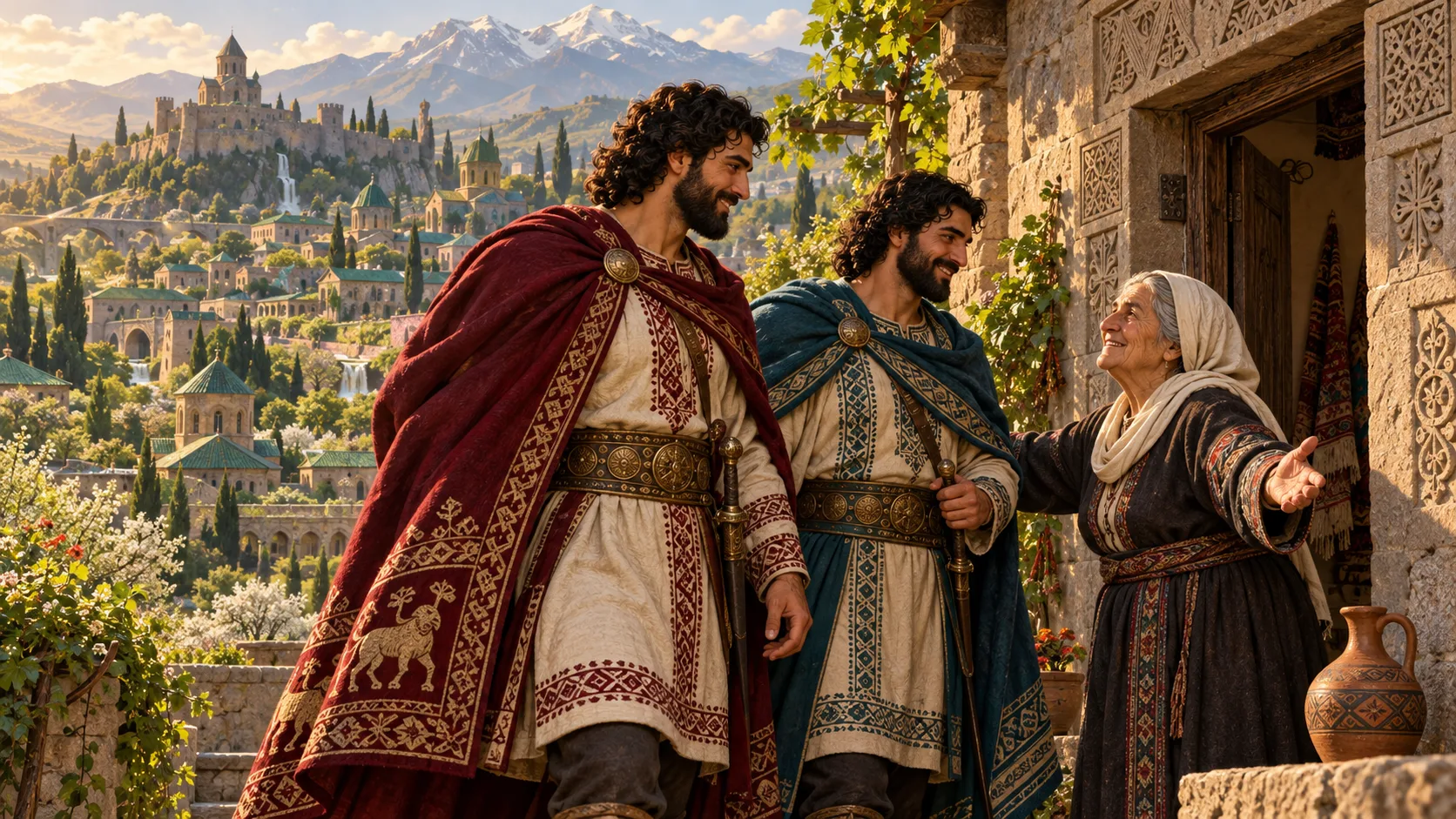
Sanasar went to his mother, Lady Tsovinar.
“Mother, make ready for my journey.
I must go to the land of the Kajs;
That letter came to summon me.”
“Do not go, son,” she said.
“We barely escaped from the land of Baghdad.”
“No, I must go,” he answered,
“Even if it costs me my life.”

His mother finished the preparations.
As Sanasar was about to leave,
He kissed her hand and said farewell.
He sprang onto his horse,
Stopped upon the road and called:
“Baghdasar, my dear brother,
Come, let me see you before I leave.
You stay here;
I am going to seek that maiden.
If I return within three days, all is well.
If I do not, I shall be in trouble;
Come after me and help me.”
They asked each other's forgiveness,
Made their peace and exchanged rings.
Sanasar said goodbye and rode away.

A journey of forty days
He covered in a single day.
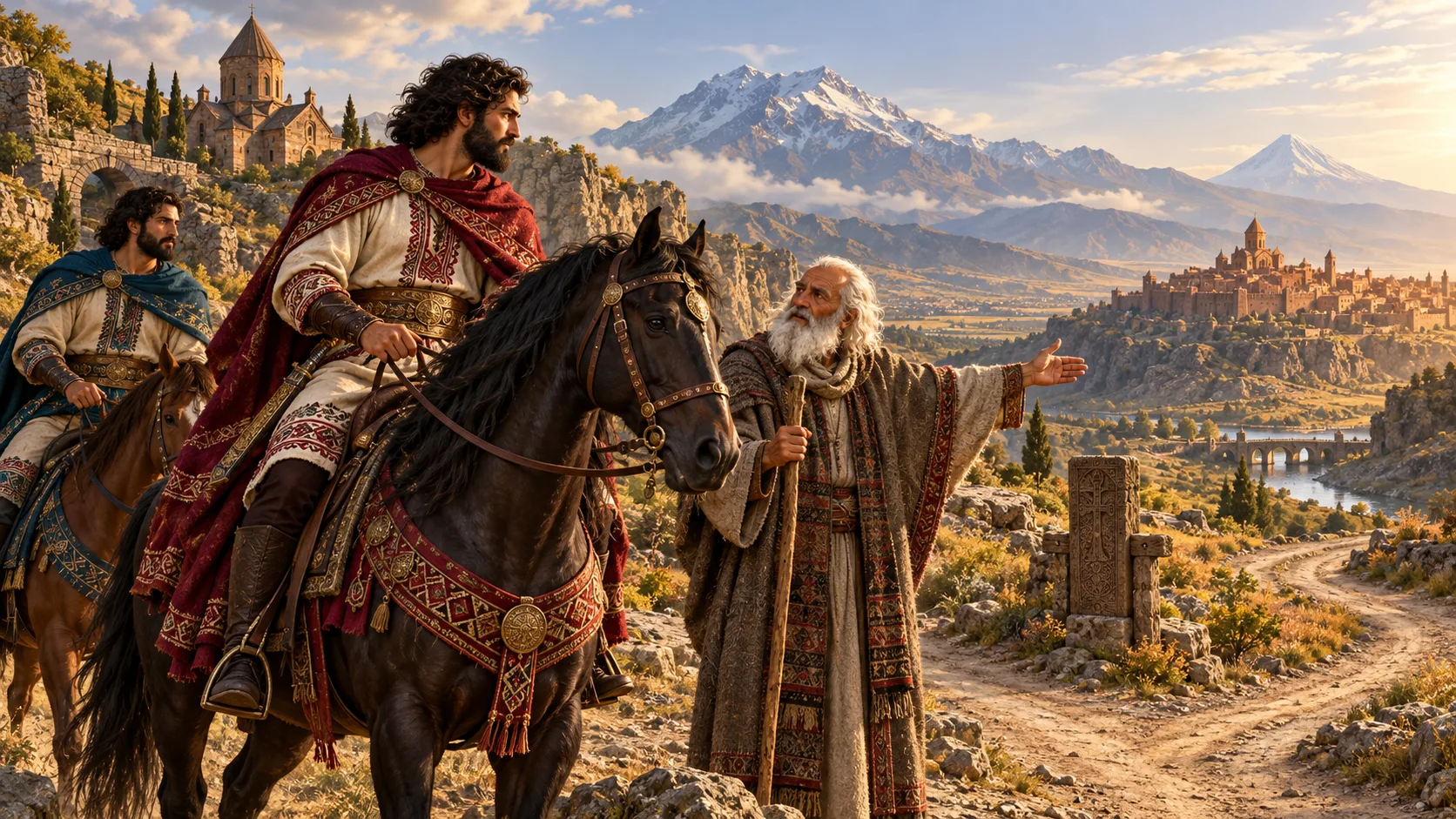
He reached a meeting of roads
Where an old, white-haired man was sitting.
“Greetings, father,” Sanasar said.
“God's blessing on you, Sanasar,” the old man replied.
“Dismount: I have something to tell you.”
“Grandfather, who are you,
That you know I am Sanasar?”
“I am God's angel.
I sit here to show travellers their roads.
Where are you bound, Sanasar?”
“For the land of the Kajs.
Show me a good road to it.”
The old man answered:
“Take this road and you will become a great king.
Take the other and you will become a merchant.
But if you go to the land of the Kajs,
You will meet with harm.”
“That is where I must go,” said Sanasar,
“Even if I knew they would cut my neck in three places.
If you have any other counsel, tell me.”
“Son, wherever you ride,
Greet everything that meets you:
Rock or bush, tame animal or wild beast.
Pass nothing without a greeting.
If you do, that enchanted land
Will bring great harm upon you.”
Sanasar bade him farewell,
Mounted and rode towards the land of the Kajs.

How far he travelled, God alone knows.
At last he entered the king's domain
And saw a shepherd before his flock.
That shepherd was the king's own,
One of his mighty champions.
He called to Sanasar:
“Young warrior, where are you going?”
“To the city of the king of the Kajs.”
“Come and sit here.
I shall milk the sheep; have some milk,
Then go on your way.”
“No, I am in haste. I must go.”
The shepherd said:
“No one passes this way
Without first taking milk. I will not allow it.”
He made Sanasar sit down.
He had a trough so large
That four men could swim in it.
He filled it with milk
And set it before Sanasar with bread.
What did the shepherd intend?
He was testing the strength of travellers.
From the way they drank the milk
He could judge how strong they were.
He tested everyone who came by that road,
Then sent them on to Deghdzun-Tsam,
Where the champions would kill them.

The shepherd set the full trough before Sanasar
And went to make a circuit of his sheep.
Before he had completed more than one round,
Sanasar shouted:
“Shepherd, come and take your trough!
Thank you; farewell. I must be off.”
The shepherd returned
And saw the milk gone and the trough overturned.
He trembled where he stood.
“Go safely, Sanasar. Have no fear.
Wherever you go, no man will overcome you.”

Sanasar rode to the Copper City.
What did he see beneath its walls?
Forty weary men who had lingered there so long
That their beards had grown and yellowed.
He greeted them:
“Greetings, elders,
White-bearded, red-bearded
And dark-bearded champions!”
They answered:
“God's blessing on you, young man.
By noon tomorrow you too will be as we are.”
One old man sighed:
“Alas, young warrior!
Have you too fallen into this unbeliever's hands?”
“Why, dear elder?” Sanasar asked.
“Why should I become like you?”
“We were brave young men like you
When we came to seek that maiden.
Before we knew it, we had become as you see us.”
“Tell me, brothers, what happened
To bring you to this condition?”
“She has her tricks; she is a sorceress.
Wait a little and you will see.
That unbeliever has a bird.
It will settle on the wall and cry out,
And you will turn into an old man of our age.”

Sanasar was wise enough not to enter the city.
He turned his horse and withdrew a little way,
Waiting for darkness to fall upon the earth.
Section 6

Section 6

6

When night fell, he returned to the city.
He gathered Kurkik Jalali's reins,
Gave his horse room for a run,
Called on God and pressed his spurs.
In one leap they cleared the copper rampart
And landed inside the city.
There was no open gate;
He had to leap over the wall.
He wandered a long while through the streets,
Finding no place where he wished to stay.
At the edge of the city he discovered an Armenian's inn
And stopped there.
A white-bearded old man kept it.
“Dear elder, what do you charge?” he asked.
“One silver coin for the horse, son,
And half a silver coin for its rider.”
“I shall give you two for my horse
And three for myself,” Sanasar said,
Setting his own worth above the horse's.
“Take good care of my mount.”
He tethered Kurkik Jalali there
And went out to explore the city.
He bought a loaf at a bakery,
Returned to the inn and sat beside the old man.

It was night. When he had eaten, he said:
“Elder, tell a tale for us to hear.”
“I know none,” the old man answered.
“Then let me ask you something.”
“What would you ask, son?”
“What is this city called?”
“Son, they call it the Copper City.”
“So this is the Copper City?”
“Yes, this is the place.”
Sanasar asked:
“The king here has a daughter.
What sort of girl is she?”
“What is that to you, son?
Let her be whatever she is.”
“I was merely asking, grandfather.”
The old man said:
“Our king's daughter practises enchantment.
Many princes have come to marry her.
She bewitched them and cast them out among the hills,
One here, another there.
Surely you have not come to seek her hand?
You look too fine a youth to waste your life.
If that is why you came, leave it alone.
Turn back; spare yourself.
Many have tried and failed.”
“No, grandfather, that is not why I came.
What have I to do with her?
But can her spell not be broken?
May God have mercy on your father:
Tell me truly what her enchantment is.”
“Her magic lies in the sea.
There is a jewel in the mouth of a dragon beneath it.
A man of fire must enter that sea
And take the jewel from the dragon's mouth;
Then, rising in the morning,
He must see the maiden unclothed in her chamber.
That is how her spell is broken.
Her magic will no longer work upon him,
And he can take her away as his wife.”

“Grandfather, could you show me her palace?”
“Why concern yourself with such things?”
Sanasar pleaded:
“Dear elder, for God's love,
I am a visitor from a distant country.
Show it to me, let me look,
So that when I return home
I may tell them what a city I have seen.”
The old man took him onto the roof,
Stretched out his hand and said:
“Do you see those dark windows and dark buildings?
That is the princess's palace.
Black curtains cover the windows
To keep her from looking outside.”
“Grandfather, what shines there like a lamp?”
“That is a golden apple, son,
Fixed at the top of her gateway.
There is also a mace on that tower.
Whoever can bring the apple down and tuck it in his bosom,
Then leap up on horseback and put it back;
Whoever has strength enough to cast the mace from the tower,
Take the jewel from the dragon's mouth,
And face the king in battle like a warrior,
Will win the maiden for his wife.”
“Oh, elder, who am I to attempt such things?
I only asked you a question.
When I travel to other lands,
I can tell them what the Copper City is like.
Come, let us go down. I am sleepy.”
They returned to the inn,
Spread their bedding and lay down.

The old man slept, but Sanasar could not.
“By the Cross,” he thought,
“If that is so, I must try tonight.”
He waited until the old man was asleep,
The streets grew quiet and the people thinned out.
Then he rose, turned towards the place of prayer,
And knelt three times before God.
He mounted his horse and rode out of the inn.
Moonlight made the night as bright as day.
He called God's name
And invoked the Cross of War.
He rode to and fro across the square to warm his horse,
Then pressed the spurs into its sides.
The horse surged forward and leapt to the gateway's crest.
Sanasar seized the golden apple and tucked it into his bosom.
He raced an hour's journey away,
Then turned and came back to the square.
Again he urged the horse into a leap,
This time to the tower's summit.
Calling on God and the Cross of War,
He seized the mace,
Wrenched it loose and hurled it away.
It flew half an hour's journey,
Struck the dry summer earth
And buried itself a gaz deep.
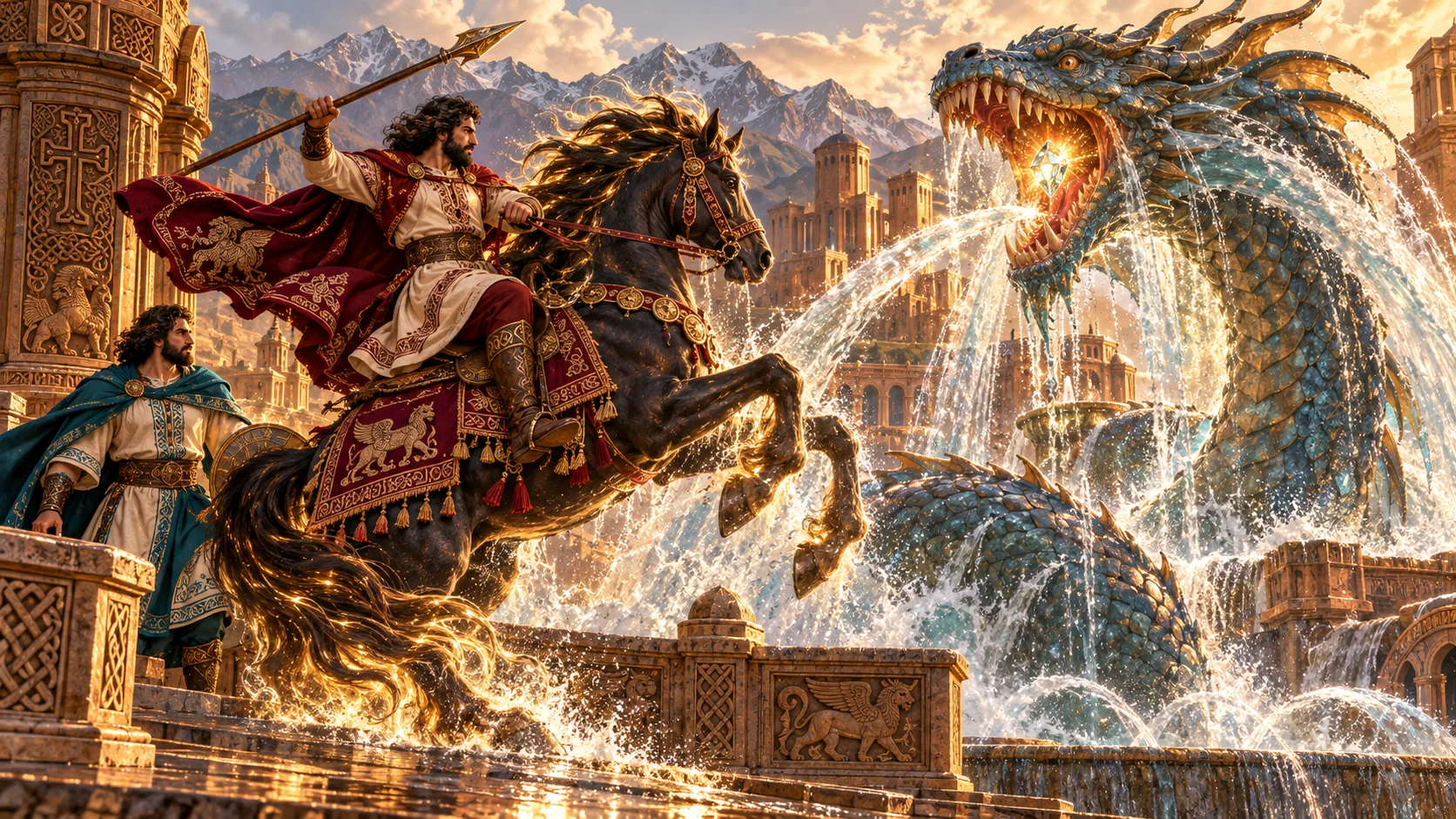
Then he rode into the sea and down beneath its waters.
He saw the dragon lifting its head,
Took his place above it
And struck its head with his mace.
The dragon shuddered;
The jewel flew from its mouth into the open fields.
The dragon shook again, sending water into the city.
It drenched the streets like falling rain.
The sea raged; a dragon-storm swept the city.
Sanasar returned to the inn,
Curled up in a corner and slept until dawn.

At first light the people saw
That Deghdzun-Tsam's windows stood open,
Their light spreading across the city.
Sanasar woke and climbed onto the roof.
Through the open windows
He saw the maiden in her chamber.
Her enchantment had been broken.
He turned to the innkeeper and said:
“Grandfather, a wind rose during the night.
A black cloud came from the direction of Sasun,
And rain from it soaked the city.”
Section 7

Section 7

7

The king ordered a proclamation:
“Find whoever took the jewel from the dragon's mouth.
Search everywhere for the stranger
Who broke off my daughter's golden apple and carried it away.
Seize him and bring him here to be beheaded.”
The heralds searched the city for two hours
But found no one.
They entered the old man's inn and asked:
“Innkeeper, is there a stranger here?”
“No one came last night except that boy.
He lay down and slept as soon as he arrived.”
The old man had thought little of the youth.
When he said there was no stranger,
Sanasar spoke up:
“Why say that? I am a stranger here.”
The old man grew cross:
“Be quiet! They will take you away and kill you.”
“Why should they kill me?” Sanasar asked.
He called to the heralds:
“Brothers, I am a stranger. What do you wish to know?”
They looked at the fine young man
And felt compassion for him.
“Lad, let us hide you,” they said.
“Do not appear before our king. It would be a pity to lose you.”
“What is wrong with the king?
Why should I not go before him?”
“Someone took his daughter's golden apple last night.
The king has ordered that whoever has it
Must prove himself a warrior and fight for his life.
If he cannot, they will cut off his head.”
Sanasar reached into his clothing,
Took out the golden apple and showed them.
“Heralds, go and tell the king
You have found the man who took his apple.”

They went and told the king.
“Go and order him here,” the king replied.
“He is the king's prisoner.”
They returned to Sanasar:
“You are the king's prisoner.
Come and surrender yourself to him.”
“The king? What king?
Yes, yes, I demand battle with your king!
God will grant victory to him or to me.
Why should I come to surrender?
I seek a fight, and fight I shall.”
When the king heard this, he said:
“Very well. Whoever did this did it for my daughter.
Let him come and explain what he has done,
And I shall give her to him.”

Sanasar came and declared:
“It was I.”
“You did this?” the king asked.
“Yes, I did.”
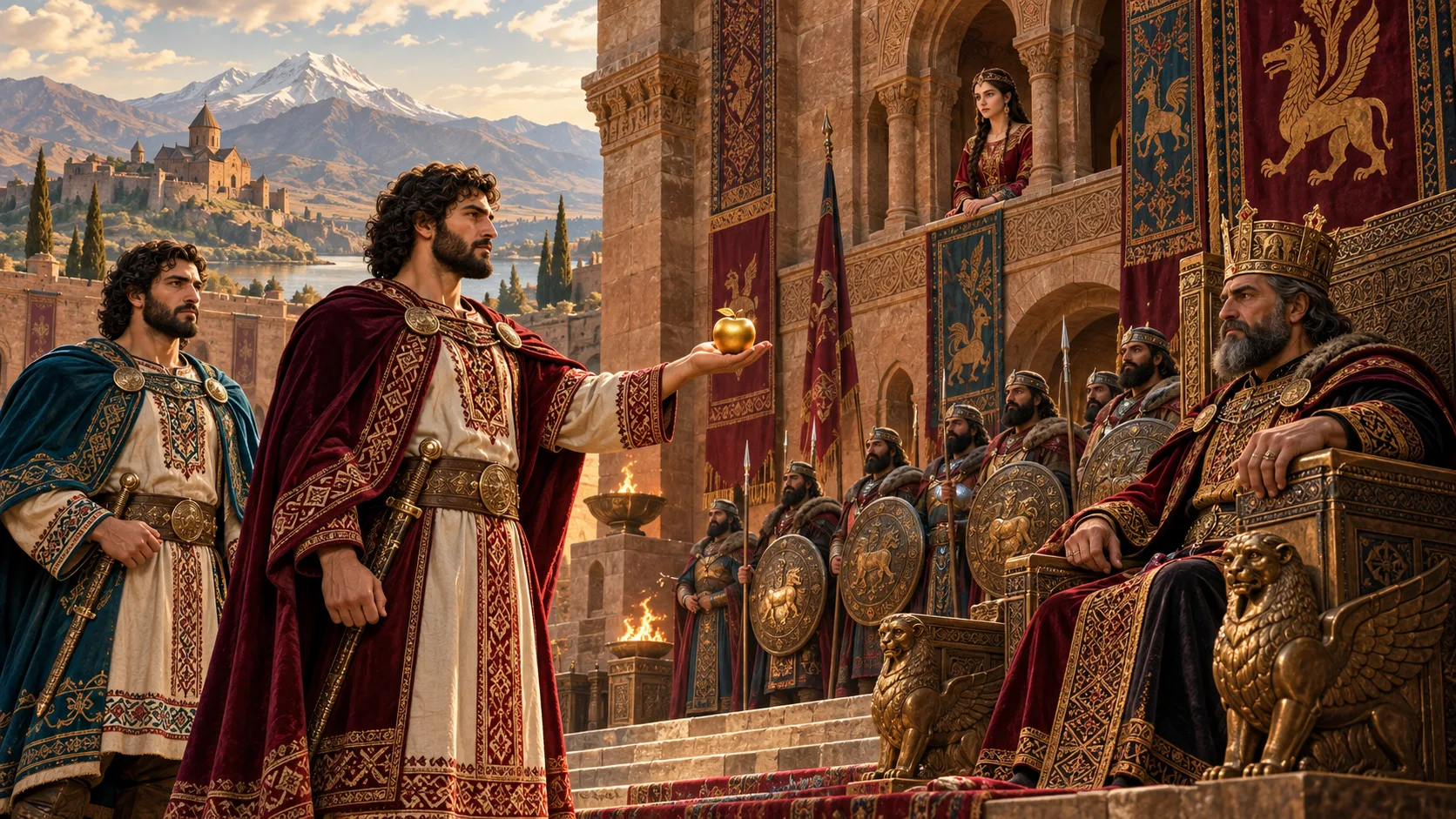
“Then just as you brought the apple down,
Take it back to the top of the gateway in daylight.
Let us see you do it,
And my daughter shall be yours.
Otherwise I shall have your head.”

Sanasar mounted and rode into the square.
He rode back and forth to rouse his horse,
Then leapt to the gateway's crest
And set the apple back in place.
He raced an hour's distance away,
Turned and returned to the king.
“That is done,” the king said.
“But the skill belongs to your horse, not to you.
Now take the mace you pulled from the tower
And hurled to the ground.
Lift it up again and cast it onto the tower,
Where we can watch you do it.
Then I shall give you my daughter;
Otherwise I shall have your head.”

Sanasar went and picked up the mace.
He swung it above his arm and threw it
Onto the top of the tower.
The impact brought the tower crashing down.
The king said:
“You seem a strong and capable warrior.
That makes three trials.
I have sixty champions chained in prison.
I shall release them, and you shall fight.
Defeat all sixty,
And you may take my daughter.”

Sanasar thought:
“I promised to remain here only three days.
Will the king send his champions against me
One by one, or all together?”
He asked:
“King, will you bring out the sixty at once
Or one at a time?”
“Sanasar, if I release them all together,
They will scatter you in pieces.
I shall send them one by one to fight you.
If you win, I shall give you the girl.
If not, they will kill you.”

“Long life to you, king,” Sanasar said,
“But I cannot stay here to fight for sixty days.
Release all sixty at once.
God will give victory either to me or to them.”
“All sixty together?
They will tear you apart!
Have pity on yourself; stay and fight for sixty days.”
“No, king, I cannot remain so long.
Bring out your sixty champions together.”

The king sent word to release them all.
Sanasar mounted Kurkik Jalali,
Drew the Lightning Sword and stood in the field.
The champions roared like buffaloes
And advanced upon him.
They charged from their side, Sanasar from his,
And clashed in battle.
Deghdzun-Tsam watched from her window.
Sanasar plunged among the champions,
Striking with his sword;
They could scarcely approach him.
The fighting lasted until evening.
He beheaded twenty champions.
The others continued through the night,
Thinking: “In the dark we shall strike and kill him.”
Before dawn he killed ten more.
They fought from morning until evening;
He killed another ten, leaving twenty.

Bodies lay all around;
Blood gathered in the middle.
Sanasar was trapped in it.
He could not get clear of the blood,
But his enemies could not kill him either.
They circled him,
Afraid to come close.
His hands grew cramped and numb.
He could no longer fight with his former strength,
Yet still defended himself.
So the battle stood.

Let us turn now to Baghdasar.
Section 8

Section 8

8

Baghdasar was still in Sasun.
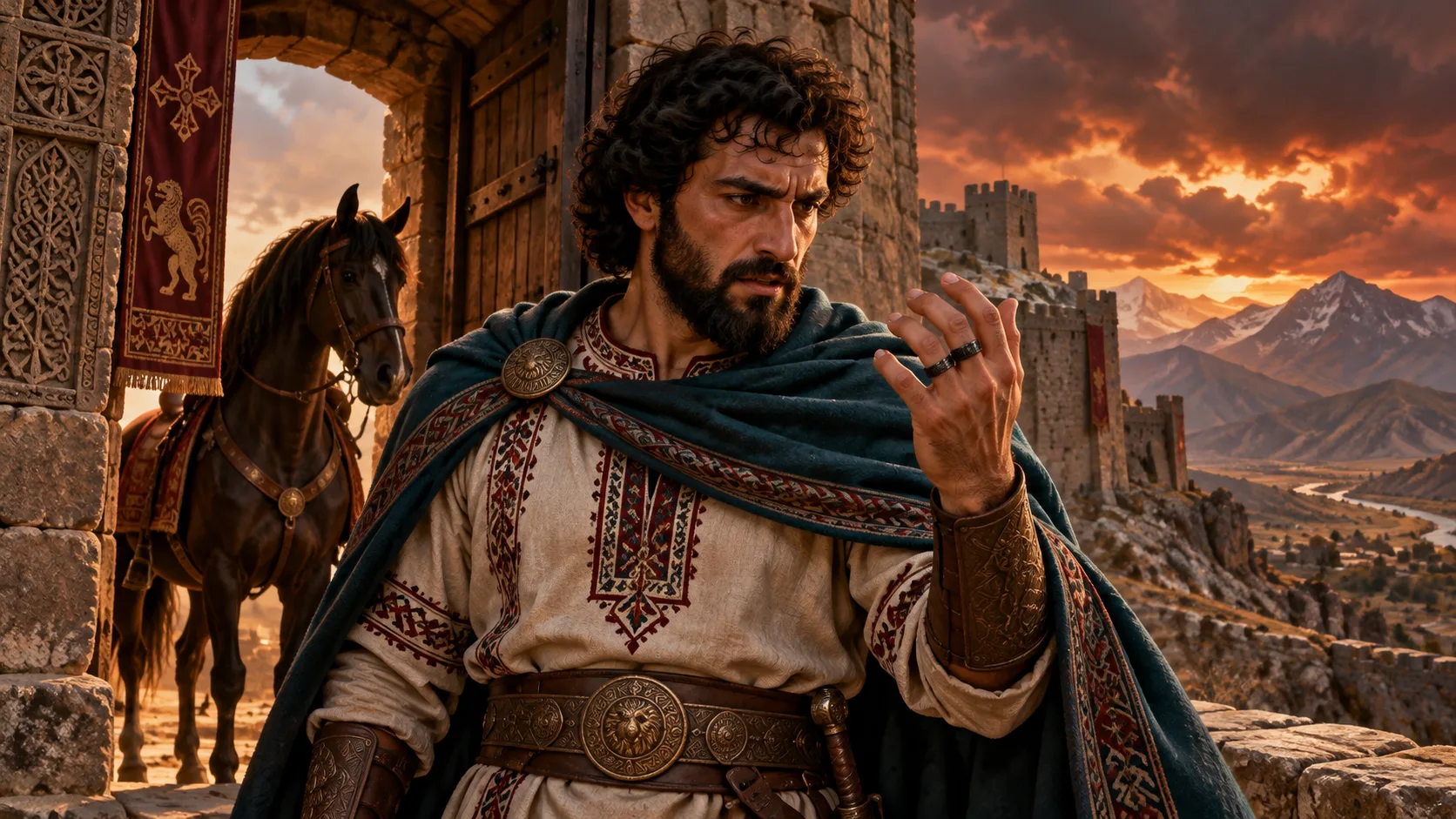
One morning, as he washed,
He glanced at Sanasar's ring,
The one they had exchanged before parting.
It had turned black upon his finger.
“Hurry!” he cried. “Bring out my horse.
I must ride to my brother!”
Outside he saw that the cloud had darkened.
He ran back indoors.
“Alas, Mother, my brother is in great distress!”
“How do you know?” she asked.
“An old man once showed us that cloud.
He told us: ‘If it darkens while you brothers are apart,
Know that one of you is in danger.
Hasten to one another's aid.’
I must reach him quickly.”
“Son, be patient,” she said.
“Those who have patience have life.
Come and eat a little,
Then go to your brother.”

He led out his fiery horse,
Saddled it and took his mace.
He mounted, called upon God and rode away,
Forgetting even to eat.

When he reached the mountains,
The giant shepherd saw
A horseman approaching like the wind.
“That must be Sanasar's brother,” he thought.
He stepped forward and said:
“Horseman, come and have some fresh milk.
Sit, rest awhile, then continue.”
“Are you a devil?” Baghdasar answered.
“My brother may be dying,
And you invite me to drink milk! I must go.”
“It is no use,” the shepherd replied.
“You cannot pass without drinking first.”
Seeing that otherwise there would be a fight,
Baghdasar sat down.
The shepherd filled his trough with milk,
Set it before him with bread,
And went to walk around his flock.
He made seven circuits
Before Baghdasar finished the milk,
Turned the trough over and called:
“Shepherd, take away your trough. I am leaving!”
The shepherd came and told him:
“Baghdasar, your brother has seven times your strength.
Never set yourself against him.
Go: he has slain forty champions.
Twenty remain for you to kill,
And then you will both return.
Have no fear;
No man can prevail against the two of you.”

Baghdasar rode to the walls of the Copper City.
There stood the forty old men,
So aged that their beards, clothes and very appearance
Had all turned yellow.
He greeted them:
“Greetings, men with white beards,
Red beards and dark beards.”
The old man answered:
“Alas, brave young fellow!
Have you too come to fall into that unbeliever's hands?”
“Why should I fall into her hands?”
“Remain here an hour, son,
And her bird will come and cry out.
You too will become a man of our age.”
Baghdasar asked:
“Dear elder, did you see a young man like me
Pass here yesterday or the day before?”
The men replied:
“A man like you passed the day before yesterday,
Only stronger and mightier.
He rode a fiery horse
That leapt with him into the city.
Until today we could hear him fighting,
Hear the champions in battle.
Today no sound has reached us.
We do not know what became of him.”
“Alas, that was my brother!” Baghdasar cried.
“If his fighting can no longer be heard,
They have killed him.
I swear I shall begin the slaughter here,
Lay waste this city
And avenge my brother!”

He left the men behind and rode on.
Whatever he encountered,
Whether cattle or people,
He struck down.
With one blow of his mace he broke the wall,
Entered the city and approached the fighting.
Sanasar still faced the twenty champions.
He was so exhausted
That he could barely defend himself.
Blood covered his eyes as he swung his sword.
Baghdasar rode past the maiden's window.
“Girl, which way is the battle?”
She recognised him and answered:
“Over there, towards the city.”
He spurred on and plunged into the struggle,
Cutting down the champions from one side.
Then he shouted:
“Sanasar! Brother!”
Sanasar realised his brother had arrived.
“Blessed be God!” he said.
“My helper is here; I need fear no more.”
He called:
“Welcome, Brother Baghdasar!
Is it you? Have you come to help me?”
“Yes, it is I.
Hold them on that side,
While I strike them down from this one.”
He went to his brother,
Pulled him out of the blood and washed him.
When Sanasar could see again, he asked:
“Where are the twenty champions who were left?”
“I have killed them,” Baghdasar replied.

They went before the king.
Seeing the two brothers, he said:
“That was the fourth trial.
Now you must go to the Green City,
Then return to take the maiden.”
Section 9

Section 9

9

“Green City, where are you? Here we come!”
They travelled over dry, barren stretches of land,
Entered the city and wandered through it.
At last they knocked at an old woman's door.
She came and asked: “Who is there?”
“Two young strangers, grandmother.
Will you receive guests?”
“Why should I not, sons? A guest belongs to God.”

She opened the door and brought them inside.
“I have no children,” she said.
“You shall be my sons and I your mother.
We shall live together; God will provide our bread.”

At dawn Sanasar said to Baghdasar:
“Why did the king of the Kajs send us here?
What are we supposed to do?”
“Brother, let us walk about the city,” Baghdasar replied.
“We shall do whatever God puts before us
And see how it ends.”
They left their horses and weapons with the old woman
And went out into the streets.

They stopped at the royal stables.
The master of the stables came and asked:
“Who are you fellows? Would you work as grooms?”
“We are strangers here, and we would.”
“Do you know how to groom horses?”
“Yes, we do.”
He led them inside.
“Make the horses' quarters ready.”
Sanasar took a broom and Baghdasar a shovel,
And together they cleaned the stalls.
“Now groom the horses,” the stable master said.
“Where are the currycombs?” Sanasar asked.
“On that shelf,” he replied, and went out.
Every currycomb Sanasar touched
Crumbled to dust in his hands.
Looking about, he saw a large object
That seemed to him a kind of currycomb.
It was a copper watering trough,
Now filled with barley for the horses.
He emptied the grain onto the floor,
Picked up the trough and began to groom them.
With a single scrape along a horse's back,
He stripped off its hide and cast it beyond the tail.

The stable master returned and cried:
“What have you done?”
“We have groomed them.”
“May your house fall in ruins!
You have killed every horse!”
He went to the king and reported what had happened.
“What shall we do with these men?
Their strength is monstrous.”
“Let them remain,” the king said.
“Tomorrow we shall send them up the mountain
To fight the dragon.”

The brothers returned to the old woman's home.
Towards evening Baghdasar said:
“Grandmother, I am thirsty. Give me a little water.”
“Alas, my dear, there is no water left.”
“What do you mean?”
She answered:
“My dear son, the Green City has no water.
There is a spring on the mountain,
But a dragon has settled over its mouth
And will not let the water flow down to us.
We dare not go near it.
Every week we must give it an unmarried maiden to devour,
And only then will it release the water.
Otherwise the people would die of thirst
And our city would perish.
There is a girl staying with the king;
Tomorrow it will be her turn.”
“Grandmother, can you not kill the dragon?”
“Son, how could anyone kill it?
The king has attacked it with his soldiers time and again,
But has achieved nothing.”

At daybreak the old woman said:
“Hear the cries outside!
They must be taking the girl to the dragon.”
The brothers looked and saw that it was so.
A maiden beautiful as the moon,
Dressed in black from head to foot,
Was being led weeping towards the spring.
Women followed with pitchers to collect water.
The two brothers went after them.
When they were outside the city,
They were told:
“Take this girl to the dragon.
Fight it and kill it.”
They said to the king:
“What shall we fight with?
We have no weapons with us.”
“That is for you to decide,” he answered.

Baghdasar said to Sanasar:
“In that large house nearby
There are two round stones, each with a hole through it.
Let us put our arms through the holes
And take the stones with us.”
They went and fetched them.

The owners complained to the king:
“We spent so much on those stones
And barely managed to bring them here.
These men will carry them up the mountain and abandon them;
We shall never be able to get them back.”
“Will you return them?” the king asked the brothers.
“Yes. We shall take them and bring them back.”

They took the stones and the maiden
Up to the place where the girls were usually tied.
“Do not be afraid,” they told her.
“Stay here while we take our places,
One above the dragon, the other below.”
The girl thought:
“I shall run away
And leave the dragon to eat them instead.”
The dragon was not yet in sight,
And the brothers saw her trying to escape.
They caught her and tied her there.
Sanasar told his brother:
“You stand above; I shall stand below.
If I were above and threw my stone,
I fear you could not catch it.
When the dragon comes out, we shall strike and kill it.
But be careful, brother:
We must not lose the stones down the ravine.”

Suddenly a roar echoed through the mountains.
They saw an enormous beast approaching,
As tall as a buffalo and as long as five.
From a distance the dragon saw
Not one meal waiting, but three.
Delighted, it sharpened its teeth and opened its jaws.
Hissing and coiling its tail,
It came towards the maiden to swallow her.
Her jaws locked in terror; she could not speak.
She wept, hot tears running down her cheeks.
The dragon came close.
Baghdasar hurled a stone.
It struck the beast but did not bring it down.
“Catch my stone!” he called to his brother.
Sanasar threw his own and shattered the dragon's side;
The stone did not reach Baghdasar.
They closed in and crushed its head with their stones,
Then picked them up and returned to the girl.
They untied her.
“You may go home now,” they said.
The bloodied dragon fell dead.
The mouths of the springs opened,
And water came pouring down in abundance.
Everyone carried away as much as they needed.
“Let us throw the stones into the ravine and leave,”
Baghdasar said to Sanasar.
“Brother, spare those Armenians the trouble.
They cannot bring the stones back.
Let us carry them to their owners.”

They took up the stones
And returned to the city with the maiden.
She told the king everything she had seen.

The king summoned the brothers:
“Did you bring back the stones?”
“Yes, we left them at the door.
Let their owners come and put them in their places.
We do not know where they belong.
We have brought them this far;
They can carry them the rest of the way.”
“They cannot carry them inside,” said the king.
“How did they get them in before?”
“They harnessed buffaloes and horses
To drag the stones into place
When they built their oil press.”
Sanasar said:
“Then let them come with us,
Open the doors and show us the places.
We shall put the stones back ourselves.”
The owners went with them and showed them where.
The brothers restored the stones
And returned to the old woman's house.

The next day the king called them again.
“Ask for anything, and I shall give it to you.”
Baghdasar answered:
“We want nothing but the girl we rescued.”
The king asked again:
“Baghdasar, what would you have me give you?”
Three times the king made the offer;
Three times Baghdasar asked for nothing else.
Then the king said:
“If you seek nothing more,
The maiden you saved is already yours.
Come, Baghdasar, let me arrange your wedding.”
“I have no time to marry now,” Baghdasar replied.
So they brought the maiden
And betrothed her to him.

Section 10

Section 10

10

The brothers said farewell to the Green City
And returned to the Copper City.
They rode to the king's gate,
Ready to take Deghdzun away by force.
The king said:
“Sanasar, Deghdzun is in her castle outside the city.
The demon Hamtol guards her door.
Go and take her, if you can.”

Baghdasar remained in the city.
Sanasar, the daredevil of Sasun,
Took his weapons, mounted and rode away.
He saw a white castle standing on a rock.
“Let me see whether that is Deghdzun's castle,” he thought,
And made towards it.
At the entrance he found an immense gate.
“Open the door!” he shouted.
From within, Hamtol the demon answered:
“Who are you, that I should open it?”
“Have you not heard my name?”
“What is your name?” Hamtol asked.
“You do not know it?”
“No, I do not.”
“Neither do I,” Sanasar said.
“I only heard something from my mother.”
“What did you hear?”
“When I was a child,
My mother would toss me in the air
And call me Hamtol's doom.”
“If you are my doom,” said Hamtol,
“Put a finger through the crack in the door.”
“Here is my whole hand,” Sanasar answered,
And stretched his arm through.

Hamtol marvelled at the hand.
He gripped it in his own and squeezed,
But to the daredevil of Sasun
It felt no worse than a flea's bite.
He could do Sanasar no harm.
“Now give me your hand, Hamtol,” Sanasar said.
Hamtol held it out.
Sanasar squeezed so hard
That blood, mingled with the milk Hamtol had suckled,
Was forced out beneath his fingernails.

Hamtol fled to Deghdzun.

“What is it, Hamtol? Why have you run here like this?”
“My lady, there is a man at the gate.
He told me to open it, but I refused.
He squeezed my hand until my mother's milk
Ran out beneath my fingernails.”
“Could you not squeeze his hand?”
“He put it in mine,
But it was a timber beam, not a hand!”
“Did you ask his name?”
“I did. He said:
‘When I was little, my mother tossed me in the air
And called me Hamtol's doom.’”
“Perhaps he is one of the Daredevils of Sasun,” she said.
“Who are they?” Hamtol asked.
“Sanasar and Baghdasar.
They built that mighty house
And named it Sasun, the House of Sasun.”

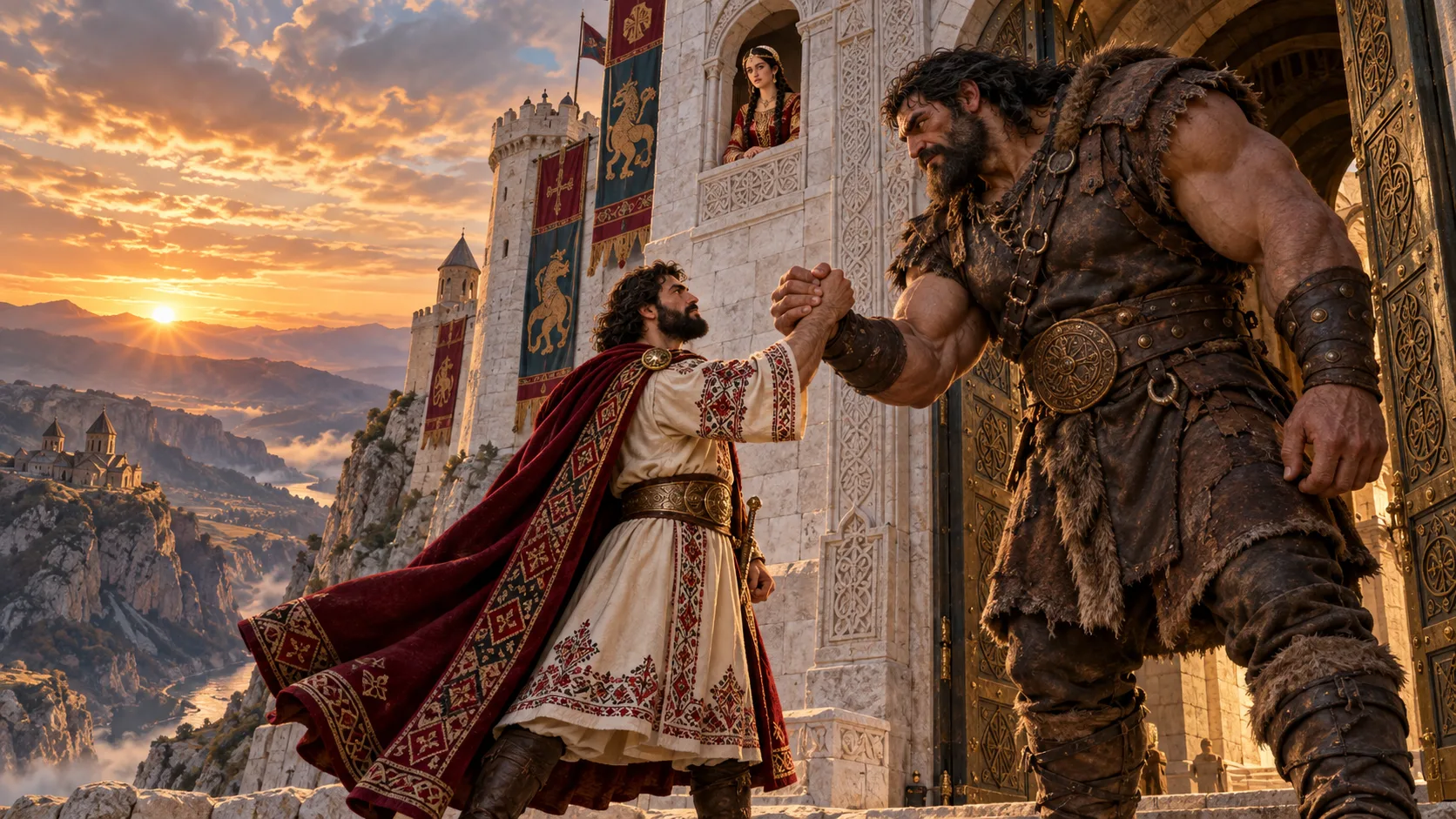
Clang! Clang! Sanasar pounded on the gate.
“Open up, or I shall pull down your gate and roof
Upon your head!”
Hamtol stood frozen with fear, unable to move.
Deghdzun looked from the window
And saw Sanasar, the daredevil of Sasun.
She slipped on her shoes,
Ran to open the door and said:
“You are welcome above all things, my lord!”
Sanasar dismounted.
They put their arms around one another
And entered the castle.
Hamtol fled outside, reduced to the likeness of a gnat.
Deghdzun said:
“I would give my life for your soul, your daylight!
What brings you, Sanasar? May it be good.”
“I have come to take you as my wife.”
“Gladly,” she answered.
“Where else could I find a warrior like you?”
As she stood before him, Sanasar saw
That she was seven times more beautiful
Than her portrait or the maiden in his dream.
There they exchanged rings.

Then Deghdzun-Tsam said:
“Sanasar, what a pity for your young life
That you came here after me!”
“Why do you pity me?”
“Because I fear they will kill you.
This is a land of enchantment.
Let us leave at night,
Without the city seeing or hearing of us.
If the people find out,
They will not let you take me away.”
He answered:
“I am not afraid. I shall leave by daylight.
There is no need for further argument.
If you will come by day,
Leap onto my horse and I shall take you.
If you will not, say so plainly,
And I shall return to Sasun.”
“How could I refuse?” Deghdzun replied.
“The life I have is yours in love.
I sent for you so that I could go with you.”

At once she sprang up behind him.
Sanasar urged his horse on, and they departed.
He greeted whatever they met:
Rock, bush or beast,
As they travelled towards the edge of the land.
There he encountered a foul creature
And passed without greeting it.
The creature rose towards the sky
And cried at the top of its voice:
“He has taken her! He has taken her!
Sanasar has carried off the maiden of the Forty Braids!”

A rock heard the cry and passed it to a bush,
The bush to a tree, the tree to an animal,
Until the news reached the city.
The people told one another;
All the city learned what had happened
And rose to fight.
Horsemen mounted in an ever-growing host
And pursued Sanasar.
The grains of sand in the sea could be counted,
The stars of the sky could be counted,
The plants upon the earth could be counted,
But those horsemen were beyond counting.

Sanasar left the maiden on a high mountaintop
And turned to meet the pursuing riders.
He drew the Lightning Sword and invoked:
“I call upon You, living Father,
And the Cross of War upon my right arm.”
Hungry and thirsty, he cut into their ranks.
Men from the city surrounded him
And gathered in force before the great gate.
Sanasar fought among them,
Striking them down and pressing forward.
Soon he saw men fleeing from the gate into the city,
While others fled out of the city towards the gate.
At the other end, Headstrong Baghdasar
Was advancing and cutting down their foes.

From afar Baghdasar noticed a rider in white,
Drenched in blood,
Slashing his way among the horsemen.
He shouted to him:
“Make ready! You must be the one who killed my brother.
When I reach you, I shall send your soul to God!”
He swung his mace and struck his brother in the chest.
Sanasar fell back onto his horse's rump,
But sprang quickly into the saddle again.
A second blow knocked him from his seat;
Again he straightened himself in the saddle.
Then he began to sing:

“Blessed and gracious God,
Great is the care of the heavenly King!
That stroke was like our Headstrong Baghdasar's,
That swing was like our Headstrong Baghdasar's!”

Hearing this, Baghdasar recognised his brother.
“You were covered in blood; I did not know you!
Why did you not recognise me
And call out before I struck you?”
Then he asked Sanasar:
“Did you bring back any game,
Or have you come empty-handed?”
“I brought the daughter of the king of the Kajs.
She is up on that high mountain.”
He led his brother to her
And signalled from a distance
That she should greet Baghdasar with a kiss upon his hand.
She did so at once.
Baghdasar was delighted.
“Little bride,” he said,
“Wash the blood from my brother's clothes.
The remaining soldiers are mine to deal with.”
He seized his spear,
Fell upon the mounted troops and cut them down.
Only those who had stayed at home were spared;
Not one escaped the battle to carry the news.

Thus the two brothers, attacking from opposite sides,
Destroyed the mounted host
And spread havoc through its ranks.
The king of the Kajs came and pleaded:
“For God's sake, Daredevils of Sasun,
Stop killing my people!
I shall give you whatever you ask.
If you want my daughter, take her.
If you want my kingdom, I shall give you that too.”
They answered:
“It is your daughter we want, and her we are taking.”
Section 11

Section 11

11

They brought the maiden to the forty old men.
They stopped, helped her dismount,
And set her before them.
Sanasar said:
“Girl, these forty men came because of you.
Your enchantment brought them to this state.
Now release them.
Restore them to the age they were
When they first arrived.”

Deghdzun-Tsam answered:
“They all came to win me.
If I restore their youth and strength,
They will rise against you.
Just take me away.”
“No, that cannot be,” Sanasar said.
So the maiden worked her magic
And summoned her bird.
At its cry, every man became
The age he had been upon arriving.
“Good!” said Sanasar.
He set the maiden aside,
Approached the men and told them:
“Valiant champions,
You all came for this maiden.
You intended to fight and win her.
We too came for her.
We two brothers fought and prevailed,
Then brought her here.
Now you have recovered your strength.
Let the maiden stand aside while we fight.
If you defeat the two of us, she shall remain with you.
If we defeat you, she shall remain with us.”
The men replied:
“Sanasar, Baghdasar,
It was you who set us free
And gave us back our vigour.
How could we now turn against you?
We dare not fight you.
Brothers, we shall not fight.
We shall return to our own countries.”

Sanasar asked:
“Brothers from distant lands,
Are you content that I take the maiden
And share my life with her?”
They answered:
“Take her, and may happiness be yours.
Our blessings on your marriage!”
The forty men said their farewells
And departed for their own lands,
Each returning to his home.
Sanasar and Baghdasar took the maiden
And set out for Sasun.
“Brother,” Sanasar said,
“You should marry Deghdzun.”
“No, I shall not,” Baghdasar replied.
“She sent her greetings twice to you.
You fought for her; you must marry her.
Who has ever heard or seen
A brother marry his brother's betrothed?
I shall marry my own promised bride,
The girl we rescued from the dragon.”

Whether they travelled far or only a little,
They met a rider dressed in blue,
Who shouted:
“Hey, you scoundrels!
That fairy beauty is meant for me.
Where are you taking her?”
Sanasar told his brother:
“Hold my horse's bridle.
I shall go and see what this rider wants.”
“You rascal!” Baghdasar answered.
“It is always you who goes.
This time it is my turn.”
“Then go,” said Sanasar.
“Why take offence?”

Baghdasar rode forward.
Words passed between them;
Both dismounted and sprang at one another.
Baghdasar lifted the stranger
And threw the rider to the ground.
At once the stranger opened her collar,
Bared her breasts and said:
“Baghdasar, the maiden you are taking is my sister.
Seven years ago I fled from her
And hid myself because of the spells
She kept casting on people.
I roamed the mountains like an outlaw,
Then went to the king of the Green City.
When I heard you had broken her enchantment
And taken her for Sanasar,
I came to you, for I am your betrothed.”

All four mounted their horses
And rode towards Sasun.
They sent word ahead to their mother:
“We are bringing the daughters of the king of the Kajs:
Deghdzun of the Forty Braids and her sister.
Have trumpets, drums and minstrels ready,
So that we may celebrate our weddings when we arrive.”
Lady Tsovinar sent for the musicians,
Forty companies of trumpets, drums and minstrels,
And gathered all the townspeople.
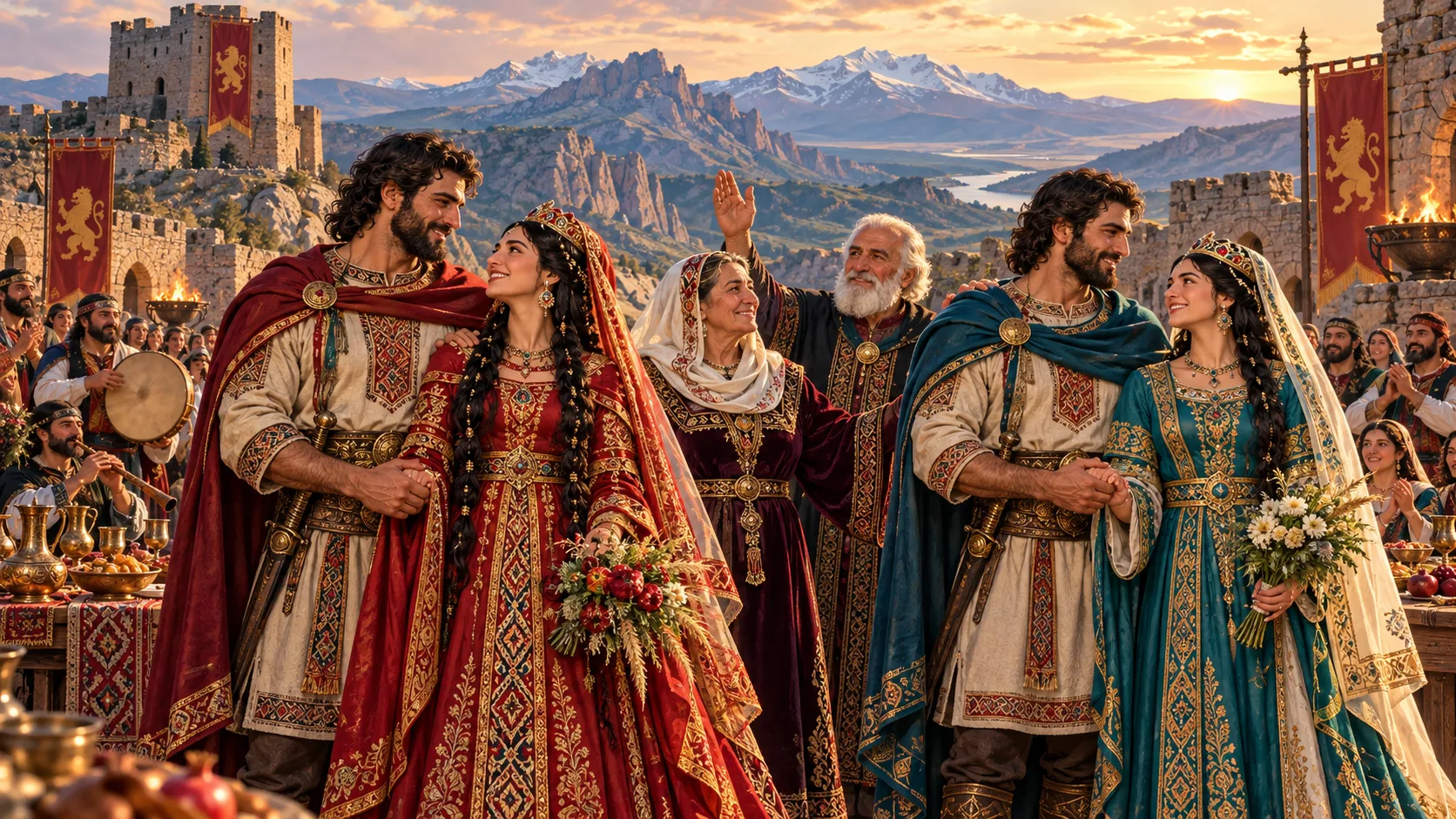
Deghdzun-Tsam married Sanasar,
And her sister married Baghdasar.
For forty days and forty nights
They celebrated with feasting, merriment and joy.

Baghdasar took his wife and went to Baghdad.
Sanasar remained in Sasun.
Baghdasar had no son.
God granted Sanasar a boy,
Whom they named Vergo.
After some years two more sons were born to him:
One was named Dzenov Hovan,
The other Mher.
Vergo proved good for nothing.
Hovan's voice was so powerful
That he wrapped himself in seven buffalo hides
Before shouting, lest his body burst.
Mher surpassed both his brothers in ability.

Time passed. Sanasar's appointed day came, and he died.
Lady Tsovinar and the others of that generation died too.
Uncle Toros, Deghdzun,
Vergo, Dzenov Hovan and Mher remained.

Now came the time of Mher.

Explore more entries

Back to Epic