Skip to content

Sanasar and Baghdasar

Legend
Type
Section 1

Section 1

Branch One · Sanasar and Baghdasar

DAVID OF SASUN

[page 1]

BRANCH ONE
SANASAR AND BAGHDASAR

[page 2]

1

Let me turn and pray for mercy*
For Lady Tsovinar.
Let me turn and pray for mercy
For Sanasar and Baghdasar.
Let me turn and pray for mercy
For dear Uncle Toros.
Let me turn and pray for mercy
For the parents of those who listen.

------------------

* The invocations are sung.

[page 3]

PART A
BATTLE AGAINST THE CALIPH OF BAGHDAD
Section 2

Section 2

2

In the beginning there was the idol-worshipping Caliph,
And there was Gagik, King of the Armenians.
The idol-worshipping Caliph dwelt in Baghdad,
King Gagik in Berd-Kapotin.

King Gagik was old and grey-haired.
He possessed great wealth,
But had no sons or other offspring;
He had one daughter of great beauty,
Whose name was Lady Tsovinar.

In those days, whichever king was stronger
Would exact tribute from the other.
The Caliph of Baghdad was mighty and powerful.
He gathered an army and marched against our people.
He carried off much plunder,
And took away many captives;
He slaughtered and diminished our people.
And Gagik, King of the Armenians,
Became a tributary of the Caliph of Baghdad.

One day the Caliph arose
And sent out two tribute collectors:

[page 4]

“Go, collect my tribute and bring it to me.”
The tribute collectors came and passed
Before the king’s palace and pavilion.
As they passed, a light appeared before them.
They looked—and what should they see?
A maiden of such beauty appeared
That she could tell the sun, “Do not rise; let me rise instead.”
The maiden was so fair, so very fair,
She resembled the fourteen-day-old moon
Rising from beyond seven mountains.
As soon as those tribute collectors saw the maiden,
Their senses left them,
And both fell unconscious to the ground.
An hour later the king sent men,
Who came and carried them into his palace.

Those men said nothing at all.
Both arose and quietly turned back
And went to their Caliph.
The Caliph asked, “Have you brought the tribute? You have not!”
They said, “Long live the king! What tribute, what business?
We have seen such a thing
That we are fortunate not to have died.
Had you been there, believe us,
You would have lain unconscious for three months.”
The Caliph asked, “What was it you saw?”
They said, “May God prosper your house!
What need have you of goods and treasure and wealth?
You have land, a realm, goods and treasure and wealth;
You have much gold, silver and precious stones.
That cross-worshipping King of the Armenians
Has a daughter of such beauty,
A maiden so lovely in herself,
That she is worth everything.
Caliph, we saw that radiant maiden:
You could go without food or drink, day and night,
And simply gaze at her beauty and grace.”
Desire seized the idol-worshipping Caliph.
He sent word to the Armenian king,
Saying, “Give me your daughter.”

[page 5]

The king said, “I am Armenian; you are Arab.
I worship the cross; you worship idols.
How should I give you my daughter?
I will not give you my daughter.”
The Caliph said, “King Gagik,
Whether willingly, you shall give her,
Or through war, you shall give her.
If you do not give me your daughter,
I shall plunder your people and carry them captive.
I shall slaughter you all,
I shall destroy your whole nation,
I shall turn your city upside down,
I shall overthrow your throne and crown.”
He said, “I shall fight; I will not give her.”
Section 3

Section 3

3

The Caliph of Baghdad called out and said,
“Ho, soldiers! Gather an army and go!
If he gives the maiden, let him give her; if he does not,
Gather up the stones, sift the sand,
Collect and bring away everything there is.”
They arose, gathered an army and came.
They came against the Armenian king.
“Now, king,
Either give us your daughter to take away,
Or we shall gather the stones, sift the sand,
And collect and carry away everything there is.”
The king looked—and what a sight he saw!
Troops had poured in as countless as the stars in heaven.
They fought and killed many soldiers;
The cross-worshipping king was defeated.

Lady Tsovinar was standing on the roof.
She thought to herself, “If my father understood,
He would not lay so much sin and blood upon my neck; he would give me away.
Because of me they will kill all these people.
Their children will be orphaned and will curse me,
And in the end they will take me by force.

[page 6]

It is better that I go of my own free will,
And my father’s kingdom remain secure.”
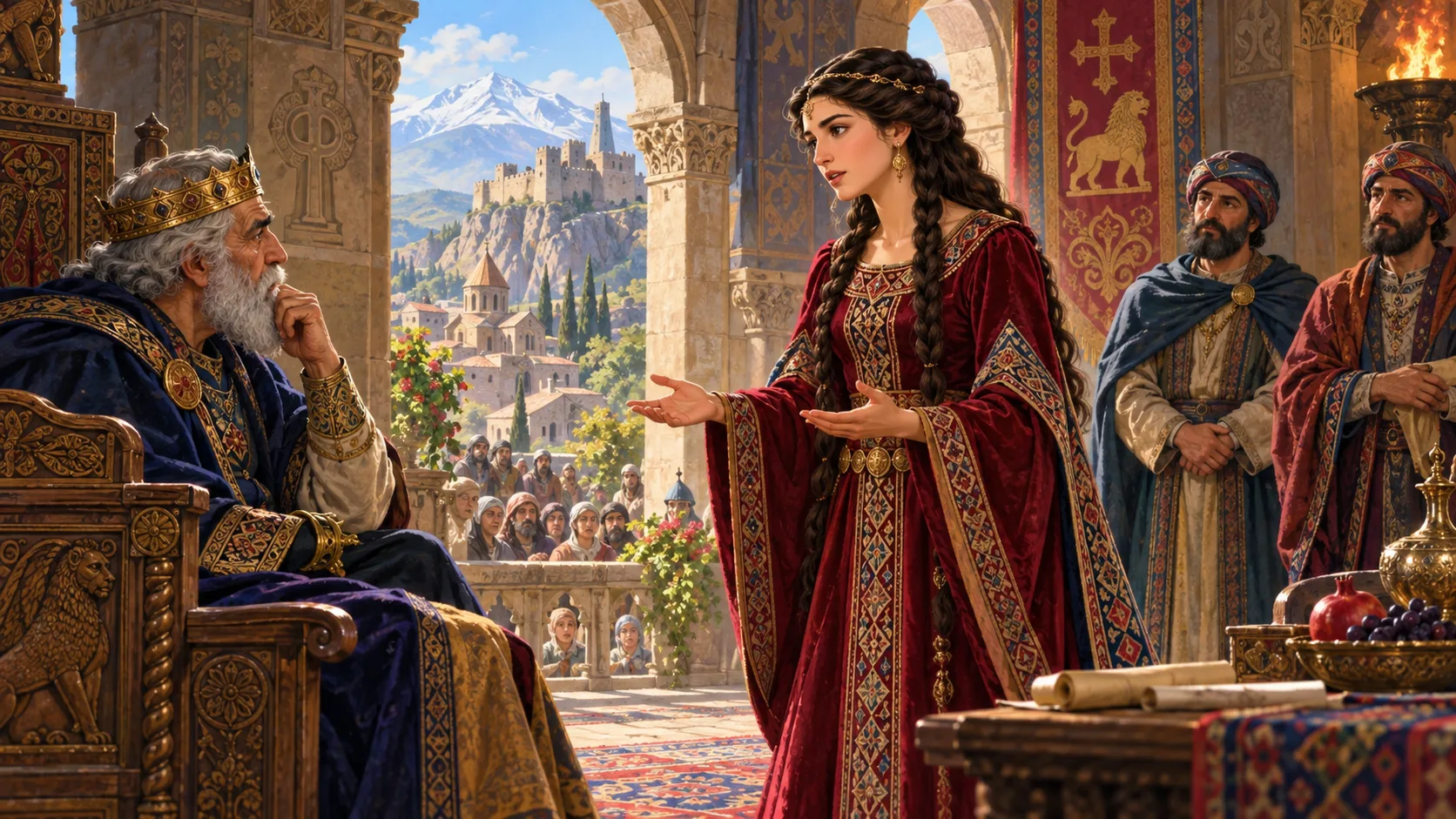
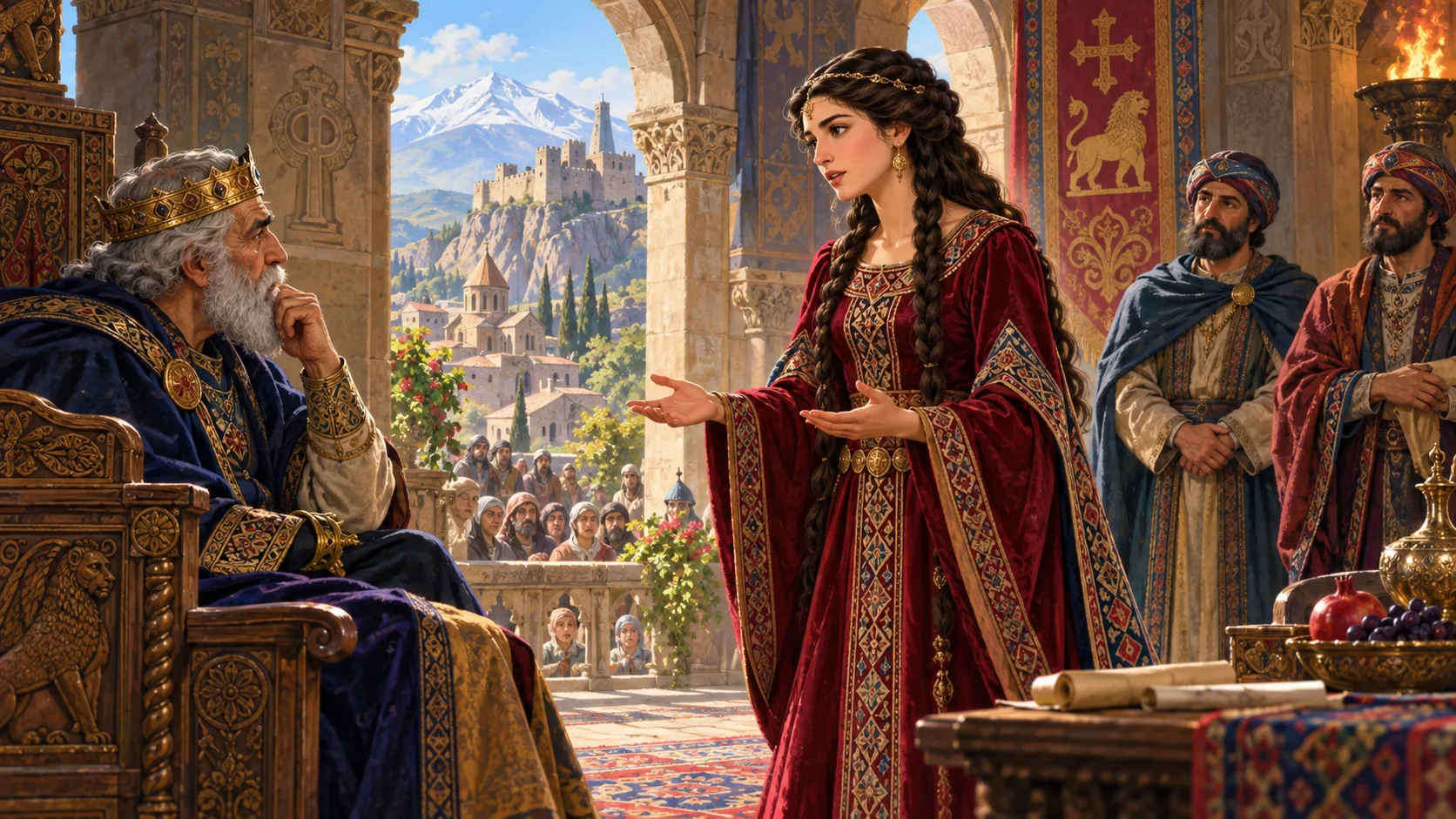
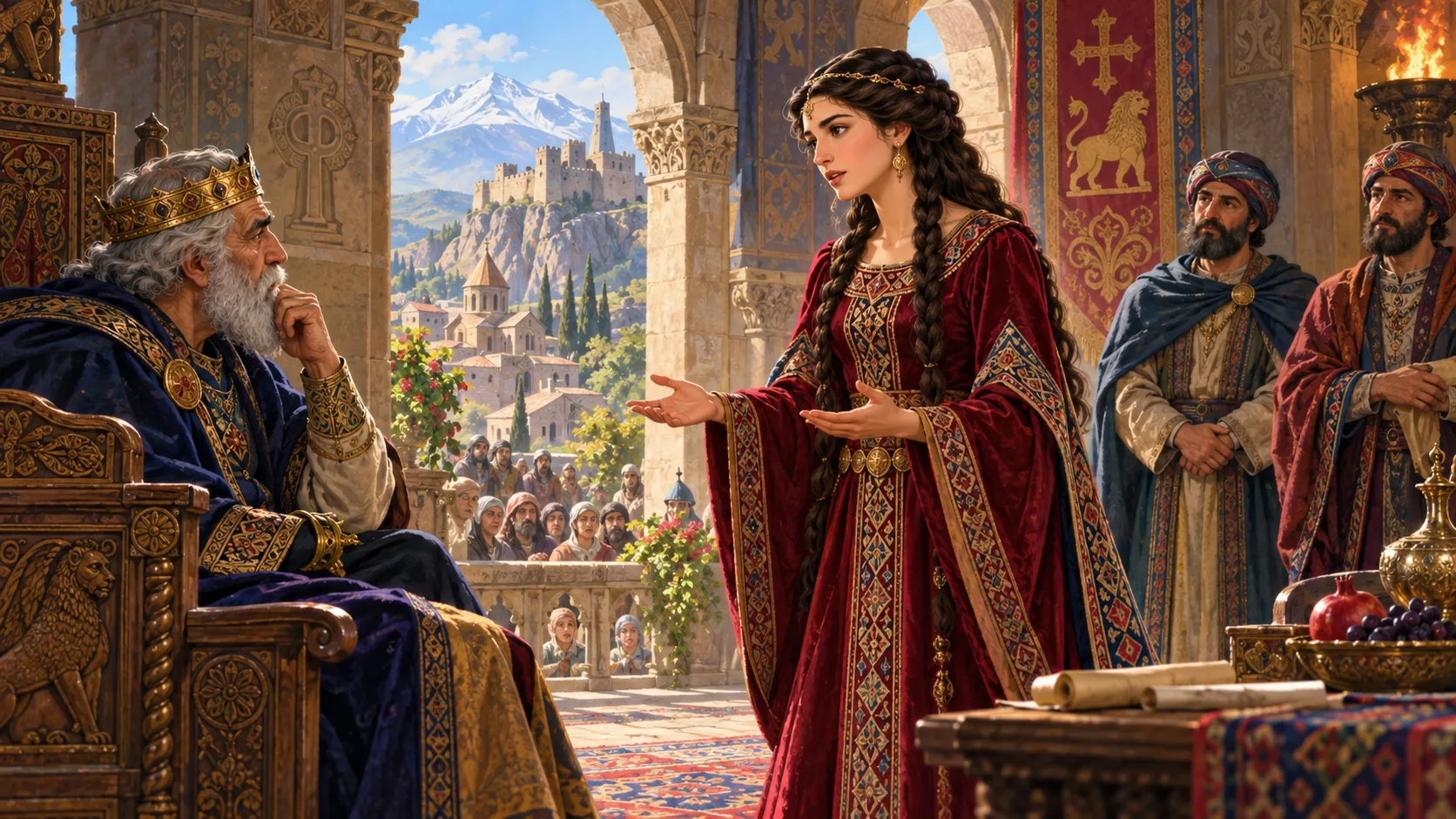
The maiden arose and went to her father’s council chamber.
She said, “Father, why are you troubled?”
Her father answered her and said,
“I am troubled
Because all these soldiers have come for you.
Either you must go, or they will lay waste our country.
The Caliph will take our kingdom,
Kill everyone and carry them captive.
Yet if I give my daughter, he is Arab and I am Armenian.”
Lady Tsovinar said,
“If I do not marry that idol-worshipping king,
He will kill everyone because of me.
It is better that I go,
And let no harm come to anyone else.
Let me alone die for my father’s sake.
I am one soul: let me go and perish,
Rather than our Armenian land be laid waste
And those many thousands of souls be lost.”
Then she said, “Father, give me to him.”

They held a council among themselves:
What should they do—give her or refuse?
They sent word to the king’s father-in-law,
Who was Bishop Vardpatrik, and he came.
They sent word to Uncle Toros, and he came.
The king summoned his family,
Gathered them together and said,
“People, what do you say?
Shall we willingly give the maiden, or shall we fight?
What counsel do you give?”
One said, “We cannot fight.
Let us give the maiden for him to marry and take away.”
Another said, “No, we shall fight!
We shall let ourselves all be slaughtered
And will not give our maiden to the idol-worshipping king.”
(They were a people, after all, defending their honour.)
Toros, who was then seventeen or eighteen,

[page 7]

Saw that the councillors wished
To honour the king,
Wished to fight and not give the maiden.
He said, “Long live the king!
I know the council wishes
To fight and not give the maiden.
It is better that one maiden perish
Than that a whole people perish.
King, if you will listen to me,
Let us give the maiden for him to take.
We cannot fight.
Let us reckon that you
Never had this daughter at all.”
They took counsel there,
And the bishop also agreed, saying,
“Shall we let a nation be slaughtered for one person?
No, let that one person go.”

Her father did not want this.
But seeing that no way remained,
He agreed to give his daughter.
He sent word to the Caliph:
“Yes, we shall give her. Come and take her.”
The Caliph made his preparations,
Took his wedding party and came.
The maiden went to her father and said,
“Father, tell the Caliph
To build a separate palace and pavilion,
And when he takes me, to lodge me there.
For one year he must not come near me
Or enter my bridal chamber.
Father, send a priest with me too,
To hold services morning and evening,
So that I may pray and keep our faith.
Send an elderly woman with me as well, and I shall go.
Ask the Caliph to fulfil
Everything I have told you.”

Her father told the Caliph of Baghdad
Everything his daughter had said.

[page 8]

“Caliph,” said King Gagik,
“I shall not fight with you.
I shall make an agreement with you.
If I give you my daughter,
A priest must go with her.
Let her call upon her God and worship her cross,
While you worship your idols.
You must give her a separate chamber,
And for one year you must not go near her.”
The idol-worshipping king said,
“My dear fellow, I shall make peace with you.
We shall make an agreement.
Give me your daughter,
And I shall ask no tribute of you.
Let my name be joined to your daughter’s;
Let them call me the Armenian king’s son-in-law—that is enough.
I vow that not merely for one year,
But for seven years, I shall not go near her.
Send a servant with her,
Send a priest with her.
Give me the maiden, and I shall take her home.
Opposite my palace we shall build
A separate palace and pavilion for her.
Let the maiden keep her faith,
And I shall keep mine.
For we are Arabs, are we not, and you are Armenians?”
Section 4

Section 4

4

The idol-worshipping king had come and was staying at Teghtis.
King Gagik’s residence
Was in the plain of Noraghegh.
The king had a summer residence there,
With fragrant, sweet pastures,
Adorned with flowers and meadows.
The Milky Spring is found there.
They pitched their tents there
And celebrated the wedding for seven or eight days.

Lady Tsovinar made a request of the king.
She said, “Father, my king,

[page 9]

Tomorrow is Ascension Day. Give me leave
To go to Hili and walk among the springs.
Send ten maidens of my age with me.
Let us go on an outing and make merry,
And wander until evening.
In the evening I shall return and go to my place.”
The king said, “You have my leave.
Go, walk about and return.”

Lady Tsovinar, her elderly attendant and the maidens
Went walking to the Milky Spring.
They wandered until evening.
The maiden saw the sunlit world and the sun,
And everyone busy at their work:
Some tending their water and their sheep,
Others occupied with farming.
The maiden reflected and said, “Alas!
There is so much light in the world, and I did not know it.”
They went up the mountain.
There they sat upon the grass and ate and drank.
Then they wandered on and saw the Blue Sea.
They went to stroll along the shore.

In the evening, when it was time to return home,
Tsovinar said to the maidens,
“Girls, go on ahead.
Walk about and enjoy yourselves;
I shall go and drink a little water.”
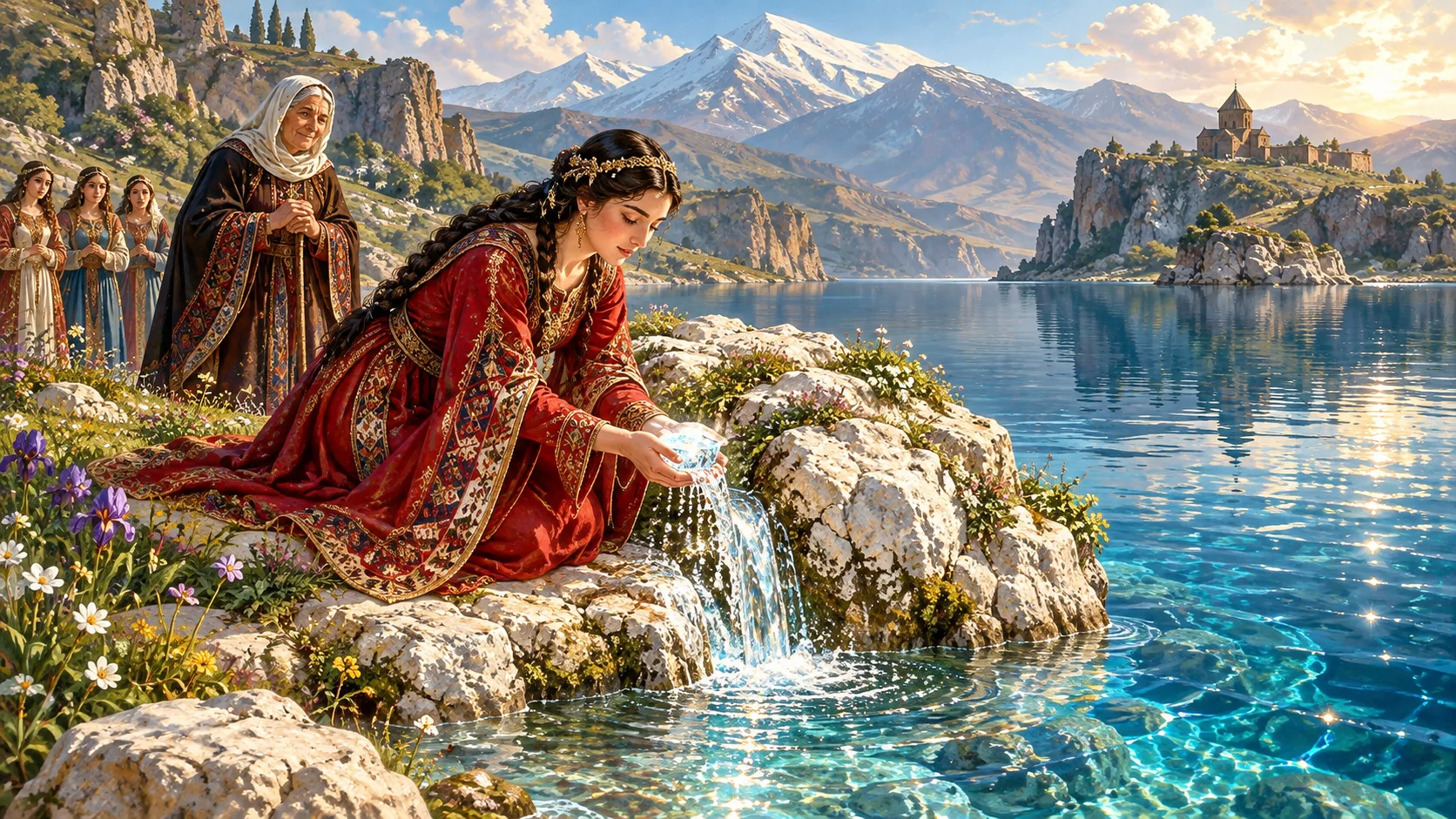
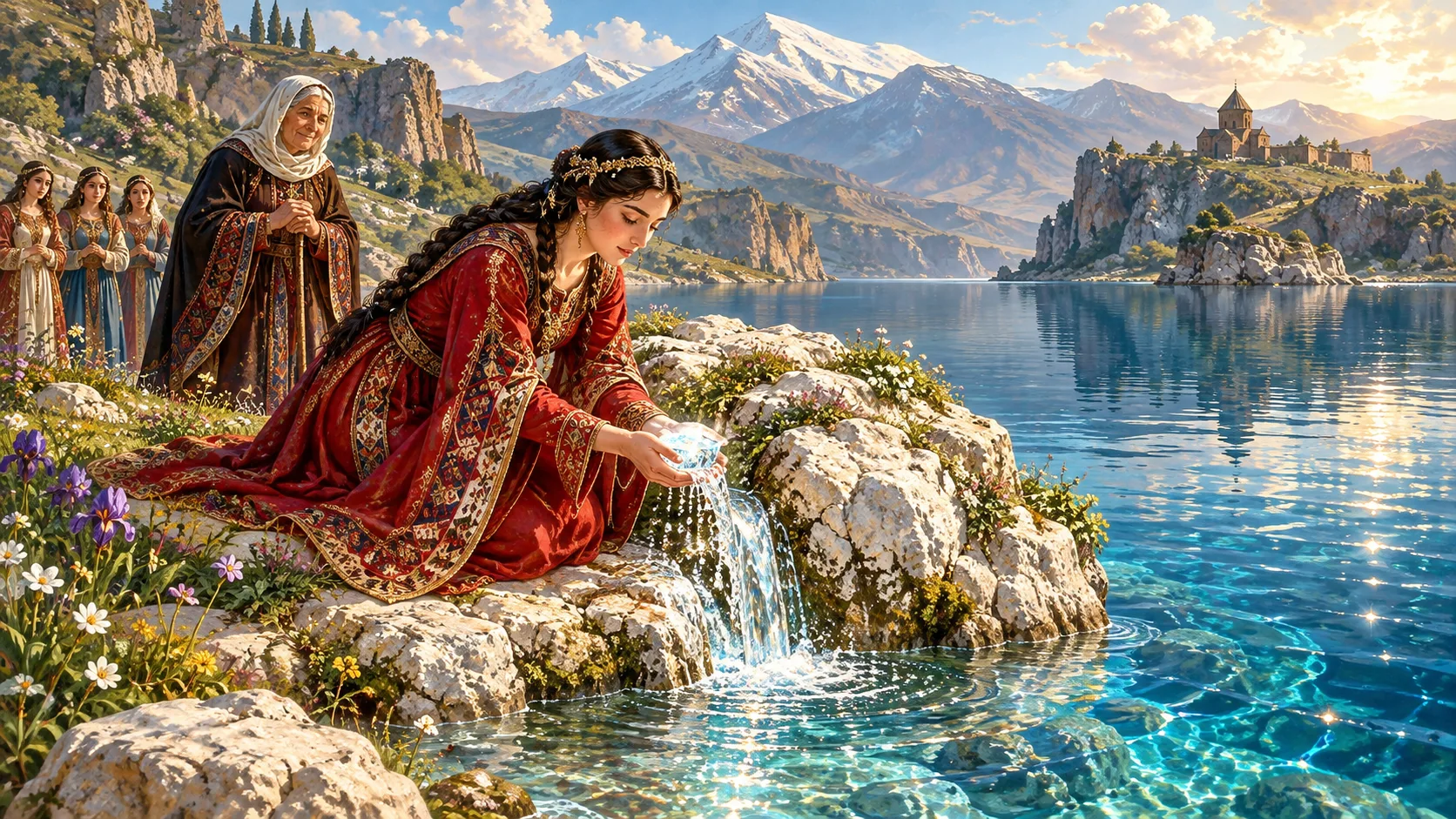
Lost in thought, she went down to the water’s edge.
She came and stood on a rocky bank,
Looked and saw that the sea had no end.
She and her attendant sat on the shore and wept.
The maiden grew weary from walking.
Her servant became very thirsty,
And she too was very thirsty and said,
“The water of this sea is very salty.
Ah, if only there were one drop of water
For me to drink and quench the burning in my heart!”
The old woman searched far and wide but found no water.
Then Tsovinar said,

[page 10]

“God, make a spring rise here,
And grant me a ray of hope and a way out.”
At God’s command the sea parted,
And delicious water came forth.
She looked and saw a great rock at the water’s edge.
A clear spring gushed from that rock,
And water surrounded it on every side.
No one could reach the spring to drink
Without taking off their clothes.
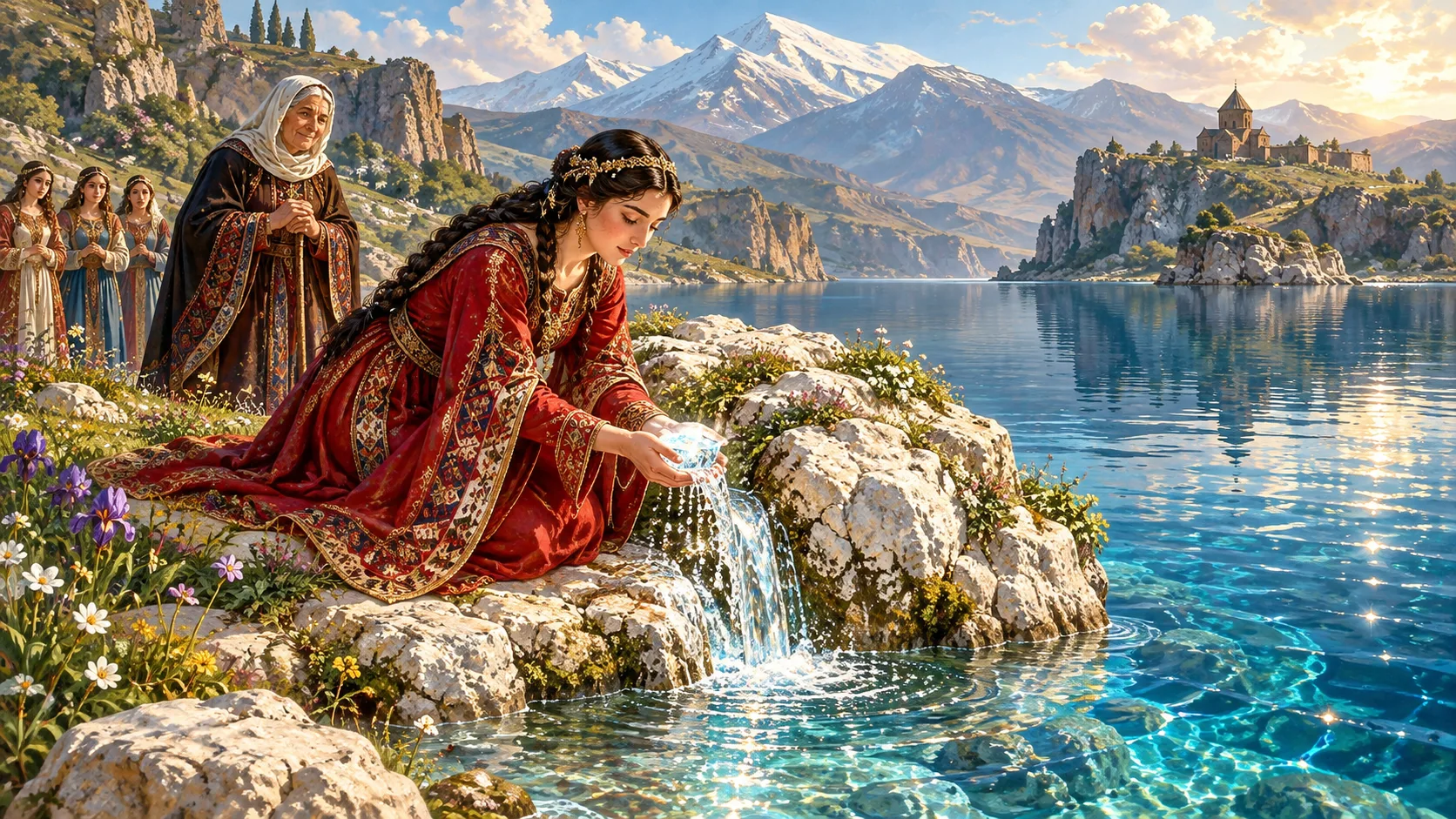
She took off her clothes and went to the spring.
She dipped her hand into that life-giving spring,
Drank one full handful of water,
And then another half-handful.
The spring dried up.
From those two handfuls she conceived.
Afterwards she gathered her maidens,
And they turned back and came home,
Returning to King Gagik.

In the morning the Caliph’s army set out.
The king made ready everything his daughter needed.
They mounted her and took her away
To the city of that idol-worshipping Caliph.
When they reached the city,
The king rejoiced greatly.
For seven days and seven nights he held a wedding,
With feasting and merriment.
He built a separate palace for her
And sent food and water there,
Saying, “Do not leave the palace.”
Lady Tsovinar entered the seven-roomed dwelling,
Shut herself behind seven doors and mourned.
Section 5

Section 5

5

Some time passed.
Tsovinar learned that she was with child.
She understood that it was from the sea,
But did not tell the Caliph.
The Caliph found out too and said, “It is not my offspring.”

[page 11]

He went and sat in council and summoned the vizier.
“Would you believe it? Such a thing has happened.
Vizier, what shall we do?”
The vizier said, “Long live the king! Let us kill her.”
They commanded the executioner,
“Go and cut off her head.”
The executioner came to the palace and said,
“The king has commanded
That I cut off your head.”
Lady Tsovinar said,
“Does your king have no justice?
Is not beheading a woman with child
The killing of two people at once?
Tell the Caliph to wait
Until I have borne my child.
Then let us see
Whether it is a boy or what it is, and let them behead me.
If you ask me,” she said,
“I came a virgin from my father’s house,
And to this day I am still a virgin.
My child, by God’s will,
Was formed from the water of the sea.”
The executioner went to the Caliph
And said, “Long live the king!
Your wife, King Gagik’s daughter,
Said thus and thus to me.”
The vizier said to the Caliph,
“Lady Tsovinar has spoken well.
Let her remain and bear her child;
Then we shall cut off her head.”
They gave her time to bear her child.
And the Caliph said, “Take care!
Let us wait until the child is born; she shall have her wish.
I am her master; Tsovinar is my wife.
Do not interfere any further.”

She remained. When nine months, nine days,
Nine hours and nine minutes were complete,
Her time had come.
She bore two boys,
One fully formed, the other smaller.

[page 12]

Melkiset the priest came
And baptised them over the tonir.
He named the elder boy Sanasar,
And the younger Baghdasar.

They brought the Caliph the joyful news:
“A pair of sons has been born to you.”
While others grew by the year,
They grew by the day.
When the Caliph looked
And saw the two boys, his eyes darkened.
He said, “Tell the executioner
To go and cut off her head.”
The executioner went to Tsovinar
And said, “I must cut off your head.”
Lady Tsovinar said,
“Does your king have neither rule nor law?
How will they rear children who still nurse
If he cuts off my head?
Let my boys grow up,
And then let him cut off my head.
I cannot run away from here, after all.”

The executioner went and told the Caliph.
He summoned the vizier and asked,
“What counsel do you give in this matter?”
The vizier said, “Give her ten years.
Let the boys grow up; then we shall behead her.
Where can she go from here?
Let them remain inside like prisoners.
Let them not leave the palace.”

They remained in the palace for half a year.
Then she sent word to the Caliph:
“Am I a bird, that you have put me in a cage?
Am I a prisoner here,
That you have put me in jail
And will not let us leave the house?
We see the sun through the roof opening,
And receive light only through that opening.”
The Caliph said, “What am I to do?

[page 13]

Let them come out and go for a walk.”
The doorkeepers gave them leave,
And they came out to walk about.
Some time passed.
Day by day the children grew stronger.
When they were one year old,
They were like boys of five.
They would go out and play with the children,
Beat them and make them cry.
Five or six years had scarcely passed
When Sanasar and Baghdasar became mighty lads.
Their mother said to the priest, “Father,
Teach my boys to read.”
He gave the boys lessons,
And they learned to read and write.

One day the Caliph
Summoned the two boys,
Brought them to his council chamber and looked at them.
When he saw their great size,
And heard their speech and conversation,
He grew afraid of them
And sent them home.

The children reached seven years of age.
One day they were playing with the other children.
Sanasar slapped the vizier’s son;
His neck bent over and remained crooked.
The vizier went to complain to the Caliph,
Saying, “What punishment from God is this?
They have not left a single child of ours unharmed.”
The Caliph said, “They have the power to do it.
I know that when they grow up
They will seize me by the beard.
Wait; we shall do something about them.”
Section 6

Section 6

6

When the boys had grown,
One morning
They were playing with the children.

[page 14]

The children crowded round them,
Saying, “You are bastards! You are bastards!”
When they heard those words,
They came weeping to their mother and said,
“Either tell us who our father is,
Or we shall go and throw ourselves into the river.”
“My sons,” she said, “your father is the Caliph.”
“No,” they said. “If he were our father,
People would not call us bastards.”
For a time, with these words,
She kept the boys indoors.
A few days later the boys again
Went into the city to play.
The children again crowded round them,
Saying, “You are bastards! You are bastards!
Why do you come among us?”
Again they returned weeping
And threw themselves into their mother’s lap.
When they wept so much, their mother’s heart ached.
She said, “My sons, be still.
Tomorrow morning I shall take you out
And tell you about your father.”

In the morning she arose and said to her servant,
“Take a bundle, and let us go to the riverbank with the boys,
So that our hearts may find a little ease.”
When they went, Sanasar said,
“Mother, come, tell me who my father is,
Or I shall throw myself into the river.”
His mother said, “My son, you have no father.”
The boy said, “Mother,
I did not come from under a stone or a bush.
Surely I too was born of a human being.”
She said, “My son, once
I went to the seashore with my elderly attendant.
I became very thirsty and told her,
‘Find me some water.’
The sea opened, and sweet water came forth.
I drank that water:
One full handful and one half-handful.
God gave you to me from that water.

[page 15]

You came from the full handful,
And headstrong Baghdasar from the half-handful.”
The boy said to his mother,
“Now we know our origins.
Come, tell us yours.”
Their mother said, “My sons,
I am the daughter of the Armenian king.”
They walked about until evening.
In the evening they returned to the city
And entered their palace.
Section 7

Section 7

7

Much time passed.
Sanasar and Baghdasar saw
That their mother was wasting away day by day.
They said, “Mother, what has happened to you,
That you waste away day by day
And the tears never cease from your eyes?
We see that God
Has given you us, a pair of sons.
You are a king’s wife.
As far as we can see, you lack nothing.
Come, let us know what grief is yours,
That you waste away day by day.”

Their mother turned and said to the boys,
“Ah, my sons, if I do not waste away, who should?
Today or tomorrow, the Caliph
Will cut off my head and both of yours.”
Sanasar answered and said,
“Mother, can such a thing be?
Very well, let us see how he will do it.”

When the ten years were over,
The Caliph sent executioners,
Saying, “Go and cut off their heads.”

Sanasar and Baghdasar
Were sitting on little stools in the adjoining room.

[page 16]

They talked and laughed, while their mother wept.
The executioners entered and said,
“Today we must cut off your heads.”
Their mother said, “Cut off my head,
But as for my boys,
Could your hands bear to behead them?”
One of the executioners said,
“Our hands would not willingly harm your boys,
But what can we do?
It is the Caliph’s command that we behead them.”
Weeping, their mother said, “Speak a little more softly,
So my boys do not hear and become frightened.
Let them laugh a little longer.
You too, sit down and rest.”
“No,” he said, “we have no leave to sit.
Hurry, let us go outside.
If we behead you here,
Blood will spill inside the palace.”
He shouted, “Hurry!”
His voice reached Sanasar’s ears.
Sanasar opened the door and saw several men
Standing in the room with swords.
He said, “Who are you? What do you want?”
His mother secretly pleaded with them,
“Do not tell my boys
That you have come to cut off their heads.
Let us take my boys outside.
Let one executioner stand on one side, another on the other,
And strike off my boy’s head
Without his seeing and taking fright.
But kill me first, and then my boys.”
The executioner said, “Come, let us go.”
Sanasar said, “Mother, where are you going?”
“We are going outside; we shall return.”
“Mother, tell me:
Something is going on, since they are taking you away.”
His mother did not wish to say.
Sanasar would not let her go and said,
“Something is going on that you are not telling me.”
His words touched his mother’s heart, and she said,

[illustration]

They took him to be baptised and named him David.

[page 17]

“Son, if you want the truth,
The Caliph has sent them to cut off my head.”
He said, “Who is to cut it off?”
“This man.”
He went up to the executioner and shouted,
“Are you going to cut off my mother’s head?”
The executioner said, “The Caliph has commanded
That I cut off your heads.”
Sanasar struck the executioner across the face.
His head flew off; his body remained standing.
When the others saw this, they fled.
They went and told the Caliph,
“Your boy slapped the executioner;
His head flew off and his body remained standing.”

The Caliph sent troops to fight them.
Sanasar and Baghdasar saw
That soldiers had come to do battle.
They went out and, by evening, killed half that army.
They stopped fighting and returned home.
The next day no one came to fight.
The Caliph said to the commander,
“Go and fight.”
The commander said to the Caliph,
“Padishah, we cannot overcome them.
They are men of extraordinary strength, mighty heroes.
They will destroy your kingdom.
It is better that we do not go to battle,
So our soldiers will not be killed.”

The Caliph thought and thought,
And saw that there was no way out.
War would only harm him, so he said,
“We shall have no more dealings with them.
Now I believe
That Lady Tsovinar is innocent.
Those mighty ones came from the sea.
Tsovinar is my wife,
And they are my sons.”

[page 18]
Section 8

Section 8

8

That Caliph once again gathered an army
And marched against our people.
While he was making his preparations,
Lady Tsovinar had a dream.
She arose in the morning and told her dream.
She said, “Long live the Caliph!
Come, listen to me:
Do not go to war.”
The Caliph asked, “Why?”
She said, “Last night I had a dream.”
He said, “What dream did you have?”
She said, “Last night I saw little stars
Gathered round one great star.
All at once those little stars
Fell upon the great star.
That great star flashed and came down,
And fell before our door.”
“Ah,” he said, “beautiful Tsovinar,
You sleep for yourself,
But dream for someone else.
While I am still young,
I must go to war.”
She said, “It rests with your will.
Whether you go or stay, you know best.
But have you not an agreement with my father?”
He said, “I have changed my mind.
I shall go to war and collect my tribute.”

He gathered troops and formed an army,
Made every preparation for his soldiers,
Arose and marched to war.
For seven years he fought.
He came and surrounded the city of Berd-Kapotin.
He encircled it with his army and settled down.
The city’s goods and cattle remained within it.
The people could neither plough nor sow;
They cast no seed into the earth.
Prices soared in the city.

[page 19]

Such scarcity arose
That they would not give one loaf for a gold coin.
Prices soared in the city,
And many people starved to death.
People crowded into rooms and said to one another,
“God, shall we ever again
See a time of plenty,
And eat bread until our bellies are full?”

Among them was a good man who said,
“By this time tomorrow, a hundred measures of bread
Will find no buyer even for a silver coin.”
Among them was an unbelieving man
Named Kro. He arose and said,
“Take this handful of gold and give me bread,
So I can take it to my children to eat.
Come, man, where will you get it?
Even if I see bread with my own eyes,
Even if I eat it with my own mouth,
I shall not believe it, I shall not believe it!”
The good man cursed him:
“Kro, I trust in my God
That tomorrow bread will lie about like discarded rags.
Since you will not believe my words,
May you see it with your eyes but not eat it with your mouth.”

King Gagik gathered young men
And made an army for himself.
When darkness fell in the evening,
He assembled his soldiers
And instructed them, saying,
“Do not strike until I give the order.”
At a moment in the night when all sound had fallen still,
He suddenly cried, “Strike!”
When they struck,
The idol-worshipping king’s soldiers
Turned against one another:
Those in front upon those behind,
And those behind upon those in front.
Uncle Toros and the young men
Rushed with swords and sabres into the Caliph’s army,

[page 20]

And struck and slew and slaughtered.
Such carnage swept through the army
That soldier could not recognise soldier.
They killed and struck one another,
Until blood rose and flowed away.
They brought word to the idol-worshipping Caliph:
“What are you doing? Your army is being cut to pieces.”
The Caliph himself arose and looked.
He saw the soldiers slaughtering one another,
And the slaughter drawing near him.
The Caliph was left alone.
Our people pressed him hard that time.
He mounted the great camel and fled—
They call it the Shama camel—
He mounted it and fled.

At dawn they arose and saw
That the Caliph’s army had been annihilated.
They brought that unbeliever and made him the measurer,
To distribute the bread and provisions left there
To each person, so they could carry them away and eat.
He gave one man less than his share.
They took the measure from his hand and struck his head.
The unbelieving measurer died.
Truly, he saw with his eyes but did not eat.

When the Caliph mounted and fled,
In his distress he called upon his idols:
“Idols, come to my aid!
Free me from the hands of these Armenians.
I shall sacrifice forty heifers that have never calved.”
Ah, how could idols come to his aid?
Again he turned and said,
“Idols, come to my aid!
I shall bring you a hundred measures of silver,
I shall bring you an offering of gold.
Free me from this enemy.”
The idols did not come to his aid.
What is an idol, after all, that it should come to help?
This time he cried out and said,

[page 21]

“O Great Idol,
If you come, if you come,
If you free me from these people,
And I return safe and sound,
I shall sacrifice Sanasar and Baghdasar to you.”

Then demons came
And slipped beneath the camel’s belly,
And carried the Caliph away to safety.
Section 9

Section 9

9

That night Tsovinar slept and dreamed.
She saw that she had two lamps.
Someone came forward to put them out,
But they turned and shone again.
She arose in the night when she awoke,
Called her two boys and brought them beside her.
She placed one upon one knee
And the other upon the other knee,
And wept and kissed the boys’ faces.

The boys asked, “Mother, why are you crying?”
Their mother told them
What she had seen in her dream and said,
“Tonight Saint Karapet appeared to me in a dream.
The Caliph has fallen into distress
And has promised you as a sacrifice to his idols.
When he returns, he will sacrifice you.
Find a way to save yourselves.
My sons, he will sacrifice you.
Flee and go to the Armenian king’s city.
At night take the bright star as your guide,
And by day ask the way
To the kingdom of the East.”

The boys arose and each took weapons,
A bow and arrows, a mace and a sword.
They took provisions
And filled a saddlebag,

[page 22]

Then went to the Caliph’s stable.
“Hey, groom,” they said, “bring out
Two good horses for us at once!”
They brought out the horses, mounted and returned.
They kissed their mother’s breast and said,
“Mother, let that Caliph come now,
Seize us and take us to slaughter for his idols!”
The two brothers called upon their God,
And set out in the night.
They fled on until daybreak.

It was the hour of morning prayer; dawn had broken.
Lady Tsovinar went outside.
She climbed onto the roof of the council hall
And saw him coming, without army or commander,
Riding the Shama camel.
The Caliph had turned as black as pitch.
The idol-worshipping king arrived
And hurriedly threw himself through the doorway.
Lady Tsovinar said,
“Ah, king, may you live long!
May God bring good of this.
For those seven years, good reports came of you.
What has happened to you?
Caliph, where is your army?
Where is your commander?”
The Caliph answered,
“Wife, I had driven the unbelievers
Inside the fortress walls.
It was the final hour; they were about to surrender.
Then at dawn fire suddenly rained from above.
My army and commander were all destroyed.
A flaming sword fell among my soldiers;
They slaughtered and hacked one another apart.
I too was about to be caught among them,
But I mounted the camel and fled.
However many sacrifices I promised my idols,
However much gold and silver I offered,
They did not come to help me,
They did not come to rescue me.

[page 23]

I promised Sanasar and Baghdasar
As a sacrifice to our Great Idol,
And only then did it barely rescue me and bring me home.”

Tsovinar thought to herself,
“Truly, he would have taken my two boys
And slaughtered them though they were innocent.”

Some time passed.
The idol-worshipping Caliph went to the temple of idols.
May it be far from those who listen: the evil enemy
Entered their idols,
And they demanded their sacrifice.
A voice came from the Great Idol, saying,
“Bring your boys, Sanasar and Baghdasar,
Before me and sacrifice them to me.
Whatever wish you have,
I shall bring it to fulfilment.”
The chief priest of the idols also came before the Caliph.
“The idols demand a sacrifice.”
He said, “Take whatever you want and sacrifice it.”
“You have two sons
By the daughter of the cross-worshipping king.
They demand those boys as a sacrifice
And will accept nothing else.”
He said, “Very well. In ten days
Let us take our idols on an outing to the springs.
I shall take my two boys too
And sacrifice them to our idols.”

That day the Caliph came and said,
“King’s daughter, do you know what has happened?”
“Well, what is it?” Tsovinar asked.
“Would you believe it? My idols demand a sacrifice.”
Lady Tsovinar said,
“May your house not fall! Have you no heifers,
No sheep, no cattle?
Sacrifice those.”
The Caliph said, “No, no, they want a human being.”
“Oh, they want a human being?

[page 24]

Is there no boy in your city with no one to care for him?
Sacrifice him.”
The Caliph said, “No, no, they want your boys.
Wife, I promised your boys as a sacrifice.
I must take the boys and sacrifice them to the idols
That freed me from the enemy.”
King Gagik’s daughter said,
“May your house not fall! Why?
Are my boys not your boys too?
Do as you see fit.
Take them and sacrifice them.”
But where was Sanasar, and where was Baghdasar?
Where were they, and where were their two boys?
Section 10

Section 10

10

That night Sanasar and Baghdasar
Mounted their horses, set out and rode away.
For four days and nights they rode
And passed beyond the Caliph’s lands.
They wandered far and came to a strange country,
And entered a narrow gorge.
They saw a great river flowing through it,
And a slender stream on the other side
Descending from the high mountains.
It struck into the river
And cut across it,
Dividing its waters as far as the middle,
Then mingled with the river and flowed away.

There the two brothers asked each other,
“What strength has that slender stream,
That it cuts and divides that enormous river,
Crosses it and strikes this bank?”
Sanasar began to think differently.
He said to Baghdasar,
“I am amazed, truly amazed by it.
That slender water comes
From there, from the mountain top,
And strikes the river and cuts through it,

[page 25]

And only then flows on with the river.
What sort of water is this, Baghdasar?”
His brother said to Sanasar,
“That water is the water of heroes.
Whoever drinks from its source
Will become such a mighty man
That no one will be able to throw him to the ground.”
Sanasar said to Baghdasar,
“Whoever finds the source of that little stream
And builds his house beside that water,
His children too, when they are born,
Will be just as strong.
From him will spring a heroic race;
His sons will be mighty warriors.”
There Sanasar swore an oath:
“By the bread and the wine, by the living Lord!
Wherever the source of that water may be,
Let us go and build our home there.
Let us build a settlement beside the water.
We are strong, and this water is strong.
Whoever drinks it will become a man as mighty as the angel of death.”
Baghdasar said, “As you say, brother.”

They crossed the great river to the other side.
They set off along the stream,
Following that slender water,
And the two brothers went on.
They went and went through mountains upon mountains,
And climbed to their summits.
They made night and day as one
And reached a highland country:
Cliffs, ravines, abysses, rocky passes,
Forests, bears and wild beasts.
There were no settlements in those parts.
They liked that country very much.
They went on and found the spring.
The spring gave only a narrow spout of water,
Yet it went and cut through the great river below.
They saw that the water was sweet, and the place was pleasant too.
Sanasar said, “It is beautiful here.

[page 26]

It is good for us to stay here
And build ourselves a house and a palace.”
They settled beside the spring
And resolved to build themselves a fortress.
The elder brother said to the younger,
“Go and bring back some game to cook and eat.
Meanwhile I shall pile stones upon one another
To mark the place where we shall build a village.”
For seven days in succession, until noon,
Baghdasar shot birds and brought them back,
While Sanasar brought stones and laid out the site.
They brought stones and laid their fortress’s foundations.
Sanasar went to the east,
And Baghdasar to the west,
And they carried back enormous rocks.
They brought and gathered the stones,
Joined hands and called upon God.
They became builders and raised walls;
Together, beside that water,
They built themselves a house.
Then Sanasar would take his bow and arrows
And hunt from dawn until evening,
While Baghdasar worked upon the fortress.
Section 11

Section 11

11

They worked on that palace for ten or twenty days.
One day Sanasar returned
And saw that Baghdasar was exhausted
And had fallen asleep.
The bloody game lay uncooked,
Thrown upon the ground, while he slept.
He felt great pity for him
And said, “Brother, let us go again.
We cannot live like this.
How long are we to remain here
And eat unsalted meat?
If God had meant to grant us such a home,
He would have given us the Caliph’s palace and pavilion.”
Baghdasar asked Sanasar,

[page 27]

“What shall we do, then, brother?”
“Let us leave and go out into the world.”

The two brothers mounted and rode until they reached Mush.
They went before King Mushegh,
Bowed their heads and kissed the earth seven times,
And on the eighth stood with their hands folded.
The king asked them,
“What do you lack?
What do you need, my sons?”
The boys answered,
“We lack nothing.
Above, we have taken refuge in God;
Here below, in you, king,
So that you may keep and protect us,
And your watchful eye may shelter us.
In times to come, may God keep us from bringing shame upon one another.”
He asked, “My sons, whose boys are you?”
“The Caliph of Baghdad’s.”
He said, “If that is so, my sons,
We dare not shelter you.
He is a powerful king;
He will come and plunder us and carry us captive.
Turn back and go; we cannot keep you.”
They arose and left that place.

They thought, “Where shall we go?”
And they made for the emir who lived in Erzurum.
The two brothers went to that man,
Bowed their heads and stood before him.
They were enormous men, those two brothers,
Strong-armed and powerfully built.
When the emir of Erzurum
Saw them, he liked them very much.
He asked their family and origins,
And said, “Who are you?”
Sanasar answered,
“We are the sons of the Caliph of Baghdad.”
That emir said, “Ah, ah, ah!”
And shook himself free of them.

[page 28]

“We flee from their dead,
Only to run into their living!
No, we cannot take you under our protection.
Go wherever you are going.”
They arose and left that place as well.

On the road they took counsel.
Sanasar said to Baghdasar,
“Brother, we are fleeing from that man.
Why have we taken his name upon ourselves?
Let us not mention that dog’s name.
As long as we speak his name,
No one will shelter us.
From now on, wherever we go, whoever asks,
We shall say we have nothing:
Neither father nor mother, neither home nor homeland.
Perhaps people will take us in.”
Section 12

Section 12

12

They turned away from there
And came to the fortress of Manazkert.
There was a king there named Tevatoros.
They came and stood at his door.
The king’s men came out
And asked, “Who are you?”
They said, “We have come to serve the king.”
They informed the king.
The brothers went in and bowed their heads,
Kissed the earth seven times,
And on the eighth folded their hands
And stood before him.
As soon as the king saw those two fair-haired,
Handsome boys,
He liked them greatly and asked,
“My sons, what do you need?
Why have you come?”
They answered him,
“Above, we have taken refuge in God;
Here below, in you, king,

[page 29]

So that you may keep and protect us,
And your watchful eye may shelter us.
In times to come, may God keep us from bringing shame upon one another.”
The king asked,
“My sons, where are you from?”
They answered, “We do not know.”
“What do you have, and what do you lack? Have you a father and mother?”
They said, “We have nothing at all:
Neither home nor dwelling nor homeland.
Since we were born,
We have seen neither father nor mother;
We have known ourselves only as orphan boys.”
The king asked again,
“What is your wish? Why are you wandering?”
“We have come to you; we shall be your servants.”
The king liked them very much and said,
“Take these boys and lodge them in a clean place.
Spread beds for them in a room.”
They took them and lodged them in a room,
And brought them food at the proper hours.
The king grew very fond of them.
He made Sanasar master of the table,
And Baghdasar master of the wine.

They kept them for a full year.
When the year was over, the vizier said to the king,
“King, why not bring them out and test them,
To see whether they possess any skill?”
The king said, “You speak well.”
They summoned the boys,
Brought them to the king’s council chamber,
And the king said to them,
“My sons, tomorrow we shall go to battle.”
The boys arose from that place
And went and sat in their room.
They remained there until daybreak.
At first light they arose,
Each took up his weapons,
Mounted their horses,

[page 30]

And went to the field of battle.
The king came with his army too.
He said, “Sanasar,
Take the soldiers and stand on one side;
Baghdasar, the vizier and I shall stand on the other.”
Sanasar said, “Not like that, king.”
“How, then?” asked the king.
He said, “My brother and I shall stand on one side,
And you, your soldiers and the vizier on the other.”
The king said, “Let it be as you say.”
They came together and began to fight.
The king looked again and saw
That no soldiers remained; all had been struck down.
He said, “Vizier, may your house be ruined,
As you have ruined mine!
Until now they believed
That there were men among us.
Now they are the men, and we are women.”
The vizier said, “If that is so,
Send them out of the city and let them go.”

That day bandits drove away the city’s cattle.
The king brought thirty horsemen
To send with the boys
In pursuit of those who had taken the herd.
Sanasar said, “King,
We do not want those thirty horsemen.
The two of us shall go alone.”
They took their weapons, mounted and rode away.
They caught up with the bandits,
Struck them down and freed the herd.
They drove the bandits among the cattle
And brought them back to the city.
The king seized and bound the bandits.
After that he treated the boys even better.

In the morning they arose and went for a walk.
They saw young men practising shield combat,
Holding shields and striking one another with sticks.
They said, “Let us go and play with them too.”

[page 31]

They went, and everyone they laid a hand upon
Fainted and fell to the ground.
People went and told the king,
“Look what they have done again!”
The king summoned them and said,
“Boys, what are you doing?
What is this you have done?”
They said, “Long live the king!
We were playing, and this is what happened.”
He said, “You are powerful men of extraordinary strength.
Can they stand against you?
Do not do such a thing again.”
They said, “We shall not do it again.”

It was a great city, and a wedding was held.
The young men went out to play games on horseback.
The king said to Baghdasar,
“Get up and go as well.
Race your horses and make merry.”
When they arrived, the horsemen took their places.
Those two stood on one side,
And the horsemen on the other.
They charged and drew fire from one another.
When the elder brother went in pursuit,
He threw his javelin but did no harm.
When the younger brother went,
He struck and broke ribs,
Injuring two or three young men.
Sanasar did not like this.
They turned back and came home.

The elder brother took a tray of fruit,
Placed it on his younger brother’s head,
And took him to the king’s council chamber.
The injured boys’ relatives had arrived
And were making complaints, saying,
“King, send these boys away.
They are powerful; otherwise they will harm you.”
When Sanasar brought the fruit,
The boys’ relatives forgot about their boys.
They gathered round the fruit and ate.

[page 32]
Section 13

Section 13

13

One of their young companions came and said,
“The king is angry with you.
He is going to drive you out of the city.”
Sanasar said to Baghdasar,
“Brother, there will be no home for us here.
Let us go and build our own house.
We put so much effort into that place,
And our unfinished building still stands abandoned.”
He said, “As you say, brother. Let us go.
In the morning, do not prepare his food,
And I shall not pour and serve his wine.
Tomorrow we shall not go and appear before him.”

The king awoke, and neither one nor the other was there.
Then he summoned them.
They came before the king.
“King,” they said, “what is our fault,
That you are driving us out of the city?”
He said, “My sons, the words have left my mouth;
I must send you away.
Go from here to your room
And think: let us see
Which district you want me to give you,
So that you can go and settle there.”
The boys thought,
“Let us go where we marked out our building site.
Let us settle there.”

They spent the night in their room.
When fair morning dawned,
They came and stood before the king.
The king asked, “My sons,
Which place have you chosen to settle in?”
They said, “Long live the king!
It is true that we have neither father nor mother.
But though we might conceal something from you, what can we conceal from God?
We put a little effort into an unfinished building,
Then abandoned it and came here.”

[illustration]

In the evening David drove lambs and wild beasts into the city.

[page 33]

They told him the story and said,
“There is a little spring of this kind,
And beside it we have laid foundations.
We ask that you allow us
To go and build our house and establish a home.”
King Tevatoros said,
“But, my sons, I asked you at the beginning
What you had, whether you had a father or mother,
And you said you had nothing—neither home nor dwelling.
Now, since that is how things stand,” he said,
“Go, with a thousand blessings.
Go and build your house and fortress.”

Sanasar and Baghdasar answered,
“King, may you live long!
We ask one more thing of you.
We cannot live there alone.
We ask you to give us a few poor households
And a few rich households.
Let them come with us and build homes beside ours,
So that in the evenings we may gather
And talk together in our own town.”
The king’s heart was moved with pity for them.
He gave them forty households—
Ah, what households they were!
Each had only a donkey and a spinning wheel.

In the morning he sent his vizier into the city
To arrange the departure of those forty households.
He gave them fifty loads of flour
And sent provisions with them.
They arose and loaded their household belongings.
The brothers said farewell to the king
And set off with their people.
They went and climbed the mountains,
And reached their little spring
And the foundations of their fortress.
Sanasar said to Baghdasar,
“Shall we build our fortress first,
Or the houses of these poor people?”

[page 34]

Baghdasar answered,
“Let us build their houses first,
And then our fortress.
Those poor people cannot
Remain out in the sun.”
And they began the houses.

Sanasar was so strong
That he could dig the foundations of ten houses in a day.
The other brother brought the timber,
And the two of them did the building together.
In four full days the two brothers
Raised the walls of forty houses.
They cut great beams in the mountains
And brought them down without even trimming the branches.
They laid them over the walls, roofed the houses and finished.
Then they settled the newcomers in the houses.

While the boys were building the houses,
Each day they ate in someone’s home.
Whichever house they ate in,
Its kneading trough and sieve were left hanging empty.

When the newcomers had settled into their homes,
The boys began building the fortress again.
Sanasar shouldered and brought huge rocks,
And his brother brought enormous stones too.
Then they went to the city
And brought master builders and labourers.
The master saw the stones they had brought
And said, “I cannot build with these.”
Sanasar went to the city
And brought another master.
When this master saw those enormous stones,
He said, “Sanasar, how are we to lay these?
I cannot put these rocks together.”
“Who can, then?” asked Sanasar.
The master answered,
“No man can put them together.”
“Then how are we to build?”

[page 35]

“I do not know either,” said the master.
Then Sanasar said,
“Master, stretch your lines and mark the places.
Tell me, and I shall put each stone in its place.”
In this way they built their fortress.
They brought enormous, wondrous stones,
And worked together with the master builders.
They were so strong
That they drove stone against stone and made sockets in them.
For a whole year they worked like this.
When the year was complete,
Their fortress and house were finished at last.
Then they built a small church as well.
Only the name of the fortress and house remained.
They did not know what to call it.
Section 14

Section 14

14

Then Sanasar said to Baghdasar,
“Very good, we have finished our home.
What name shall we give it?”
Baghdasar said, “Brother, you know best.
The building was for both of us;
The naming is for you.”
Whoever came, he stopped and said,
“Give my house a name.”
No one knew what to say.
However many people came there,
Their mouths stayed shut; they offered no name.
And whoever did suggest a name,
They found the name unsuitable.
So it remained. One evening they took counsel.
Baghdasar said to his brother,
“It would be best for you to go
And find an old man and bring him here.
Let him feast in our house,
Then rise, name the fortress and go home.”

When morning broke,
Sanasar arose and went out searching.

[page 36]

He saw a white-bearded old man,
Who had yoked six oxen to the plough
And was ploughing with his farmhand.
As soon as the old man saw that mighty warrior,
His hands began to tremble and he stopped ploughing.
Sanasar came, reached out,
Took the old man’s arm and said,
“Grandfather, come to our house.”
The old man said, “Take your hand off me.”
He said, “Do not be afraid, grandfather.
Come as our guest today.
I shall take you there and bring you back.”
The old man agreed and went.
As they approached, he grew tired and said,
“You have taken me far enough; I am weary.”
He said, “Grandfather, there, there—we are nearly there.”
Then he took the old man by the leg,
Lifted him onto his horse,
Carried him home and set him on the floor.

He brought him into the house, and they feasted.
They sat and talked until evening.
He said, “Grandfather, do you know
Why we have brought you here?”
He said, “Ah, young warrior,
How should I know? What do I know
Of why you have brought me here?”
Sanasar said, “Grandfather,
You are an old, grey-haired man, a venerable elder.
You have travelled much in the world.
We have only just built this house,
And our house still has no name.
We do not know what to call our fortress.
Grandfather, I brought you here
So that you would name our fortress.
Give our home a pleasing name.
Let us see what you will call it.”
The old man said, “Very well.”
Then he asked,
“Dear boys, may I die for your souls,

[page 37]

What name do you want? What name shall I give it?”
They said, “Old grandfather,
It is not for us to choose. Give it whatever name you wish.”
Then the old man said,
“It is dark now. In the morning let us get up and walk about.
I shall look at it, and we shall find a fitting name.”

They slept. In the morning they arose,
Washed and said their prayers.
The old man ate his fill,
Got up and walked round and round the courtyard,
Looking carefully at everything.
Then he turned and said, “I cannot see
How large your house is, so that I may name it.”
Sanasar said, “Grandfather,
Let me carry you on my back
And take you all round our fortress.
Look at it, and then give it a name.”

He lifted him onto his back, went out and walked round the fortress.
The old man looked all about the house
And saw a mountain of stone piled up.
In the morning Sanasar went out through the western gate
And carried him round the fortress.
Only in the evening did he finish and return to that gate.
They came and stood before the entrance.
The brothers had decided,
“As soon as the old man returns, we shall meet him.
Whatever word comes from his mouth,
Let that be our fortress’s name.”
They said, “Grandfather, what do you say?”
The old man looked at the gateway,
Saw its upper storeys,
And the stones raised to those great heights.
He saw cliffs built into walls,
And stood astonished, asking,
“Am I to name this?
May God prosper your house!
What name can I give such a house?
May God grant you good fortune!

[page 38]

How much strength you must possess,
To have raised these enormous stones!
Why, what mighty—sasun—stones these are!
How did you raise those sasun stones
To that high place,
And drive stone against stone?
You have not built a house;
You have built a mighty stronghold, a sasun!
Ah, what a sasun fortress!
This is no house; this is a sasun!”

Sanasar said, “Enough, grandfather!
Say no more; give it no other name.
Grandfather, the name is given:
Its name is Sasun.
What greater name could there be?
When you said ‘sasun stones,’
And ‘you have driven stone against stone,’
Our fortress received the name Sansun—Sasun.
The name of our house is the House of Sasun.”
And that fortress was called Sasun,
And the house remained the House of Sasun.

When the fortress had been named,
Sanasar said to the old man,
“Grandfather, stay here.
I shall take good care of you.”
The old man said, “For the love of God,
Take me back and set me in my own place.
That is my homeland; I cannot be content here.”
Sanasar lifted the old man,
Carried him back and set him in his own place.
Section 15

Section 15

15

What was their habit, their occupation?
By day the two brothers wandered in the mountains.
They would go as far as the seashore,
Hunt, and return home in the evening.

[page 39]

One day Sanasar said to Baghdasar,
“Brother, let us go to the seashore
And find ourselves a fine horse and bring it home.”
They were of supernatural fire and knew there was a horse in the sea.
They arose and went to the water’s edge,
And the two sat down there.

Sanasar said to Baghdasar,
“Brother, let us throw ourselves into this sea
And see whether a man will sink in it.”
Baghdasar answered,
“Brother, life is sweet.
I shall not throw myself into the sea.”
Sanasar said to his brother,
“Very well, stand here; I shall go.
If I do not sink into this sea, come after me.
If I sink and drown, do not come;
You will remain alive here.”
Sanasar took courage,
Called once upon God’s name,
And flung himself headlong into the sea.
At God’s command the sea opened.
Before Sanasar’s eyes dry ground appeared,
But to Baghdasar’s eyes it still looked like the sea.
Baghdasar remained at the water’s edge,
Weeping and saying,
“Alas, my brother has gone into the sea and is lost!
My brother has gone into the sea and drowned!”
When he could no longer see him,
He lost consciousness from grief
And fell beside the water.

When Sanasar entered the sea,
He walked as though upon dry ground.
He went on and reached a garden beneath the sea,
And saw a palace and pavilion there.
A pool lay in the garden,
And water flowed before the palace.
He saw the sea-horse, Kurkik Jalali,
Tethered there, with its mother-of-pearl saddle ready,

[page 40]

And the Lightning Sword hanging from it.
He looked and saw a church there.
As soon as he entered the church,
He lost consciousness, tumbled and fell.
In his sleep he had a dream.
The Mother of God appeared to him and said,
“Sanasar, get up!
The Cross of War is here.
Arise, kneel seven times and pray before it.
If you are worthy, it will be granted to you,
To place upon your right arm so that no blow may strike you.
The sea-horse, Kurkik Jalali,
Stands there saddled and bridled,
With the heaven-sent Lightning Sword hanging from it.
If you are worthy, you shall take it and ride.
There is a cupboard here; open it.
Within it are a shirt of armour,
An armoured belt for your waist,
An armoured cap for your head,
Armoured boots for your feet,
A warrior’s heavy mace,
A stout spear, bow and arrows,
A copper horn and a strong shield.
Everything is here; you shall take it.
You shall also bathe in the spring of that palace.
You will grow, gain strength and become a mighty warrior.
Your strength will become sevenfold;
For every measure, seven will be added, and you will be filled with power.
You shall go and attain your heart’s desire.”

Sanasar awoke, arose and said,
“What a dream I have had!
I wonder, is it true or false?”
He went where she had shown him,
Opened the cupboard and saw there
Everything he had seen in the dream.
He saw an armoured cap there.
Even if he put two measures of cotton inside
And set it on his head, it would not stay in place.
There was an armoured belt,

[page 41]

Which went seven times round his waist.
There was a pair of armoured boots.
Even with a measure of cotton in each,
When he put them on, they were still too large.
He came out of the church,
Went into the palace pool and bathed.
He drank the spring water and slept.
He slept a little and received God’s grace.
He grew, gained strength and became a mighty warrior.
He filled out and became a being of fire.
He arose and put on all the garments.

He put on the shirt of armour.
He fastened the armoured belt—it fitted his waist.
He set the armoured cap on his head—it fitted his head.
He put on the armoured boots—they fitted his feet.
He took all the garments and weapons.
Seven times he knelt in prayer,
And girded himself with the Lightning Sword.
The angels placed the Cross of War
Upon his right arm,
So that no blow might strike Sanasar.

He arose and took courage to mount the horse.
Kurkik Jalali turned and said,
“Earth-born one, what are you doing? What do you intend?”
He said, “I shall ride you.”
The horse said, “I shall cast you against the sun and burn you.”
He said, “I am sea-born; I shall slip beneath your belly.”
The horse said, “I shall dash you to the earth, and you will fall into the abyss.”
He said, “I am sea-born; I shall spring onto your back.”
He leapt upon its back and mounted the horse.
When it hurled him towards the sun to burn him,
He slipped beneath the horse’s belly.
When it plunged towards the earth to cast him into the abyss,
He sprang onto the horse’s back.
The horse leapt higher and higher,
Rushed this way and that,
Reared on its hind legs,
And foamed at the mouth.

[page 42]

It could not throw Sanasar to the ground.
It grew calm, stood still and submitted,
Saying, “I am your horse, and you are my master.”

Sanasar rode the horse through the garden.
Again the sea opened along his path.
Suddenly he saw the surface of the sea
And came out to return to his brother.
His brother sat on the ground weeping.
He saw what looked like one mountain mounted on another, coming towards him.
He said, “That beast will eat me!
It dragged my brother into the sea,
And now it will take me and drag me into the sea as well.”
He did not recognise him; frightened, he fled in tears.
Sanasar called, “Baghdasar, do not run away!”
He caught up with Baghdasar and said,
“Boy, why are you crying?”
He said, “If I do not cry, who should?
There were only my brother and me.
My brother threw himself into the sea and drowned,
And I have been left here alone.
If I do not cry, who should?”
Sanasar said, “Boy,
If you saw your brother now, would you recognise him?”
“Of course I would recognise him!”
He said, “I am your brother.”
“My brother was not so huge.
He was only a little taller than I.
Where did my brother find that horse?
Where did my brother find those weapons?”
Sanasar came close, kissed his brother’s head and said,
“Baghdasar, I am your brother.
I am Sanasar. Do not be afraid; do not cry.”
Baghdasar kissed Sanasar’s head too
And said, “Brother, as long as you were visible,
I kept looking at you.
When you disappeared, I sat down and wept.”
They kissed each other’s heads,
Then arose together and went home.
Section 16

Section 16

16

The two brothers were living in Sasun.
One night Baghdasar was asleep,
When suddenly—what should he see?
The Great Idol took the shape of a goat,
Came above his head and bleated.
Until dawn it would not let him sleep or rest.
For a whole month it did this.
When the month was over,
Baghdasar turned yellow,
Fell ill and lost heart.
Sanasar asked his brother,
“Why have you fallen ill?
While we were working, you were cheerful.
Now you hang your head.”
Baghdasar answered,
“Brother, you do not know: I cannot sleep at night.
For this past month the Great Idol has not let me
Sleep at night.
It takes the form of a goat and comes by night,
Leaping about over me until dawn,
Bleating above my head.
It will not let me sleep.
Brother, I am going to Baghdad.
Either the Caliph will sacrifice me to the Great Idol,
Or I shall sacrifice the Caliph.”
Sanasar said,
“With God’s help, he cannot slaughter us.”
Baghdasar answered,
“But, brother, it is not fitting
That I go alone.
Let us go together and strike down and kill the Caliph.
Let us burn the temple of idols and cast the wicked men into the fire.
And let us visit our poor mother again,
To see how she is and what she is doing.”

They arose and set out with a few men.
With this purpose they went and reached Baghdad.

[page 44]

Outside the city, in the plain,
They pitched their tent and settled down.
“Baghdasar,” Sanasar said to his brother,
“Go quickly and bring our mother the happy news.”

People went and brought word to the Caliph, saying,
“Good news for your eyes! Your boys have come.”
The Caliph rejoiced and brightened, saying,
“Mighty is our Great Idol!
It has drawn its sacrifices here.”
He said to his men,
“You used to reproach me.
Have you seen the power of my idols?
The Great Idol has drawn its sacrifices here.”
He sent men to tell the boys,
“The Caliph says you are welcome.
You knew that this is the day of my idols,
A holy day, and I shall take you to be sacrificed.”
They said, “We learned that the idols are powerful.
We have come for him to sacrifice us.”
The next day the two brothers came
And went before the Caliph.
They saw that he had climbed onto the council hall’s roof,
And was pacing to and fro with his arms akimbo.
When he saw Sanasar and Baghdasar, he shouted,
“You puppies, dogs and sons of dogs!
Where did you disappear to? Where did you go? Why did you not come sooner?
Did you not know that wherever you went,
The Great Idol would bring you back?”
They said, “Dear father, may we die for you, dear father!
Since we were born,
We had never seen the world.
We saw the world and forgot.
But we fled east and could not escape;
We fled west and could not escape.
We could not free ourselves from your idols’ hands.
Your Great Idol is very powerful.
Even at night it would not let us
Find any rest there.”

[page 45]

He said, “Come, then, let us go to the temple of idols,
So I may sacrifice you to my idols.”
They said, “King, may you live long!
You are going to sacrifice us to your idols.
We are a king’s sons; it would not be fitting
For you to take us at once and slaughter us in secret.
We beg you to gather all the people
And bring them there,
So that they may see and give glory to the idols.”
The Caliph said, “Very well.
I shall do as you wish.
I shall gather everyone and bring them.”
The boys returned to their tent,
And went to visit their mother.

The Caliph sent out a proclamation, saying,
“I am going to take my two sons
And sacrifice them to my idols.
Come and give glory to the idols.”
City after city and village after village poured into the plain.
Thousands came, and the plain was filled.
Had a needle been dropped, it would not have reached the ground.

Their mother, Tsovinar, sat through the night until dawn,
Shedding tears for her boys.

Sanasar arose and said,
“Baghdasar, hold the horse’s bridle; I am going.
When I call, bring the horse to me.”
He said this and went to the Caliph.
When the Caliph saw Sanasar coming,
He recognised him and rejoiced, saying,
“Ah, may I die for you, Great Idol!
How you have drawn your sacrifice here on his own feet!
It will not be long
Before you draw the other here on his own feet as well.”
Then he turned and said, “Son,
Where is your brother? Why did you not come sooner?”

[page 46]

Sanasar answered,
“My brother is younger and is coming behind me.
Take me and slaughter me before my brother arrives.”
He said, “Bend down, then, so that I may slaughter you.”
Sanasar said, “Caliph, why?
Does one slaughter a sacrifice at a holy shrine, or out in the wilderness?
Let us go to the temple of idols and slaughter it there,
So that the sacrifice may be accepted.”

The Caliph said, “Yes, truly, you are right.”
The Caliph took a sword in his hand
And called, “Come, son, let us go.
Bow before the Great Idol,
So that I may slaughter and sacrifice you.”
He took the boy, and the two entered the temple of idols.
The boy said to the Caliph,
“When we went away, we were little.
We did not know the power of your idol.
I have never bowed before it.
I do not know how to prostrate myself
In a way that pleases the idols.
Come, first lie down before the idols yourself.
Bend down and worship,
So that I may see how you do it.
I shall learn from you and do the same.”
The Caliph bent down and worshipped,
Saying, “Like this, boy. Do it like this.”
Sanasar crouched down.
The Caliph drew a knife
And reached out to cut his throat and sacrifice him.
Sanasar saw that he really intended to cut his throat.
He said, “By the bread and the wine, by the living Lord!”
And struck the Caliph such a blow
That he went tumbling three times,
One somersault after another.
He seized the Caliph and bound him.
The Caliph’s men raised the alarm in the city.
They gathered troops and came;
The whole city poured out to fight.

[page 47]

Sanasar called, “Baghdasar, the horse!”
Baghdasar brought the horse to him.
Sanasar leapt up and mounted.
He said, “Alas, alas!
If they were cotton and I were fire,
I could not burn them all.
If they were fire and I were water,
I could not quench them all.”
The horse found its voice and said,
“Sanasar, why are you afraid?
Call upon your God.
As many as you cut down right and left with your Lightning Sword,
As many shall I kill with my tail.
As many as you cut down with the Lightning Sword,
As many shall I kill with my breath,
And as many with the wind I raise.
As many as you cut down with the Lightning Sword,
As many shall I trample beneath my feet.”

The two took their swords in hand,
And the two brothers charged.
Once or twice they rode back and forth,
And the dust from their horses’ hooves rose to the face of heaven.
They cut them down, cut them down
As a horse crops its barley.
The Caliph’s men fell
And lay spread upon the earth like mats.
The brothers dismounted,
Seized the Caliph and brought him before their mother.
They wrapped him tightly in rope from foot to head.
They fitted a board over his head
And lit a lamp above it.
Sanasar and Baghdasar sat beneath it,
Set pomegranate wine upon the table,
And drank red wine before his eyes.
They made merry and feasted.

[page 48]

Section 17

Section 17

17

Word reached their grandfather
That Sanasar and Baghdasar had become powerful,
Had seized and bound the idol-worshipping Caliph,
And were sitting and making merry.
Their grandfather said, “O God,
If only I could see those boys,
Then you could take my soul.”
The cross-worshipping King Gagik arose,
Wrote a letter, gave it to the Wind and said,
“Carry my letter to Baghdad
And place it in my grandson Sanasar’s hand.”
The Wind carried the letter
And dropped it through the window into Sanasar’s hand.
Sanasar read the letter.
His grandfather had written,
“A thousand blessings to my grandson Sanasar.
When this letter reaches your hand,
Wet your head there and dry it here.”
Sanasar said to Baghdasar,
“I am going. Do not release the Caliph.”
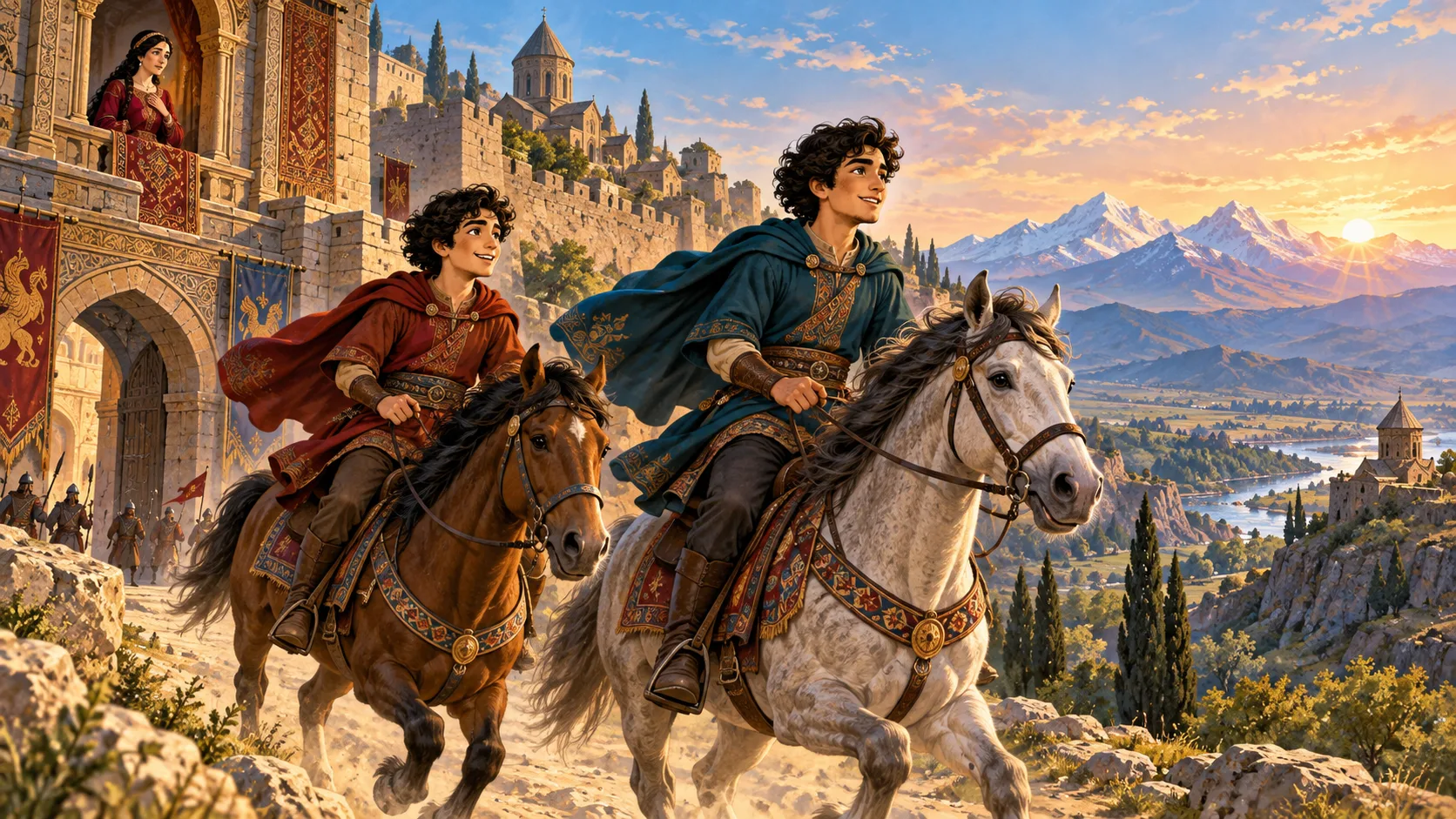
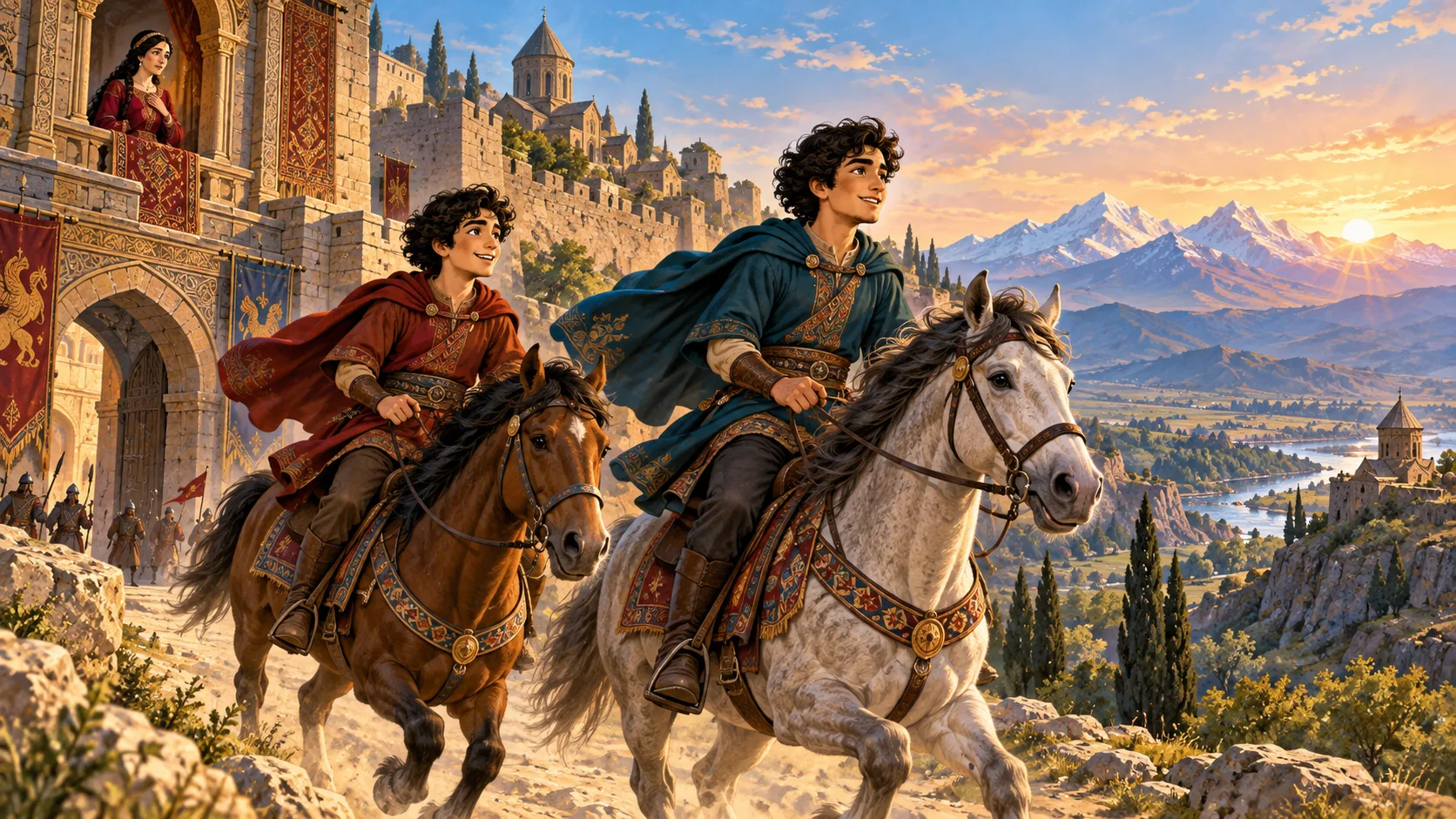
He brought out his horse, mounted and rode to his grandfather’s house.
His grandfather recognised his grandson by his resemblance to his mother.
They rejoiced greatly and talked.
Sanasar became so absorbed in their conversation
That he forgot his mother and brother.

Every day Baghdasar arose and went hunting.
Each day he brought back a wild sheep.
They would sit down to eat and drink
And make merry.
One day, when he had gone hunting,
The Caliph, still bound, said to the king’s daughter,
“Am I not wretched? May your house not fall!
Loosen my bonds a little.”
She arose, untied his bonds and laid them aside.

[page 49]

The Caliph arose—and what did he do?
He saw everyone and gathered them together.
He went to the city, to whatever nobles remained.
The Caliph’s men took counsel:
“What shall we do to free ourselves?”
One of the nobles said,
“Sanasar has gone; only Baghdasar remains.
Let us go and kill him.”
Another said, “We cannot kill him.
Let us invite him to a wedding and make him drunk,
Take him and throw him into a pit,
Heap thorns and brushwood over him and let him die.”
The Caliph said to his men,
“Come, fill seven camel-loads with sour wine
And take it to Mount Akhmakh.
Tomorrow I shall deceive Baghdasar and bring him there.
There we shall give him wine,
Make him drink until he is drunk, and kill him.”
The men arose and did so.

In the evening headstrong Baghdasar returned from hunting.
He saw that the Caliph had been released, but said nothing.
The Caliph said to him,
“Baghdasar, do you know what?”
He said, “What is it, Caliph?”
He said, “Let me take you to the Black Mountain.
I know a hunting ground
Where wild sheep and wild cattle
Have all gathered.
Let us go tomorrow and catch them all.
We shall make merry there
Until your brother comes back.”
Baghdasar said, “Very well, let us go.”
Thus he persuaded Baghdasar.

The next day they mounted their horses and rode away.
When they reached Mount Akhmakh,
From this side and that, with wine goblets in their hands,
People cried, “A thousand blessings to you, Baghdasar!”
And offered him wine from every side.

[page 50]

However much wine they brought, no one else drank it;
They gave it all to Baghdasar.
In this way they deceived Baghdasar
And made the seven-year-old sour wine go to his head.
Whenever anyone was given a cup of wine,
He said, “A thousand blessings to Baghdasar!”
Baghdasar cried, “Enough of your thousand blessings!
Fill the troughs, and let me drink.”
Baghdasar drank and became so drunk
That he collapsed helpless and unconscious.
The Caliph said to his men,
“Now take your maces and fall upon him.”
They took their maces and came to kill him.
Out of fear, they struck from a distance.
They struck and struck so much
That all around Baghdasar
They dug a trench, a pit
That was forty cubits deep.
By God’s command,
Not a single mace struck Baghdasar.

Sanasar went outside and looked at the sky.
He saw that Baghdasar’s star had darkened.
He thought to himself, “My brother is in distress.”
He turned and said to his grandfather,
“Alas, grandfather, I am leaving. Bring out my horse.
I shall reach my brother either for his funeral or for his feast.”
His grandfather said, “May your house not fall!
Your brother is sitting peacefully now,
Making merry with his mother.
He is rejoicing; let us rejoice with you too.”
Sanasar could not wait.
He arose and brought out his horse himself,
Mounted, and in the blink of an eye reached his mother.
“Mother, where is my brother Baghdasar?”
She said, “The Caliph took him out into the countryside.
They have gone to Mount Akhmakh to make merry.”
He said, “Ah, he has deceived my brother and taken him away!
Alas, they are going to kill my brother!”
No sooner had he spoken than he spurred on and reached Baghdasar.

[page 51]

He saw that Baghdasar had drunk so much
That he lay deeply drunk and unconscious.
The others had taken maces and swords
And were striking from every side to kill him.
Sanasar called upon God’s name,
Charged fiercely into their midst,
And brought down his heavy mace.
He drove the Caliph of Baghdad
Seven cubits into the ground,
And killed the Caliph and all his men.

He went and stood over his brother,
Poured water on his head, washed his head and rubbed his chest,
So that his drunkenness would pass and he would recover.
He called, “Baghdasar! Baghdasar!”
His brother regained consciousness,
Raised his head and said,
“Ah, may your house not fall!
I was sleeping so well, and you would not let me sleep.”
He said, “May your house not fall!
Get up and look around you.”

The two brothers arose and returned to the city.
Baghdasar called out,
“Whoever believes what I believe,
Let him come and pass beneath my sword.”
The whole city poured out and came,
And passed beneath his sword.

Their mother, Lady Tsovinar,
Bowed with her face to the ground,
Worshipped and said,
“I give thanks to you, Creator of heaven and earth,
For freeing us and our people
From the hands of that tyrant.”

[page 52]
Section 18

Section 18

18

They stayed there for a time.
Then they arose, took their mother and her elderly attendant,
And set out towards Armenia.
They drew near King Gagik’s city,
Pitched a tent beside a spring and rested.
They saw a man coming from the other direction,
Called him and said,
“Go and bring the king the happy news.
Carry our warm greetings to him and to Uncle Toros.
Say, ‘Your Tsovinar and her two sons
Have arrived safe and sound and are resting beside the spring.
May this news bring light to your eyes.’”
King Gagik and Uncle Toros
Arose and came to meet them.
They fell into one another’s arms,
Kissed, wept and laughed.
They ate and drank and made merry.
The king and Uncle Toros said,
“Come, get up; let us go to the city.”
They agreed and went to the city,
And lodged in the king’s palace.
For seven days and seven nights they rejoiced.

Sanasar said to the king,
“Grandfather, I ask one thing of you.”
He said, “What do you ask?”
He said, “In a certain place
We have built ourselves a house. Let us go there.”
The king answered,
“My son, I have no son.
When I die, my kingdom
Will be yours; it will be your home.”
They said, “No, king, may you live long!
We have come and seen you.
Thanks be to God, you are safe and well.
We have eased our longing for one another; now we shall go home.”

[page 53]

As they made their preparations,
Their mother advised her two sons,
“My sons, ask the king for these things.
Say, ‘Give us Tsovasar, the waters of Maratuk,
And Bazh and Koden of Chapaghjur.’
If he swears, ‘By the bread and the wine, by the living Lord,’ he will give them.”
Sanasar said to the king,
“We ask one more thing of you.”
“My sons,” said the king,
“Whatever you wish, apart from our souls—
By the bread and the wine, by the living Lord—we shall give it.”
They said, “Give us Tsovasar, the waters of Maratuk,
And Bazh and Koden of Chapaghjur.”
He said, “We give them, my sons.”
Lady Tsovinar and her boys arose,
Mounted and set off on their journey.
Uncle Toros went with them too.
Sanasar rode ahead,
And they went up to the fortress of Sasun.

Sanasar was a man of great might.
Around the Black Mountain and as far as Tstsmakakit,
Above Mush, he had raised a wall,
Extending to the belt of Mount Seghansar,
To Duran of Chapaghjur, at the mouth of the Murad River.
He ruled over all those lands.
He left four gates in his fortress.
He would always pass out through his gate,
Mount his horse, Kurkik Jalali,
And catch whatever wolves and wild beasts there were.
One day he rode as far as Msyr,
As far as the Batman Bridge and the Gorge of Anggh.

Sanasar became such a mighty warrior
That his fame spread throughout the world.
Many who heard of him said,
“Brother, why are we sitting here?
Thieves come time after time

[page 54]

And drive away our possessions.
By God, we shall go to that Sasun,
Where there are two mighty warriors
Like Sanasar and Baghdasar,
Where neither tribute nor tax is taken from the people,
And no one will seize and carry off our goods.”
Little by little, more and more went to join them.

Sasun grew and became a great city.

Explore more entries

Back to Epic