
ORGOV AND THE ORGOV SOLAR CALENDAR
From an Ancient Cultural Landscape to the Modern Exploration of Space
Orgov is located in Armenia’s Aragatsotn Province, on the southern slopes of Mount Aragats, among the hills and plateaus of the Amberd River valley. It should not be confused with the settlements of Syunik: Orgov belongs to the Ashtarak Municipality and is known for its archaeological landscape as well as its exceptional scientific heritage from the twentieth century.
The surroundings of Orgov contain monuments extending from the Late Bronze and Early Iron Ages into the medieval period. Archaeological remains include cyclopean fortresses, burial structures, menhirs, vishap stones and rock-cut roads. These monuments demonstrate that the slopes of Aragats formed an inhabited, protected and ritually significant landscape for thousands of years.
During the twentieth century, Orgov became associated not only with archaeology but also with modern astronomy and radiophysics. Between the villages of Orgov and Tegher, within the Aragats Scientific Centre, the ROT-54/2.6 radio-optical telescope was designed and constructed between 1975 and 1985 under the direction of Paris Herouni. Its system combines a fixed spherical radio mirror measuring 54 metres in diameter with an optical telescope whose mirror measures 2.6 metres. The monumental structure became one of the most impressive achievements of Armenian science and engineering.
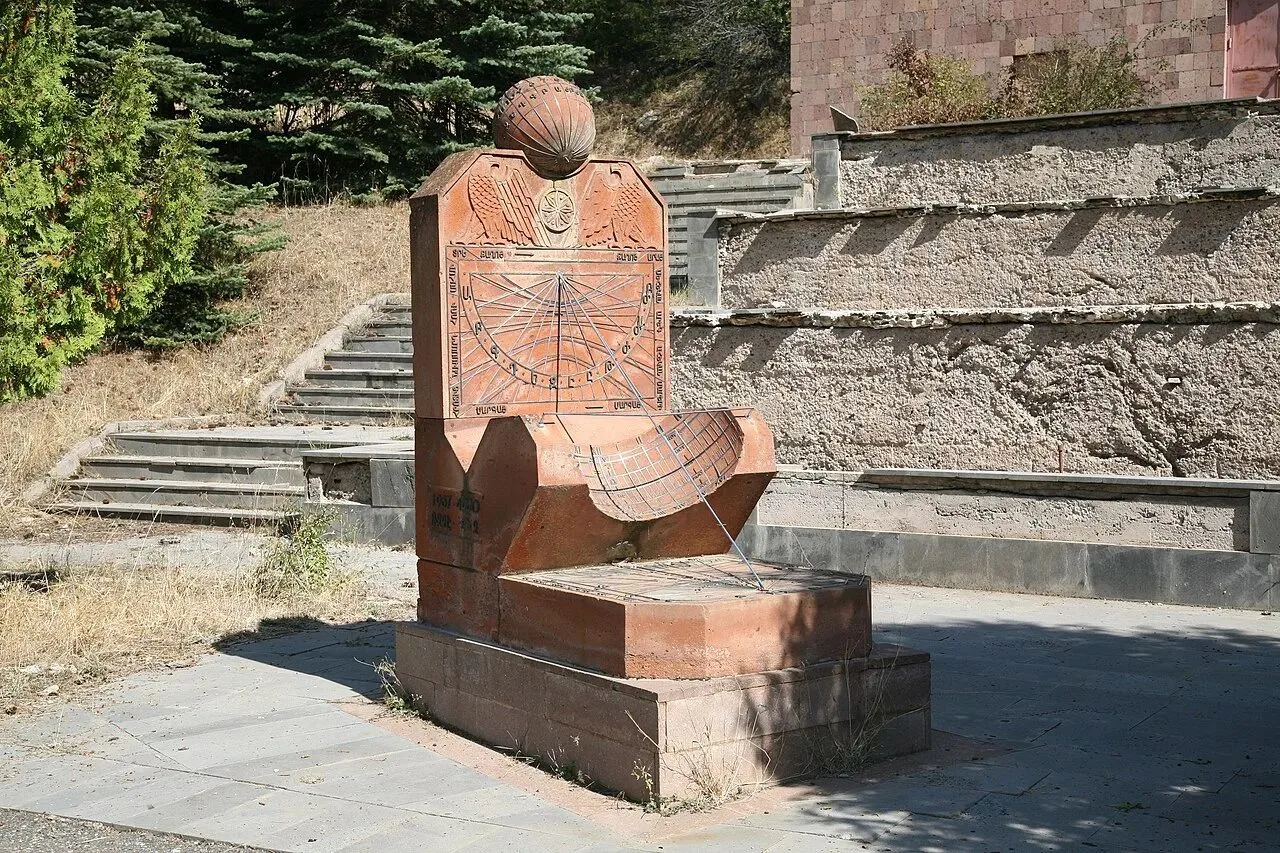
The Orgov Solar Calendar is also installed within the scientific complex. It is not an archaeological or pre-Christian monument but a twentieth-century scientific and artistic construction. Made of reddish tuff, it combines the principles of a sundial, a calendar and monumental sculpture. Hour and calendar divisions are carved across its surfaces, while metal rods serve as gnomons, casting shadows upon the corresponding lines.
The instrument indicates solar time, which is determined by the position of the Sun. During the day, the movement of the shadow marks the hours. As the seasons change, the shadow’s direction and length also change, providing an indication of the period of the year. The structure therefore does more than show the time: it makes the Earth’s rotation and the natural passage of time visible.
The symbolic decoration of the upper and frontal sections brings scientific meaning together with the expressive tradition of Armenian stone carving. A sphere resembling a celestial body, winged figures, a circular ornament and geometric grids give the calendar a monumental character. It was created as a tribute to astronomical and calendrical knowledge developed in Armenia and as a symbolic bridge between ancient methods of measuring time and modern science.
This connection must nevertheless be understood accurately. The Orgov Solar Calendar is not a surviving original Armenian calendar from antiquity, nor does it belong to Orgov’s Bronze Age archaeological complex. It is a modern authored work that interprets older astronomical ideas through the scientific language of the twentieth century.
Orgov is remarkable because several periods of human thought coexist within one landscape. Ancient fortifications and monoliths reveal the world of early communities; the solar calendar represents the measurement of time through celestial movement; and Herouni’s telescope expresses the ambition to explore the universe through advanced technology. Orgov is therefore a distinctive cultural and scientific landscape in which the heritage of the past and science directed towards the future exist beneath the same sky.