
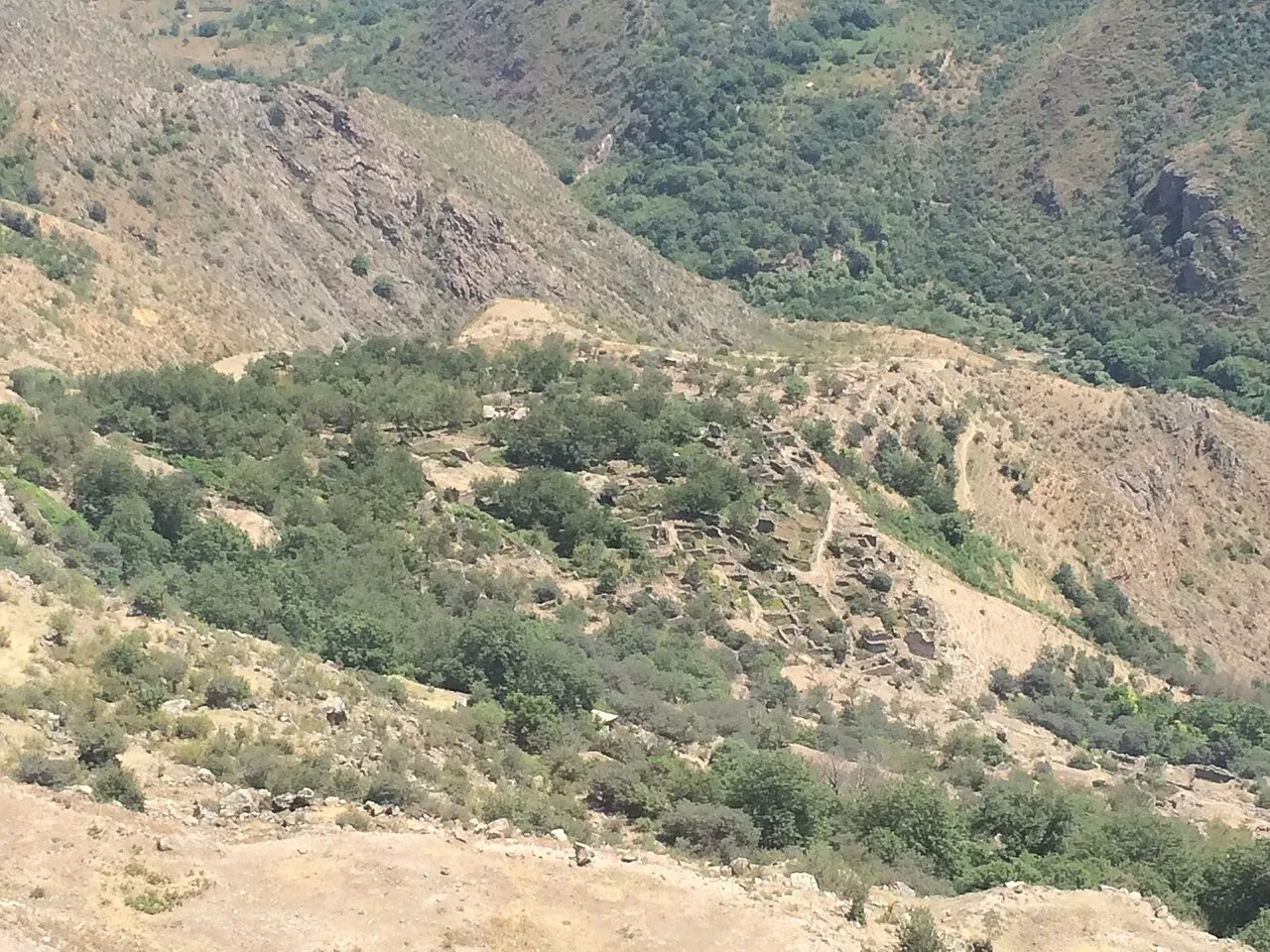
OLD HALIDZOR
A Historic Settlement Preserved in the Vorotan Gorge
Old Halidzor is located in Armenia’s Syunik Province, approximately three kilometres southwest of the present-day village of Halidzor, on an elevated slope above the left bank of the Vorotan Gorge. The ruins of stone houses, old pathways, a spring, a cemetery and a church form a historic environment in which the former structure of the mountain settlement remains visible. The site should not be confused with Halidzor Fortress near Kapan.
Halidzor was one of the ancient settlements of the historic district of Haband and has been mentioned in written sources since at least the beginning of the 10th century. According to historical accounts, Hamazaspouhi, daughter of Prince Barden of Syunik, donated the village to Tatev Monastery. Tarsayich Orbelian reconfirmed this possession in 1274, and Halidzor remained within Tatev’s economic and spiritual sphere for a considerable period.
The old village was built in direct response to the natural conditions of the mountainside. Houses occupied different elevations, while stone walls and retaining structures divided and reinforced the residential plots. Some of the former household lands continue to be cultivated, meaning that Old Halidzor has not been entirely separated from the life of the modern community.
At the centre of the settlement stands the Church of Saint Minas, built in 1611. It is a modest single-nave stone building and the best-preserved monument of Old Halidzor. Earlier khachkars were incorporated into its walls, including a 13th-century stone and the Khachkar of Shahandukht, dated to 1215. Their presence indicates that the site possessed spiritual importance before the construction of the existing church.
A cemetery dating from the 9th to the 20th centuries extends along the western edge of the settlement. Khachkars from the 9th–11th centuries survive there, demonstrating the village’s long history and the continuous presence of successive generations. A spring built in 1831 stands slightly north of the church and was once an important part of the community’s daily life.
During the 20th century, communal life gradually shifted to present-day Halidzor, leaving the old settlement partially ruined. Nevertheless, the remains of its houses, Saint Minas Church, the spring and the cemetery preserve a coherent image of the former village. The value of Old Halidzor does not lie solely in its individual monuments. It is a historic landscape where Syunik’s mountain environment, rural life, faith and the cultural memory associated with Tatev have become part of a single heritage.