
NORAVANK
The Spiritual Centre of the Orbelian Dynasty and an Architectural Masterpiece of Momik
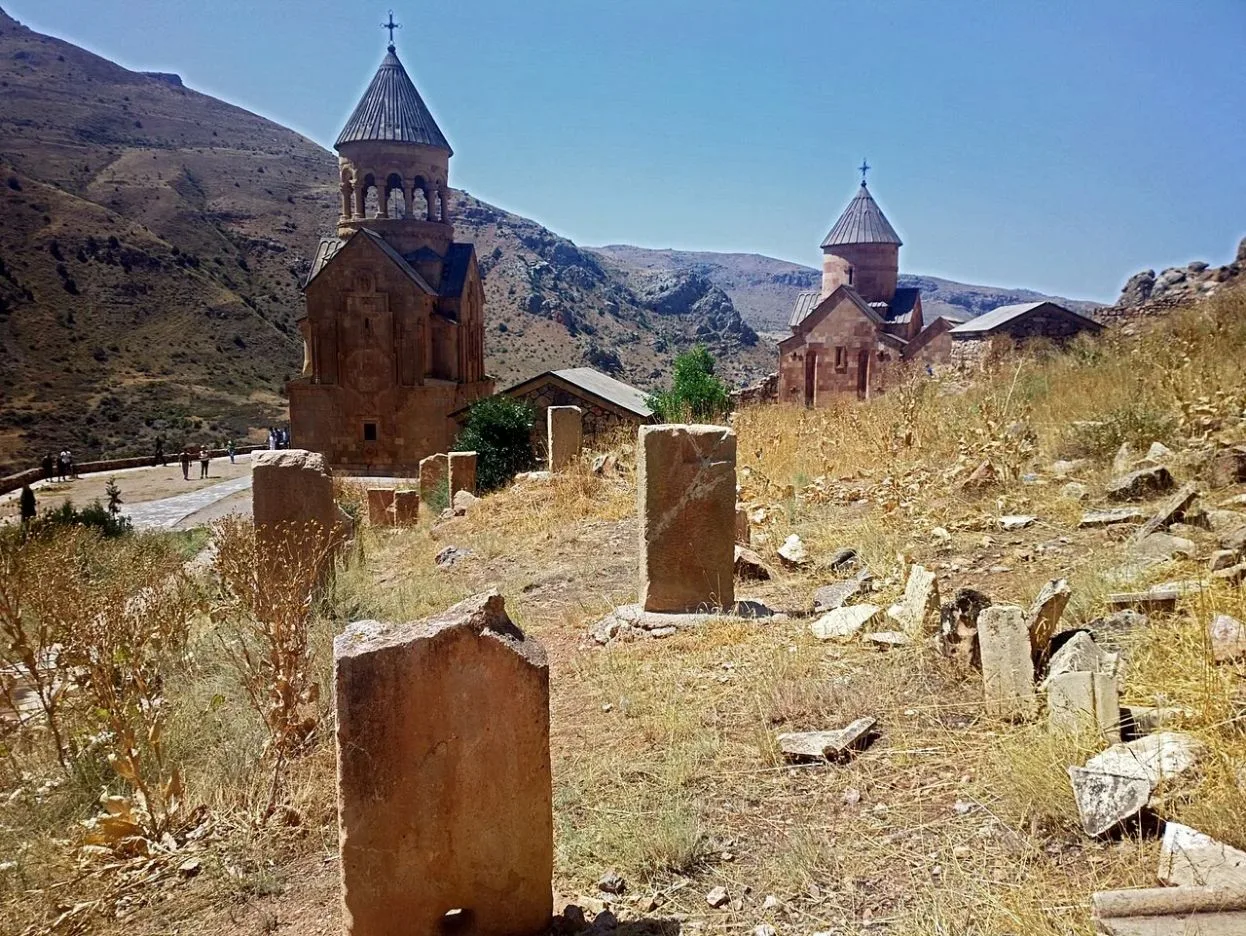
Noravank is situated in Armenia’s Vayots Dzor Province, within the narrow gorge of the Amaghu River, on a natural promontory surrounded by towering reddish cliffs. It is also known as Amaghu Noravank, after the nearby historic settlement. The warm tones of the monastery’s stone and the surrounding red rocks create a unified landscape in which architecture appears to continue the forms and colours of the mountains. The present complex took shape mainly during the 13th and 14th centuries.
The foundation of the monastery is traditionally associated with Bishop Hovhannes, but Noravank’s major historical development began in the 13th century, when it became one of Syunik’s principal spiritual centres. It served as a seat of the Metropolitanate of Syunik and brought together clerics, scribes, illuminators and architects. At the same time, it became one of the principal monasteries patronised by the Orbelian princes and their dynastic burial place.
One of the complex’s central buildings is the Church of Saint Karapet, constructed in the first half of the 13th century under the patronage of Prince Liparit Orbelian. A gavit built in 1261 and later altered adjoins its western side. Its dim interior, deep niches, khachkars and inscribed tombstones create a solemn atmosphere. The gavit functioned both as a place of assembly and as a setting for the commemoration of the Orbelian family.
The reliefs preserved on the western façade of the gavit are among Noravank’s most important works of art. The tympanum above the entrance depicts the Virgin and Child, while the upper composition contains a rare representation of God the Father. Expressive faces, vegetal ornament and exceptionally delicate stone carving demonstrate the skill of the artists who worked here.
The Chapel and Mausoleum of Saint Grigor was added to the northern side of Saint Karapet Church in 1275. Members of the Orbelian princely family were buried within it. Particularly notable is the tombstone of Elikum, son of Prince Tarsayich Orbelian, decorated with a lion bearing a human head. The symbolic figure combines ideas of princely power, courage and the preservation of memory after death.
Noravank’s most recognisable building is the two-storey Church of the Holy Mother of God, also known as Burtelashen. Completed in 1339 under the patronage of Prince Burtel Orbelian, it is associated with Momik, the celebrated medieval Armenian architect, sculptor and manuscript illuminator. The ground floor served as a princely mausoleum, while the upper level contains the church. Narrow exterior stairways climb along the western façade to the upper entrance, giving the structure a remarkable sense of vertical movement.
The façades of Burtelashen unite architecture and sculpture into a single artistic composition. Carved portals, representations of the Virgin, Christ and angels, the columned rotunda and the soaring dome transform the building into a complete system of stone imagery. Momik is also credited with Noravank’s delicately carved khachkar of 1308, while a modest khachkar beside the church is regarded as his memorial stone.
Noravank has endured numerous earthquakes and historical upheavals. Different structures were repaired or restored at various times, while archaeological excavation, consolidation and restoration were undertaken during the 20th century. These efforts helped preserve the monastery, although certain reconstructed elements continue to be discussed by specialists.
The importance of Noravank extends beyond the beauty of its individual churches. It brings together princely history, spiritual life, architecture, sculpture, khachkar art and the exceptional landscape of Vayots Dzor. Noravank Monastery and the Upper Amaghu Valley have been included on UNESCO’s World Heritage Tentative List since 1995, but the complex has not yet been formally inscribed as a World Heritage Site.