
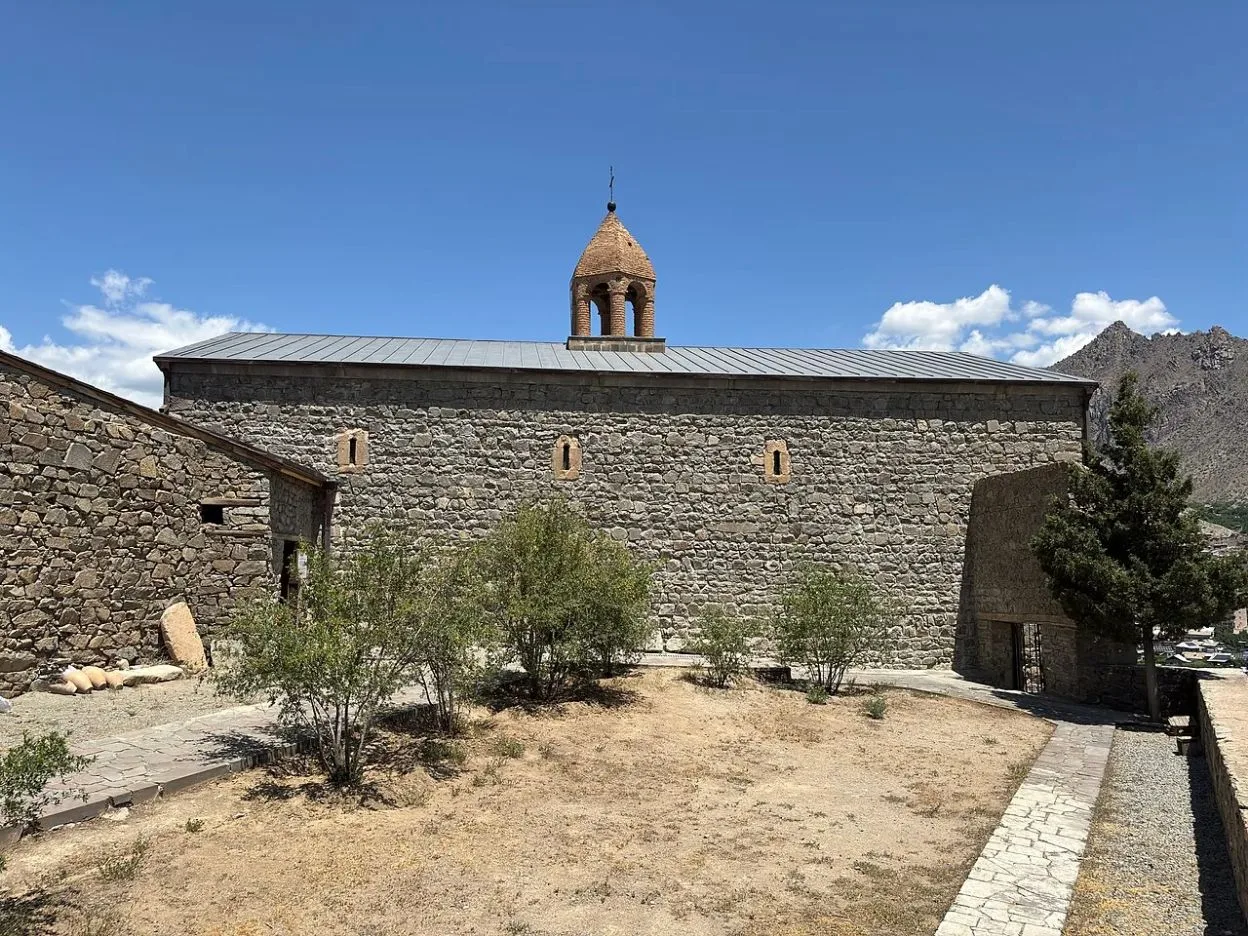
Church of Saint John the Baptist in Meghri
The Spiritual and Artistic Heritage of Meghri’s Small Quarter
The Church of Saint John the Baptist is located in the historic Small Quarter of Meghri in Armenia’s Syunik Province. In local tradition, it is also known as the Church of Saint Sarkis. Surrounded by old houses, narrow streets, gardens and stone walls, the church forms an inseparable part of Meghri’s historic urban landscape. It is particularly distinguished by its richly painted interior and is regarded as one of the important monuments of late medieval ecclesiastical art in Syunik.
The church was constructed in the seventeenth century, during a period when Meghri continued to possess commercial, defensive and communal importance. Despite the political instability of the region, the local population continued to build and restore churches, transforming them into centres not only of prayer but also of community organisation and cultural memory. The Church of Saint John emerged within this historical environment as one of the principal spiritual buildings of the Small Quarter.
Architecturally, the church is a three-nave basilica. Its rectangular prayer hall extends from east to west and is divided by two pairs of massive piers into a central nave and two side aisles. The central nave is wider and directs attention towards the sanctuary at the eastern end. Two-storey vestries are positioned on either side of the semicircular apse and were used to preserve liturgical vessels, books and other objects required for religious services.
The building is constructed mainly from locally quarried, roughly dressed basalt. The natural dark colour and irregular surface of the stone give the church a restrained and solid appearance, harmoniously connecting it with Meghri’s traditional stone-built houses. Its exterior decoration is modest, and its architectural expression is created primarily through simple proportions, massive walls and the contrast between the heavy main structure and its lighter upper elements.
A small six-column brick bell tower rises from the central section of the roof. Its open rotunda lightens the church’s strict horizontal volume and introduces a vertical accent into the overall silhouette. The combination of stone and brick is characteristic of several religious buildings in Meghri and reflects the union of local building traditions with practical architectural solutions.
The church’s principal artistic treasure is its extensive system of interior murals. The walls, piers, arches, sanctuary and vestries are covered with biblical and hagiographic images. The main layer of the paintings is associated with the late medieval period, while certain sections were renewed or supplemented at later dates. This layered character demonstrates that the church remained active over a long period and that successive generations continued to care for and decorate it.
The paintings include the Nativity of Christ, the Crucifixion, the Resurrection, the Virgin Mary, apostles, prophets, saints and other biblical scenes. The figures are frequently framed by rich vegetal and geometric ornaments. Strong colour contrasts, expressive faces and a clear narrative structure make the scenes direct and easily understandable. The murals served not only a decorative but also an educational function, transforming the church walls into a spiritual book narrated through images.
A defining characteristic of the church is the combination of late medieval Armenian ecclesiastical art with local folk artistic traditions. Canonical Christian images are presented in a simple and human manner, while the decorative patterns resemble the carved woodwork and painted interiors of Meghri’s traditional houses. The church’s art therefore belongs to the wider Armenian ecclesiastical tradition while also expressing the distinctive cultural identity of Meghri.
Over time, the structure and murals were damaged by moisture, natural deterioration and unsuitable interventions. During conservation and restoration works carried out in the twenty-first century, the church’s structural elements were reinforced, its roof was restored, and the murals were cleaned and conserved. The work was completed in 2019, after which the church reopened to worshippers and visitors.
The significance of the Church of Saint John the Baptist lies not only in its architectural age. It remains a living centre of the historic quarter, bringing together religious tradition, urban life, folk art and communal memory. The church demonstrates that distinctive cultural centres developed even in Armenia’s remote southern settlements and that their heritage is equally important for understanding Armenian architecture, painting and historical identity.