
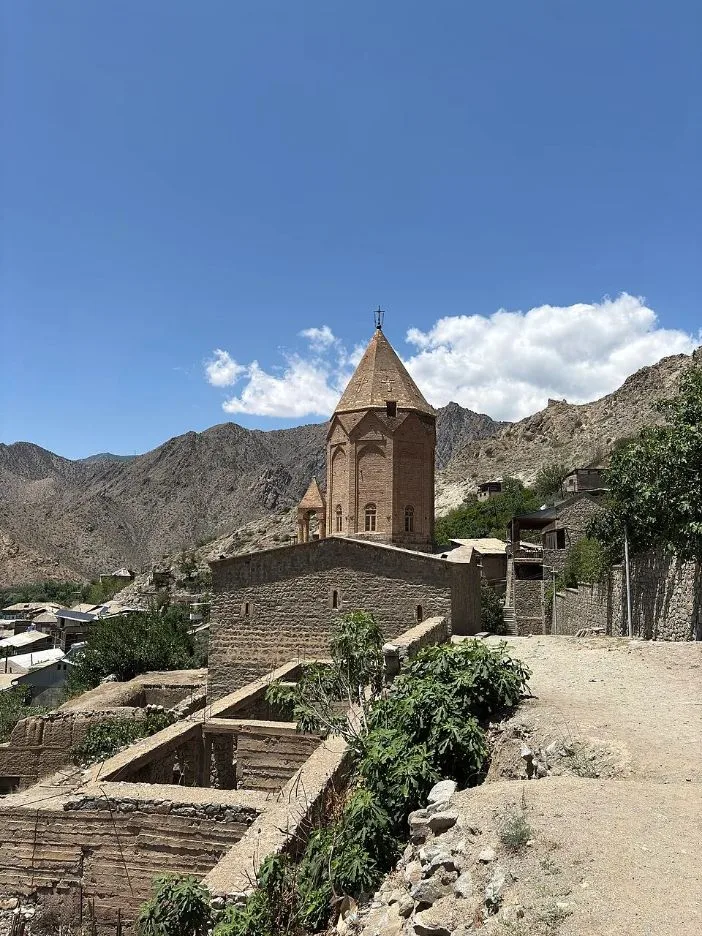
Church of the Holy Mother of God in Meghri
Architecture and Frescoes in Meghri’s Great Quarter
The Church of the Holy Mother of God stands in the Mets Tagh, or Great Quarter, of Meghri in Armenia’s Syunik Province, in the elevated northern part of the town near the foot of Meghri Fortress. Surrounded by old houses, gardens, stone walls and steep mountain slopes, it forms an integral part of Meghri’s historic urban environment. The church is distinguished not only by its architectural volume but also by the wall paintings preserved inside, which make it one of the most important monuments of Syunik’s late medieval and modern cultural heritage.
The church was founded in 1673 and belongs to the group of seventeenth-century Armenian domed churches. Its construction took place during a period when the communities of Syunik continued to restore and develop their spiritual centres despite political instability and economic hardship. Meghri, an important trading and communication centre in the Araks Valley, maintained an organised communal life in which churches and monastic institutions played a central role.
The Church of the Holy Mother of God is a four-pier domed basilica. Its rectangular structure extends from east to west, while the interior is divided into three naves. The central nave is considerably wider than the side aisles, emphasising the principal spatial axis directed towards the sanctuary. Four massive piers support the dome structure and organise the interior by dividing it into interconnected areas for prayer, movement and liturgical ceremonies.
The main walls are constructed from local dark stone, principally basalt. The comparatively rough masonry corresponds to the character of Meghri’s traditional houses and defensive structures. In contrast to the heavy stone body of the church, the drum and dome are built of brick. Octagonal on the outside and cylindrical within, the drum rises on a stone ring and is connected to the square beneath the dome by pendentives. The combination of stone and brick gives the church a distinctive appearance while reducing the weight of its upper structure.
The church has two entrances, one on the western side and another on the south. Its exterior decoration is restrained and lacks an elaborate system of carved ornament, allowing the simple and powerful volume of the building to dominate. A small bell tower rises above the pitched roof on the southern side. Its slender form contrasts with the massive rectangular body of the church and completes its silhouette against the mountainous landscape of Meghri.
The principal artistic treasures of the church are its interior wall paintings. Its plastered walls, piers, sanctuary and side chambers are decorated with nineteenth-century compositions, most of which are dated to the 1840s. They are regarded as valuable examples of Armenian ecclesiastical painting from this period and are associated with the artistic traditions of the Hovnatanian school. The names of the painters have not survived, but the structure of the compositions, their use of colour and the expressiveness of the figures demonstrate the work of experienced masters.
The murals depict narratives from the Old and New Testaments. Among the subjects represented are Adam and Eve, the Nativity of Christ, the Crucifixion, the Resurrection, the martyrdom of Saint Stephen the Protomartyr, images of saints and extensive scenes of the Last Judgement. The paintings were intended to do more than decorate the interior. They served the congregation as a visible theological narrative, helping worshippers understand the ideas of sin, repentance, sacrifice, salvation and eternal life through images.
A defining feature of the Meghri murals is their direct and narrative language. The figures are presented through clearly understandable actions, while strong colour contrasts make the scenes legible even from a distance. Local folk artistic thought is combined with the established conventions of Christian iconography. This combination makes the murals both solemn and deeply human, bringing sacred narratives closer to the everyday understanding of ordinary worshippers.
The location of the church within the historic quarter is also significant. It is not an isolated monastic structure but a natural centre of a residential environment. For centuries, the ritual and communal life of the neighbourhood developed around the church. Baptisms, marriages, memorial services and community gatherings were held there. The immediate proximity of the houses demonstrates that the church was not a distant sanctuary for the inhabitants of Meghri but an inseparable part of their everyday life, family memory and identity.
The Church of the Holy Mother of God in Meghri is valuable as a unified monument of architecture, painting and historic urban life. The contrast between its restrained exterior and richly painted interior reveals an important characteristic of Armenian ecclesiastical art: within simple stone walls, a symbolic world was created in which biblical history became part of the community’s spiritual memory. The church demonstrates that cultural life in seventeenth- to nineteenth-century Syunik not only continued but produced a heritage distinguished by local individuality and considerable artistic value.