
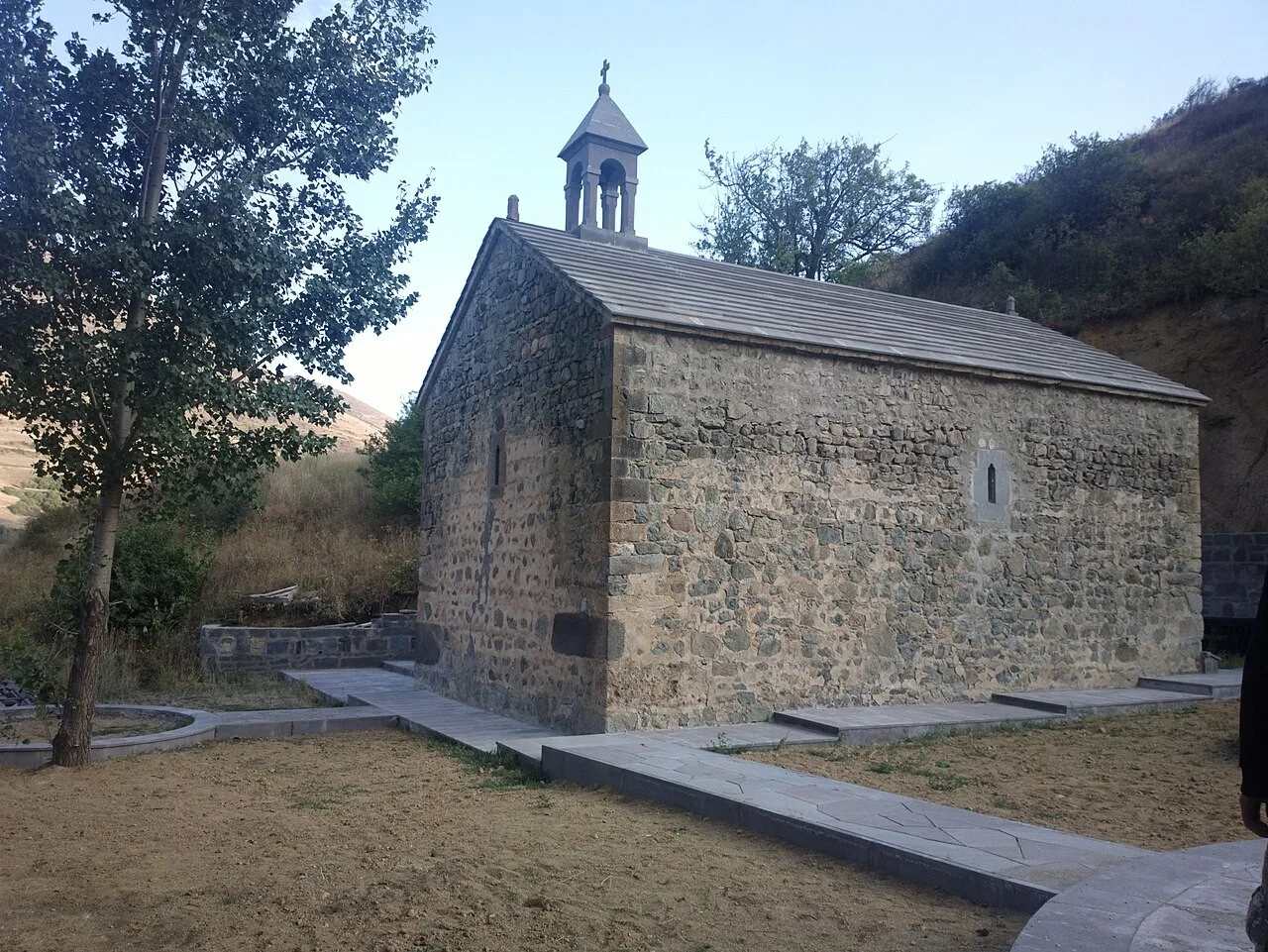
TSARU SAINT HOVHANNES CHURCH OF LOR
A Historic Pilgrimage Site and a Restored Spiritual Heritage
Tsaru Saint Hovhannes Church is located in Armenia’s Syunik Province, approximately half a kilometre south of the village of Lor, on a hillside within the historic settlement of Mardakayr. Built in 1686, it is an important monument of the late medieval spiritual heritage of the Lor area. Its position slightly apart from the inhabited village gives the church the silence and close relationship with nature traditionally associated with pilgrimage sites.
The church was built during the 17th century, when the settlements of Syunik continued to preserve their religious centres despite difficult political and economic conditions. Small village churches served not only as places of prayer but also as centres of community unity, family remembrance and the transmission of local traditions. Tsaru Saint Hovhannes likewise remained connected with the religious life of Lor and neighbouring communities for centuries.
The name “Tsaru” is associated with the historic name of the site and with folk traditions that developed around it. Local historical accounts also describe the sanctuary as a pilgrimage site connected with older traditions of reverence for trees and water. The survival of such memories around a Christian church demonstrates how natural places could gradually receive new spiritual meanings and continue to function as centres of prayer and pilgrimage.
The original monument was a modest stone church with a gavit attached to its southern side. Khachkars and funerary monuments survive around the church, including one dated to 1423. These monuments suggest that the site possessed religious and commemorative importance before the construction of the present church. Saint Hovhannes is therefore not merely an isolated building but a small historical environment preserving the memory of several centuries.
Over time, the church suffered extensive damage and was reduced to an almost completely ruined state. Nevertheless, it never lost its meaning for the local population and the religious community. Construction and restoration work carried out over several years was completed in 2024, returning the historic church to a coherent architectural form.
The ceremonies of opening the doors and blessing the renovated sanctuary were held on 9 May 2025, and the church was reconsecrated on 10 May under the leadership of the head of the Diocese of Syunik. Following its restoration, Tsaru Saint Hovhannes reopened to worshippers as an active spiritual centre and a place of community gathering.
The value of Tsaru Saint Hovhannes Church is not limited to its age. It preserves the memory of a historic settlement, the traditions of local pilgrimage and the determination of a community to return spiritual life to a ruined monument. Its story demonstrates that heritage preservation is not merely the restoration of stone walls but also the renewal of the connection between the past and future generations.