
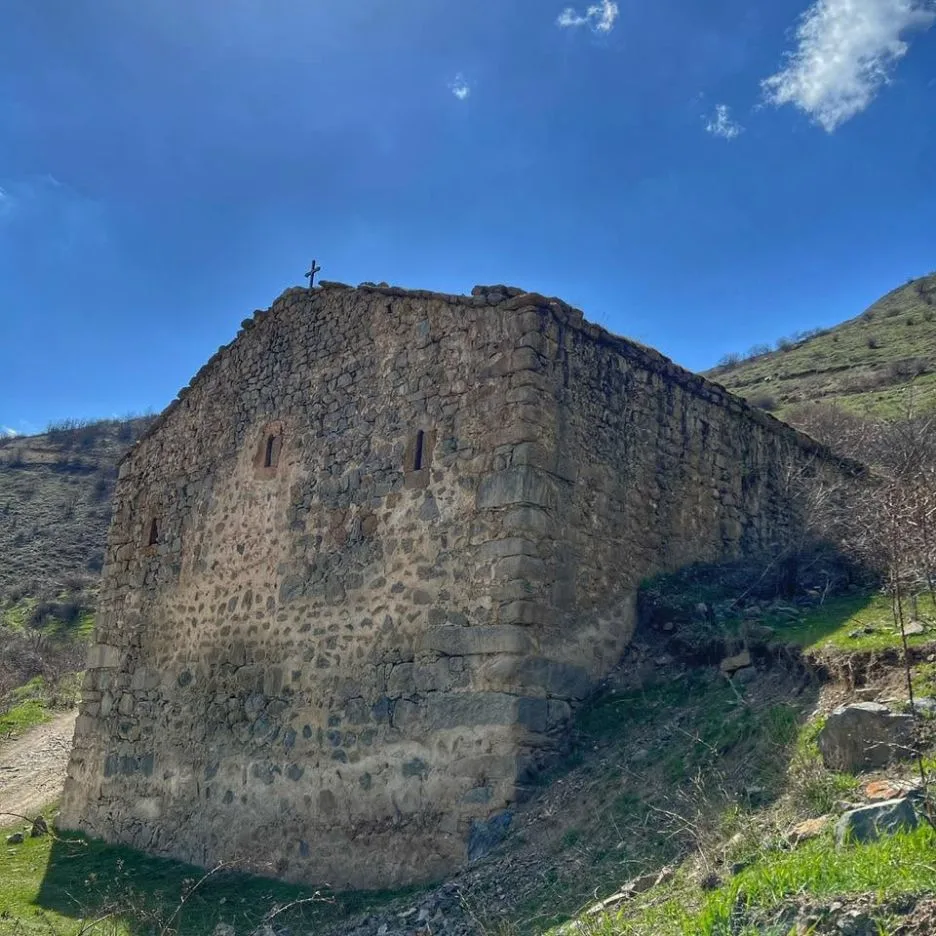
Krdikants Church of the Holy Mother of God
The Spiritual Memory of a Historic Settlement near Lernadzor
The Church of the Holy Mother of God of Krdikants is situated within the territory of Lernadzor in Armenia’s Syunik Province, approximately four kilometres east of the town of Kajaran. It was constructed in the former settlement of Krdikants and is now the most important surviving monument preserving the history of that community. Standing within a mountainous landscape, the church represents not only the late medieval architecture of Armenia but also the spiritual life, collective memory and historical continuity of Syunik’s smaller settlements.
Krdikants was a settlement with a centuries-old history. According to local tradition, its name is associated with Prince Kurdik, who built the Church of the Holy Mother of God. Surviving information indicates that the church was renovated in 1661, and it is therefore generally classified as a seventeenth-century monument. The renovation may, however, have taken place on the site of an earlier sanctuary. This is characteristic of many rural Armenian churches, beneath or around which earlier architectural and cultural layers have often survived.
The dedication to the Holy Mother of God is connected with the particular reverence for the Virgin Mary within the Armenian ecclesiastical tradition. Churches bearing this name were especially widespread in rural communities, where the Mother of God was regarded as the spiritual protector of the family, motherhood, the community and the settlement itself. For the inhabitants of Krdikants, the church was not only a place of liturgy and prayer but also the centre of important moments in life, including baptisms, marriages, memorial services and communal gatherings.
The church is built of local stone and possesses the restrained and solid character typical of the rural churches of late medieval Syunik. Its elongated hall, thick stone walls, small openings and modest exterior decoration correspond to the natural and practical conditions of a mountain settlement. Its architectural value does not depend on elaborate carving. Instead, it is expressed through simple proportions, the natural appearance of the stone and the harmonious relationship between the structure and the surrounding rocky landscape.
The church grounds have preserved traces not only of religious activity but also of the settlement’s everyday history. During archaeological investigations, the interior and surroundings were cleared of layers of soil and vegetation accumulated over many years. The outer walls, plastered floor, natural rock formations and remains of former village structures were uncovered. Archaeologists discovered several child burials and the burial of an adult, a hearth, traces of a traditional oven and stone walls, fragments of late medieval pottery and glazed vessels, animal bones, parts of church furnishings and a fragment of a silver ornament. These finds demonstrate that the church stood within a living settlement and was closely connected with the daily, ritual and family life of its inhabitants.
During the Soviet period, when many Armenian churches were deprived of their religious function, the Krdikants Church of the Holy Mother of God was also used as a storage building. In 1958, the inhabitants of the old village were relocated southeastwards to the territory of present-day Lernadzor. The former settlement gradually became deserted, while the church remained its principal surviving monument. Over time, it therefore also acquired the meaning of a memorial symbol connecting the residents of Lernadzor with the ancestral settlement of their families.
The restoration of the church began in 2022 and was accompanied by archaeological research and scientific planning. The hall, clergy area, sanctuary and vestries were restored, basalt slabs were installed, and a new carved wooden door and a bell tower reflecting the architectural traditions of the region were added. Damaged sections of the roof and walls were cleared and reinforced. During the improvement of the surrounding area, archaeological layers, natural rocks and the remains of the traditional oven and older walls were preserved. This approach restored the church’s function without transforming its surroundings into a modern urban environment.
On 9 September 2023, the restored church was reconsecrated and returned to spiritual service. The event was particularly meaningful for the inhabitants of Lernadzor, because the revived sanctuary reconnected the community with its historical past. The new life of the church represented not merely the rescue of an architectural monument but also the restoration of a spiritual tradition that had been interrupted.
The value of the Krdikants Church of the Holy Mother of God does not lie in its size or magnificence. It is a monument embodying the historical memory of a small community. Its stones preserve the different stages of the settlement’s foundation, development, abandonment and revival. The church reminds us that cultural heritage is formed not only by great monasteries and celebrated cathedrals, but also by the modest sanctuaries of remote villages, around which the faith, identity and communal life of generations were shaped.