
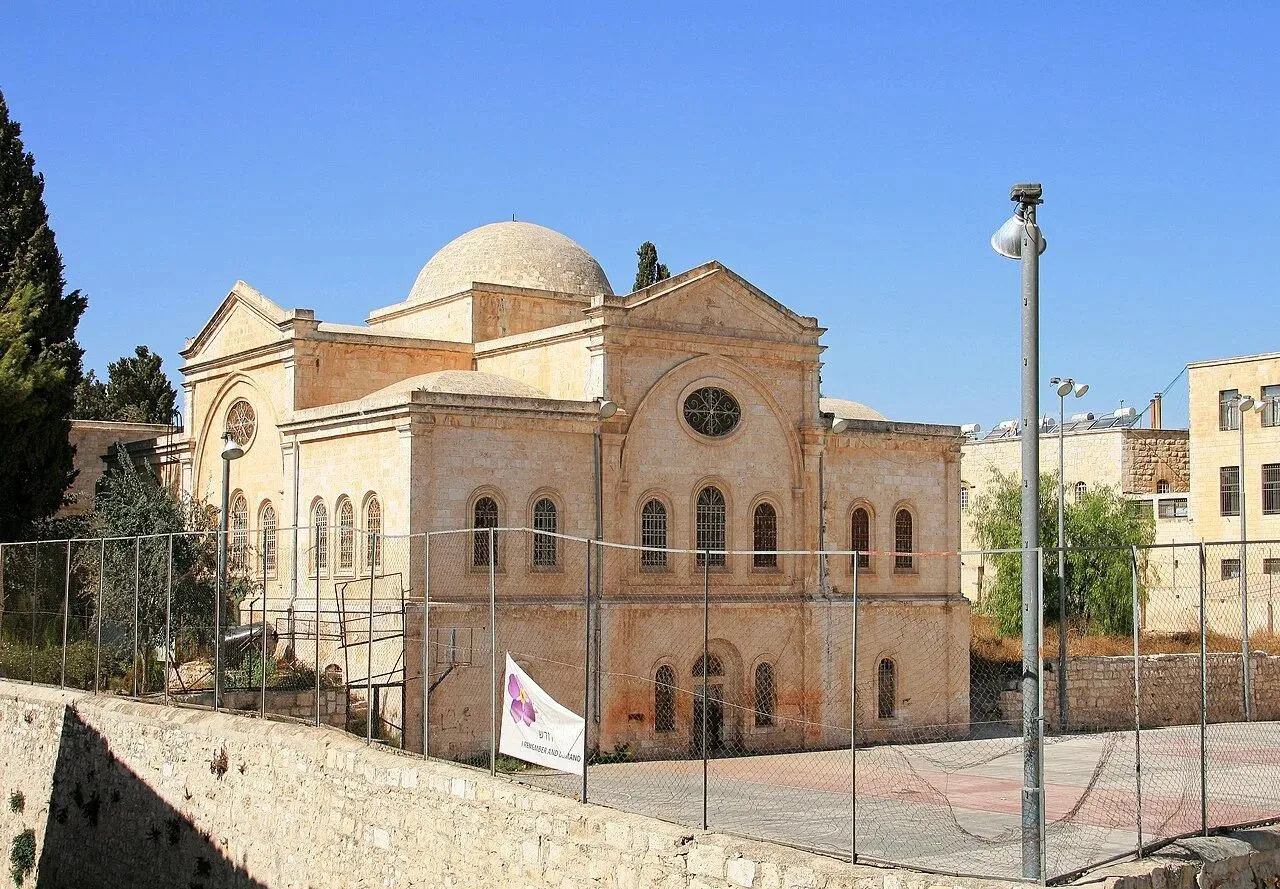
CHURCH OF THE HOLY ARCHANGELS
Jerusalem
The Church of the Holy Archangels is one of the historic Armenian sanctuaries of Jerusalem’s Old City. It stands southeast of the Armenian Cathedral of Saint James, close to Zion Gate and the city walls, near the Armenian Monastery of Saint Saviour. The complex is also known by the Arabic name Deir ez-Zeitun, meaning the “Monastery of the Olive Tree,” and occasionally as Deir el-Tuffah, the “Monastery of the Apple Tree.”
Armenian ecclesiastical tradition connects the site with the Passion of Christ. According to this tradition, the house of Annas, the father-in-law of the high priest Caiaphas, once stood here. Following His arrest in the Garden of Gethsemane, Christ is believed to have been brought to this place and bound to an olive tree in the courtyard. One chamber of the complex has also traditionally been venerated as a place of His temporary imprisonment. These accounts belong to sacred tradition rather than to archaeologically established history.
The precise date and circumstances of the church’s construction remain uncertain. Research nevertheless indicates that the monastery was an Armenian possession from at least the twelfth century, while Western pilgrims began mentioning it regularly from the fourteenth century onward. From the seventeenth century until the middle of the twentieth century, the complex also functioned as an Armenian convent for women.
The monastery underwent important renovations during the tenure of Armenian Patriarch Gregory the Chainbearer in the first half of the eighteenth century. Between 1726 and 1737, the interior walls were decorated with Armenian tiles produced in the workshops of Kütahya. These tiles formed part of the distinctive artistic tradition developed within Jerusalem’s Armenian sanctuaries.
During the Middle Ages, the Monastery of the Holy Archangels was also an important centre of Armenian manuscript production. Colophons reveal that numerous manuscripts were copied and illuminated there. More than a dozen manuscripts created at the monastery are known from the fourteenth century alone.
The complex preserves an exceptionally rich collection of Armenian inscriptions, pilgrims’ graffiti and khachkars. More than seventy inscriptions and carved commemorations have been recorded at the site. They preserve the names of pilgrims, prayers, donations and evidence of restorations, revealing the enduring relationship between Armenians from different regions and the Holy City.
Today, the church remains under the care of the Armenian Patriarchate of Jerusalem. It represents a living part of Armenian Jerusalem, bringing together Gospel tradition, medieval monastic life, manuscript culture, epigraphic heritage and the centuries-old Armenian presence in the Holy Land.