
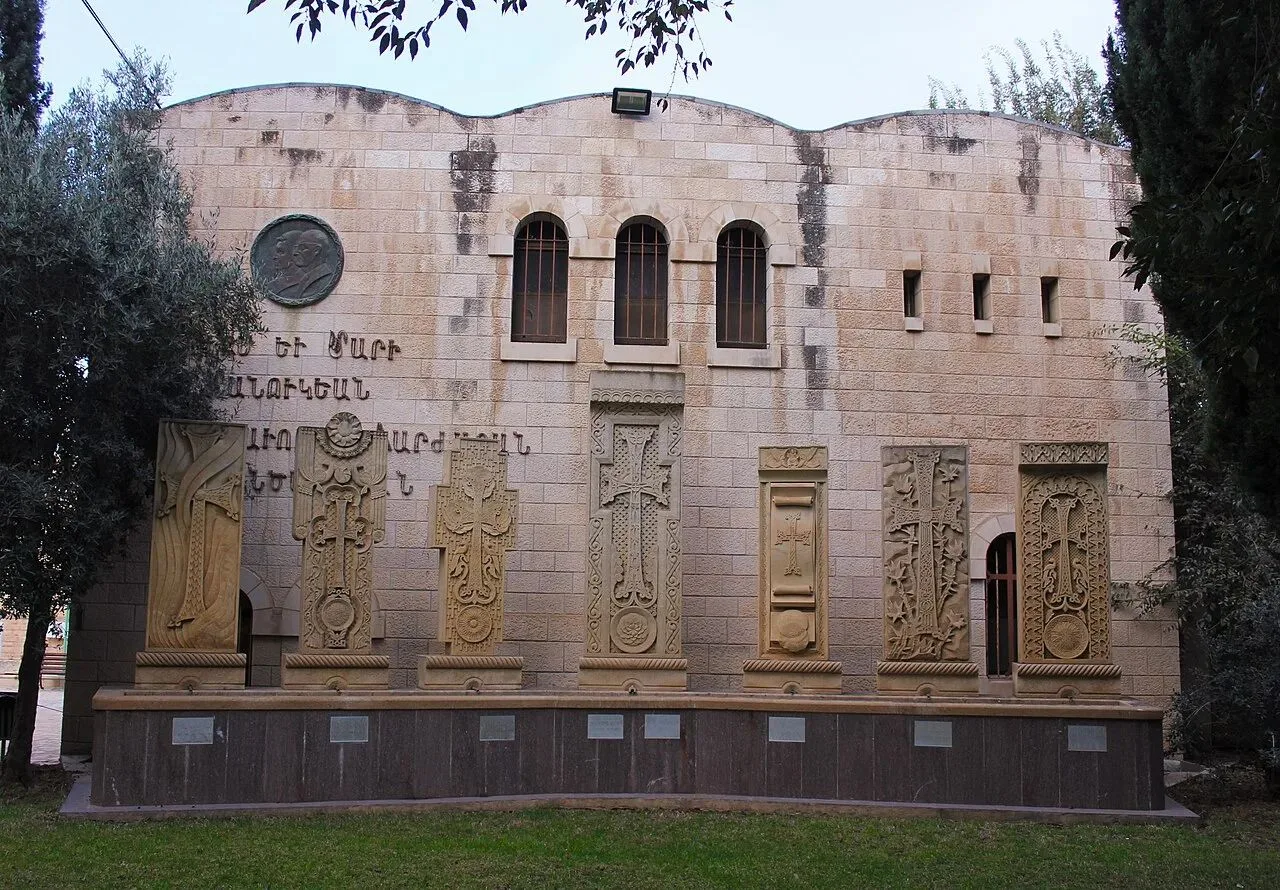
THE THEOLOGICAL SEMINARY OF THE ARMENIAN PATRIARCHATE OF JERUSALEM
Jerusalem
The Jarangavorats Seminary of Jerusalem is one of the most important institutions of spiritual education within the Armenian Apostolic Church. It operates under the authority of the Armenian Patriarchate of Jerusalem and the Brotherhood of Saint James, preparing generations for ecclesiastical service, spiritual leadership and the guardianship of Armenian holy places in the Holy Land.
The school was founded in 1843 in Ramla during the patriarchate of Zacharia of Kope and was transferred to Jerusalem the following year. Educational buildings were constructed near the Patriarchate during the mid-nineteenth century. In 1975, a new complex was inaugurated and named the Alex and Marie Manoogian Jarangavorats School and Theological Seminary, honouring its benefactors.
The Armenian term jarangavor means “heir.” It refers to students called to inherit the spiritual, liturgical and cultural traditions of the Armenian Church and transmit them to future generations. The curriculum includes Armenian language and literature, Armenian history, general academic subjects, theology, Church history, Holy Scripture, philosophy, liturgics, Armenian sacred chant and ecclesiastical music. Academic study is combined with prayer, disciplined communal life and liturgical service in the holy places of Jerusalem.
The educational process consists of interconnected stages. The school provides general and Armenian studies, while the seminary offers advanced theological and ecclesiastical formation. Its purpose is not merely to transmit knowledge, but to cultivate a spiritual vocation, a sense of responsibility and a life devoted to service.
Distinguished representatives of Armenian ecclesiastical and intellectual life taught at the institution, including Yeghishe Tourian, Torkom Koushagian, Papken Gulesserian, Tiran Nersoyan, Shnorhk Kaloustian, Hagop Oshagan, Shahan Berberian and Norayr Bogharian. Their contribution transformed the seminary into an important centre of theological education, Armenian studies, literature, language and ecclesiastical culture.
The role of the seminary became especially significant during the twentieth century. Following the Armenian Genocide and the loss of numerous spiritual institutions in the historical Armenian homeland, Jerusalem remained one of the principal centres where Armenian clergy could receive systematic education. Graduates were sent to serve Armenian communities in the Middle East, Europe, the Americas and other regions. Following Armenia’s independence, students from Armenia were also admitted to the institution.
The school’s educational environment is shaped by its proximity to the sacred places of the Holy Land. Students encounter Christian history not only in books, but also in the locations associated with the central events of the Gospel. They participate in services at the Church of the Holy Sepulchre, the Cathedral of Saint James and other Armenian sanctuaries of Jerusalem.
The significance of the Jarangavorats Seminary extends beyond the formation of clergy. It safeguards the continuity of Armenian Jerusalem by bringing together education, faith, the Armenian language, sacred music, historical memory and responsibility for the holy places. Each new generation becomes an heir to the heritage that Armenians have created and preserved in the Holy Land for centuries.