
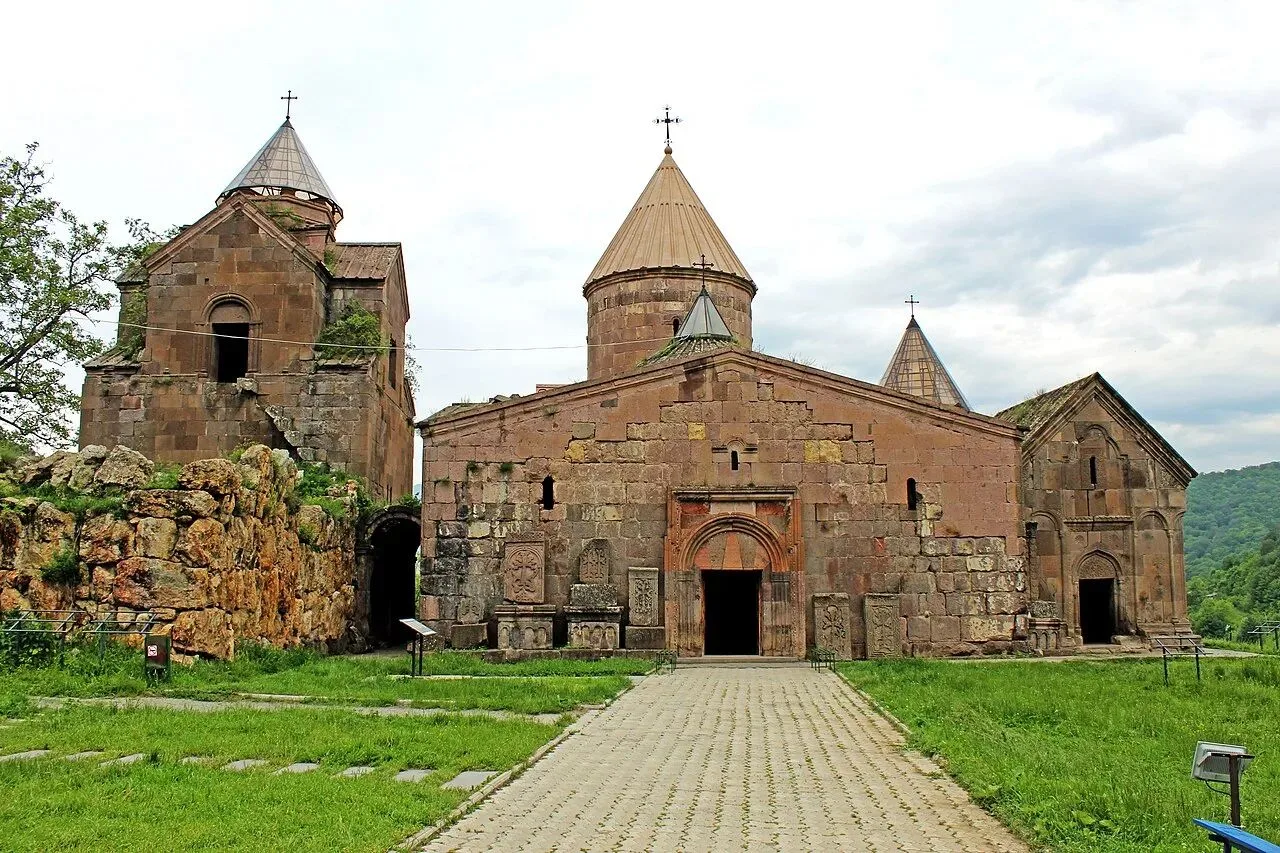
Goshavank
A Centre of Faith, Learning and Legal Thought
Goshavank is located in the village of Gosh in Armenia’s Tavush Province, amid the forested mountains and valleys of Dilijan. It was one of the most important spiritual, educational and cultural centres of medieval Armenia. The monastery complex took shape during the twelfth and thirteenth centuries and is inseparably connected with the name of Mkhitar Gosh, the renowned Armenian thinker, jurist, fabulist and clergyman. Its architecture creates more than a place of worship. It forms an entire environment in which faith, education, legal thought, literature and art developed side by side.
The history of Goshavank began after the earthquake of 1186, which destroyed the monastery of Old Getik. With the support of the princely houses of his time, Mkhitar Gosh initiated the construction of a new monastic complex. It was initially known as New Getik, but after the death of Mkhitar Gosh it was renamed Goshavank in honour of its founder. This change of name was not accidental, since the spiritual and intellectual identity of the monastery had developed around the work of Mkhitar Gosh.
Mkhitar Gosh was one of the most influential representatives of medieval Armenian thought. His Law Code systematised social, legal and moral relations by connecting law with Christian principles of justice and responsibility. Goshavank became a place where legal thought was not limited to theoretical writing. It was transmitted to students, discussed among clergymen and scholars, and applied to social life. For this reason, Goshavank may be understood not only as a monastery but also as a medieval Armenian intellectual institution.
The monastery contained a school, a library, a scriptorium and an educational centre. Theology, history, philosophy, law, music, miniature painting and manuscript writing were studied here. The educational traditions of Goshavank were continued by Vanakan Vardapet, Kirakos Gandzaketsi and other prominent intellectuals. Through their work, the monastery’s influence extended far beyond its own territory, while the knowledge and teaching practices developed there spread to other Armenian spiritual and educational centres.
The principal building of the complex is the Church of the Holy Mother of God, constructed at the end of the twelfth century. It is a developed example of the Armenian cross-domed church, distinguished by restrained exterior volumes, balanced proportions and carefully designed architectural accents. The interior is organised around the altar and the dome, creating a sense of height, inner silence and spiritual concentration.
The gavit adjoining the church on its western side served not only as an entrance hall but also as a place for gatherings, teaching, discussions and commemorative ceremonies. Its roof, supported by four columns, and its central opening for light create a balanced and solemn interior. This multifunctional character was typical of medieval Armenian gavits, where spiritual, educational and communal life often came together within the same space.
The complex also includes the churches of Saint Gregory and Saint Gregory the Illuminator. Although relatively small, the Church of Saint Gregory the Illuminator is one of the most refined buildings at Goshavank. Its outer walls are richly decorated with vegetal and geometric carvings, blind arcades and carefully designed windows. Here, stone seems to lose its weight and become a delicate woven surface, demonstrating the high technical and artistic level of Armenian craftsmen in the thirteenth century.
Another important structure is the library-bell tower. Its lower level was intended for the storage of books and manuscripts, while its upper section later served as a bell tower. Manuscripts were copied, decorated and preserved here. In medieval monasteries, copying and illustrating manuscripts were not considered merely technical activities. They were understood as forms of spiritual service and as methods of preserving knowledge and transmitting it to future generations.
Among the most celebrated artistic treasures of Goshavank are the khachkars carved by the master Poghos. Their surfaces are covered with extremely intricate cruciform, vegetal and geometric compositions. Almost no section of the stone remains undecorated, and every detail is integrated into a unified symbolic structure. The central cross is represented as the axis of life, salvation and eternity, while the surrounding ornaments create the impression of stone lace. These khachkars are considered among the greatest achievements of medieval Armenian sculpture.
One of the defining characteristics of Goshavank is the natural unity between its architecture and the surrounding landscape. The monastery does not stand in opposition to the mountains and forests. The use of local stone, the restrained colour palette and the gradual arrangement of the buildings connect the complex with the general rhythm of the environment. This relationship between nature and architecture creates an atmosphere of seclusion, peace and inner concentration.
Goshavank is one of those monuments of Armenian culture in which material and intellectual heritage have been preserved as a single whole. Its churches reflect the development of Armenian architecture, its khachkars represent the highest achievements of stone carving, and its school and scriptorium embody a continuing tradition of transmitting knowledge. The work of Mkhitar Gosh also gave the monastery the significance of a legal, moral and educational symbol. Goshavank is therefore not only a sanctuary of the past, but also a reminder that medieval Armenian monasteries were institutions that shaped society while preserving faith, law, language, art and historical memory.