
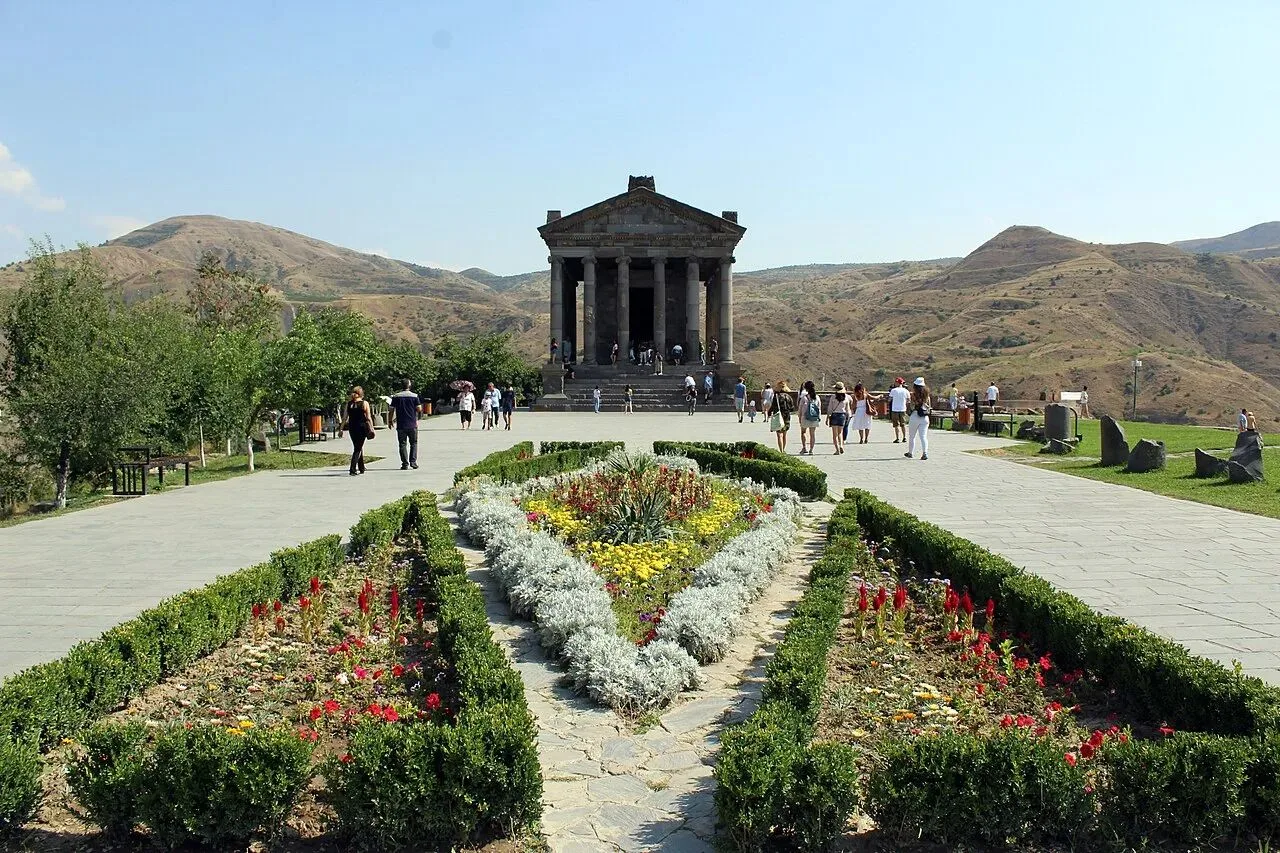
Temple of Garni
The Legacy of Classical Architecture above the Azat Gorge
The historical and cultural complex of Garni is situated in the village of Garni in Armenia’s Kotayk Province, on a high promontory overlooking the Azat River Gorge. Its principal symbol is the ancient pagan temple. It is the unique architectural monument of pre-Christian Armenia to have reached the present in a complete form and one of the most important testimonies to the interaction of classical, Hellenistic and local cultural traditions in the Armenian Highlands. Surrounded by mountains, a deep gorge and basalt cliffs, the temple appears not merely as an isolated structure but as part of a complete historical landscape shaped by the unity of nature and architecture.
The territory of Garni had been inhabited and strategically important since ancient times. The naturally protected promontory was later strengthened with massive defensive walls and transformed into a royal fortress. The complex included a royal palace, ceremonial and service buildings, a bathhouse, defensive structures and places of worship. The fortress of Garni controlled the routes leading towards the Ararat Valley and the Azat Gorge while also serving as a summer residence of the Armenian kings.
The temple is generally dated to the first century AD and associated with the reign of the Arsacid king Tiridates I. According to the traditional interpretation, it was dedicated to Mihr, the Armenian god of the sun and light. Scholarly discussion about its original function nevertheless continues, and some researchers have interpreted it as a royal mausoleum. Regardless of these differing interpretations, the monument clearly reflects a period when Armenia stood at the intersection of Roman, Hellenistic, Iranian and local cultural influences while maintaining its own political and artistic identity.
The Temple of Garni is built of grey basalt and rises on a high stepped podium. The structure is surrounded by twenty-four columns that form a balanced and monumental colonnade. Its Ionic capitals, triangular pediment, carved cornices, and geometric and vegetal ornaments demonstrate a profound understanding of classical architectural principles. At the same time, the use of local basalt, the method of stone construction and the harmonious relationship with the mountainous landscape give the temple an individuality characteristic of Armenian architecture.
The inner chamber of the temple is relatively small because the principal ancient religious ceremonies were performed in the open space in front of the building. The high staircase, surrounding colonnade and architectural axis leading towards the entrance gave the structure a ceremonial and symbolic character. Rising above the surrounding territory, the temple was visible from both the interior of the fortress and different parts of the gorge. Its position emphasised the presence not only of the sanctuary but also of royal authority.
One of the most important monuments within the complex is the Roman-style bathhouse, whose floor preserves a mosaic made of differently coloured natural stones. The mosaic contains marine and mythological imagery, while its Greek inscription reflects the educated environment of the royal residence and the influence of Greek culture. The bathhouse consisted of rooms maintained at different temperatures and was heated by a special system constructed beneath the floor. It demonstrates that Garni was not merely a military and religious centre but also a place of sophisticated royal life.
Following the Christianisation of Armenia, Garni did not lose its importance. Christian churches were constructed within the fortress, including the seventh-century Church of Saint Sion. The foundations of its circular structure survive beside the ancient temple, clearly demonstrating how pre-Christian and Christian cultural layers succeeded one another within the same territory. This proximity makes Garni an important site for understanding the transformations of Armenia’s spiritual history.
The temple collapsed during the powerful earthquake of 1679, although many of its stone fragments remained at the site. Following archaeological research in the twentieth century, the building was reconstructed with the maximum possible use of its surviving original stones. The restoration recovered not only the external appearance of the monument but also an exceptional example of the architectural thought of ancient Armenia.
Garni’s significance is not limited to its status as Armenia’s best-known pre-Christian monument. The complex represents a period when Armenia participated in the political and cultural processes of the ancient world, selectively adopting external influences and transforming them according to its own traditions. The temple, fortress, royal buildings, bathhouse and Christian monuments together create a multilayered historical environment. Garni reminds us that Armenian cultural identity was not formed within a single period but through the continuous interaction of different civilisational layers.