
BGHENO NORAVANK
A Centre of Architecture and Manuscript Culture Hidden in the Forests of Syunik
Bgheno Noravank is located in Armenia’s Syunik Province, approximately three to four kilometres east of the village of Bardzravan, on the elevated right bank of the Vorotan River. Built upon a triangular promontory surrounded by forested gorges, the monastery appears almost inseparable from the landscape. Its secluded position once provided security and concentration for monastic life, while today it gives the complex a distinctive atmosphere of silence and mystery.
The monastery’s first construction phase dates to 935–936. The Church of Saint Stepanos the Protomartyr was founded by the priest Stepanos of the Sisakan family with the support of Prince Hrahat of Syunik. During the middle of the 11th century, around 1058–1062, the complex was reconstructed and enlarged through the initiative of Metropolitan Hovhannes of Syunik, during the reign of King Grigor. After his death, the church also became Hovhannes’s burial place.
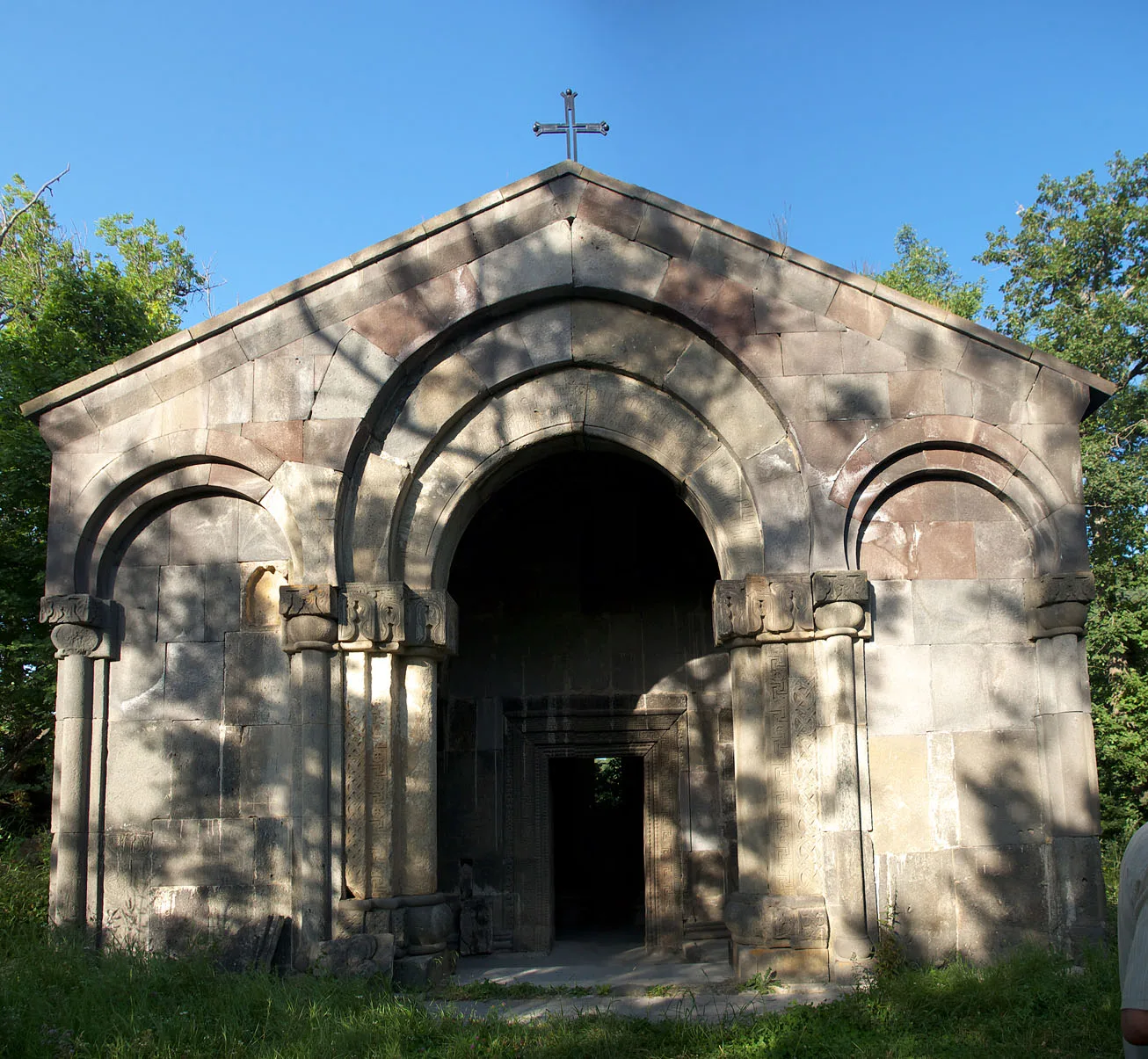
The central structure is the almost square, vaulted Church of Saint Stepanos, constructed from large and carefully dressed basalt blocks. Galleries were later added along its northern, southern and western façades, giving the church an unusual open character. Large arched openings allowed people standing outside to see and hear the liturgy taking place within. This architectural solution makes Bgheno Noravank one of the most distinctive monuments of medieval Armenian architecture.
The monastery’s sculpted reliefs are among its greatest treasures. Stone panels on the exterior walls depict episodes from the life of Christ and the Gospel narrative. Of the eight surviving reliefs, the best known are the Annunciation on the southern façade and the Ascension on the northern façade. These images did more than decorate the church: they made sacred history visible to people who could not read manuscripts. Their artistic language is closely connected with the traditions of wall painting and manuscript illumination developed by the Tatev school.
Bgheno Noravank was also an important centre of manuscript production. In 989, within the Church of Saint Stepanos, the scribe Hovhannes copied a celebrated work of medieval Armenian culture for the priest Stepanos. The manuscript later became known as the Etchmiadzin Gospel. Preserved today at the Matenadaran, it is distinguished by its miniatures, ornamentation and exceptional state of preservation. Its production demonstrates that even a small and remote monastery could possess an active scriptorium and play an important role in preserving Armenian written culture.
The monastery was eventually abandoned and almost forgotten. It was rediscovered by chance in 1932 by the Armenian writer Aksel Bakunts. Later research revealed the exceptional historical and artistic importance of the site. The area was cleared during the 1950s, while consolidation and restoration work was carried out between 1959 and 1961.
The importance of Bgheno Noravank is not limited to its age. It brings together medieval architecture, sculpture, manuscript art and the natural environment of Syunik. Almost concealed within the forest, the monastery reminds us that important centres of Armenian culture were not always located in major cities. Some of the most remarkable works of national memory were created and preserved in remote gorges, amid the silence of prayer, learning and creative labour.