
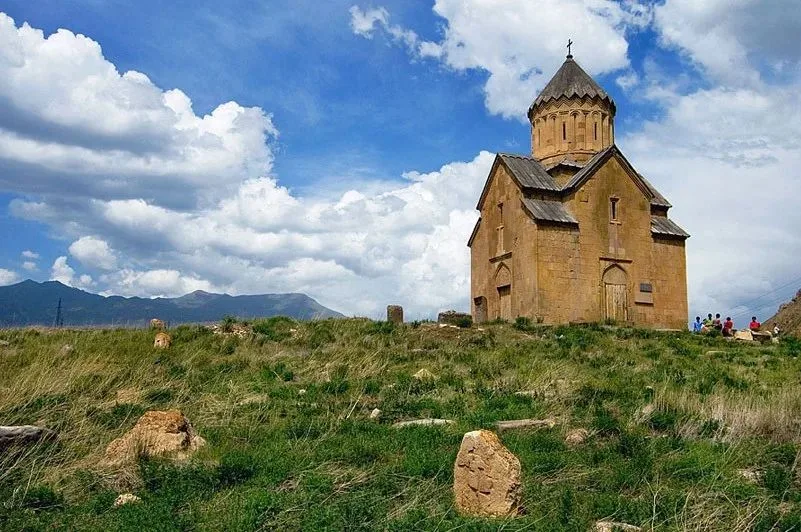
Church of the Holy Mother of God in Areni
The Art of Momik and the Spiritual Heritage of Areni
The Church of the Holy Mother of God stands on a height beside the village of Areni in Armenia’s Vayots Dzor Province, overlooking the Arpa River Valley and the historic settlement. Constructed in 1321, it is one of the outstanding works of medieval Armenian architecture and sculpture. Its elevated location, balanced form and harmonious relationship with the rocky landscape make it one of the principal symbols of Areni’s historic panorama.
The church was built under the patronage of the Orbelian princely house during a period of political and cultural prosperity in Vayots Dzor. During the thirteenth and fourteenth centuries, the region became an important centre of princely government, religious education, manuscript production and architectural creativity. The church at Areni emerged from the same cultural environment in which Noravank, the churches of Yeghegis and the Orbelian princely centres developed.
The architect and creator of the sculptural decoration is considered to have been Momik, one of the greatest masters of medieval Armenian art. His work is characterised by structural clarity, refined proportions and the inseparable unity of architecture and sculpture. Areni Church occupies an important place in Momik’s creative legacy and anticipates solutions that later received their fullest expression in the monuments of Noravank.
Architecturally, the church is a domed hall. Its rectangular exterior is crowned in the central section by a cylindrical drum and a pointed conical roof. Inside, the dome rests on supports attached to the walls and on a system of arches, allowing the prayer hall to remain open and unified. The eastern section contains a semicircular sanctuary with small vestries on either side.
The church has entrances on the western and southern façades. The tympanum of the western portal bears a high-relief image of the Virgin Mary holding the Christ Child. The figures are presented with solemnity but also with human warmth. The image not only expresses the dedication of the church but transforms the entrance into a symbolic boundary between the external world and the sacred interior. The southern portal is decorated with cross-shaped compositions and more restrained carving.
Sculptures beneath the dome depict real and imaginary animals, human faces and vegetal ornaments. These images are more than decoration. In medieval Christian art, animals and plants could symbolise the struggle between good and evil, the continuity of life, spiritual transformation and the diversity of divine creation. Their delicate execution demonstrates Momik’s ability to transform heavy stone into an animated and living surface.
Khachkars, gravestones and traces of other medieval structures survive around the church. Particularly noteworthy are the carved tombstones depicting clergymen, members of the nobility and scenes from secular life. They provide valuable information not only about the people buried there but also about clothing, aristocratic culture, hunting and social ideas in medieval Vayots Dzor.
The Church of the Holy Mother of God in Areni is valuable as a unified work of architecture, sculpture and historic landscape. It represents a period when Armenian ecclesiastical architecture achieved a high degree of structural and artistic perfection. Despite its modest dimensions, the church expresses broad ideas: the protection of the Mother of God, the continuity of the community, the responsibility of princely authority and humanity’s aspiration towards spiritual elevation.